




Christina Bowman starts every morning by checking her phone for emails about acts of violence or abuse targeting hospital workers.
“It’s probably the number one thing, I would say, that keeps me up at night,” said Bowman, a senior business manager at St. Joseph’s Healthcare Hamilton who, for over 20 years, worked as a nurse across many clinical units in the hospital system.
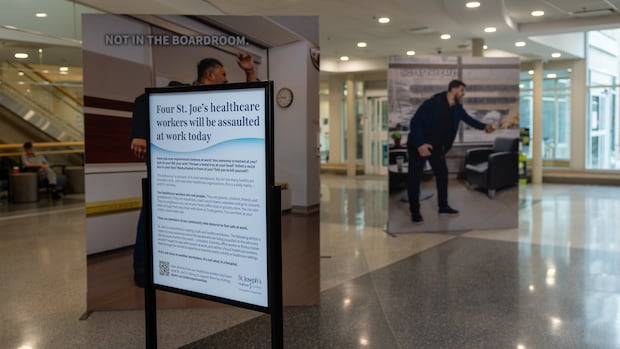
According to statistics released last month by St. Joseph’s, four health-care workers are assaulted on the job every day within its hospital system. The incidents can range from physical and verbal assaults to racial and sexual abuse.
The report comes on the heels of a survey of 4,700 nurses that was released in April by the Canadian Federation of Nurses Unions. Ninety-five per cent of respondents said they experienced some form of workplace violence or harassment in the past year.
According to St. Joseph’s, reports of violence against their health-care workers increased by nearly 30 per cent in the last year.
Bowman said she’s experienced abuse as a front-line health-care worker and now as a manager with St. Joseph’s Healthcare Hamilton, a member of the St. Joseph’s Health System, which operates hospitals in Hamilton and other health facilities in other parts of Ontario.
Bowman recalls patients or family members screaming in her face, blocking doorways so she couldn’t leave a patient’s room, inappropriate touching and name calling.
She said it’s just become worse since she became a manager.
“As a leader it’s a bit different, because it’s not whether or not violence or abuse will occur. It’s just how often you’ll see it in the day,” she said.
“You want to help, so you try to step in and create plans to keep your staff safe. But there’s some days that you can really see the toll, both on yourself and on your teams as well.”
Reports of violence rise 30%, study indicates
Unfortunately, said Rick Rigby, president of Local 786 of the Canadian Union of Public Employees (CUPE), Bowman’s experience is all too common.
Rigby said the union, which represents employees at St. Joseph’s, has seen a steady rise in reports about violent incidents in the workplace, year over year.
“There are a lot of stress disorders and PTSD [post-traumatic stress disorder] things that happen to our members that are facing violence in the workplace.”
He said staff across every part of the hospital system — from doctors and nurses, to personal support workers (PSWs), kitchen staff and porters — experience verbal abuse.
“There’s a variety of racial comments made,” Rigby said. He added that younger, newer PSWs, registered practical nurses, and even kitchen staff and portering staff get called “all kinds of names.”
Staff also experience physical violence, from patients, their families and members of the public, he said.

“Unfortunately, everybody’s running around so short-staffed, so burnt out, so exhausted that you know this is where a lot of the violence stems from.”
People come into a hospital expecting a certain level of care, attention and timeliness, Rigby said. But many don’t understand the pressures on the health-care system until they walk into a facility and experience it first hand. When their expectations aren’t met, people get upset and health-care workers become a target, Rigby said.
“We do notice a spike in the violence is definitely attributed to the lack of funding … members of the public are coming into the facility — whether it be the patient, whether it be the patient’s families, they expect better care, more timely care,” he said.
“Health-care workers seem to have to absorb this violence without consequence, whereas this wouldn’t happen to a police service member or a municipal worker. It seems to be a growing concern, especially in a female-dominated industry like health care.”
About St. Joseph’s data saying reports of violence against their health-care workers has spiked by nearly 30 per cent in the last year, Rigby said “I think it might be higher.”
More people are reporting such incidents, but many still don’t come forward, he said.
When asked how the province of Ontario is working to prevent such violence and add staff to hospitals, spokesperson Lily Barnes said in a statement that the government supports healthcare workplaces facing violence through prevention funding. She did not specify what this funding pays for or how much of it is earmarked for health care.
Barnes, who works in the office of health minister Sylvia Jones, said the province has increased funding to the hospital sector by 4 per cent for four years in a row.
“Since taking office, we’ve invested over $941 million across Hamilton Health Sciences and St. Josephs’ Healthcare Hamilton,” she said. The Progressive Conservative government has been in office since 2018.
St. Joseph’s announced last week that it will eliminate 24 jobs after a budget review, including seven vacant nurse positions. In addition, a separate review of its staffing plan resulted in reducing 57 nursing positions, but adding 80 positions that include registered nurses, registered practical nurses and personal support workers, it said in a statement shared with CBC Hamilton.
In a statement sent by email, Brooke Cowell, executive vice president of clinical operations and chief nursing executive at St. Joseph’s, said “we have implemented a series of changes, including increased security, enhanced staff training and an improved reporting process as well as a public awareness campaign.”
In the email, Cowell said their plan “will also help ensure staff have the support they need by properly matching healthcare providers to patients based on their acuity and need. We are adding more healthcare providers in areas of critical need across our clinical programs, which will help support patients as well as staff.”
‘It’s not a hidden, hushed kind of topic’
Last month, the hospital launched a new exhibit featuring videos, photos and testimonies from staff members who shared their experiences with violence, harassment and abuse.
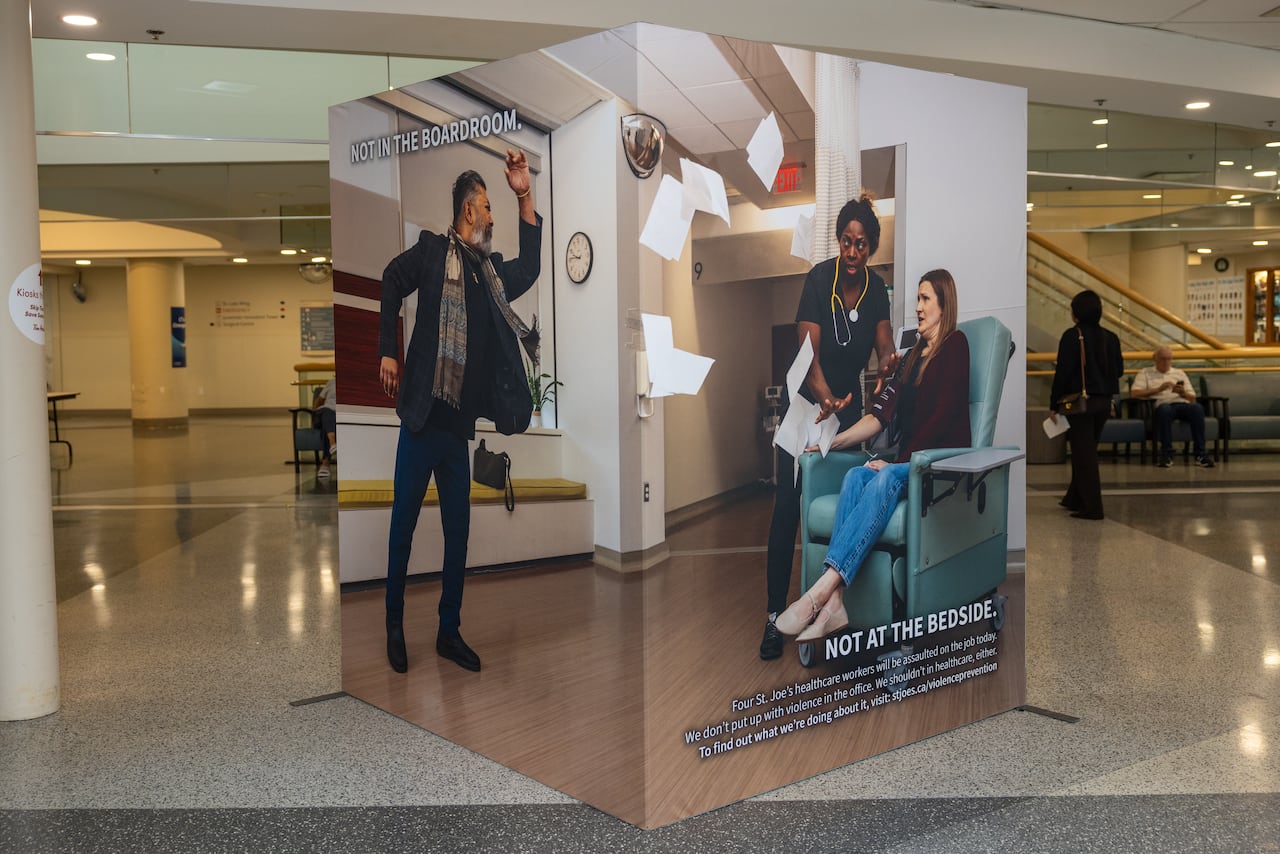
The goal is to create a workplace where staff feel like they can come forward and to encourage a culture of support among staff members, said Michael Heenan, president and CEO of St. Joseph’s Health System.
“We’ve seen about a 30 per cent increase in reporting, which we’re glad to have because that means staff are saying, ‘Hey, I feel unsafe and I want my organization to pay attention to this.'”
Keeping that conversation going is especially important to Bowman, which is why she decided to share her story as part of the new exhibit.
“It was nice to have someone listen and be genuinely interested, and not only hearing experiences of myself and others, but also open to saying it happens, it’s not a hidden, hushed kind of topic,” Bowman said.
“I would like to see people continue to share their stories and experiences. … the goal would be, obviously, that we get to a place where maybe it’s talked about enough in the community that they’re holding each other responsible for it or accountable for it, that we see those incidents actually drop.”
Long wait times, other stress on patients
As for what’s driving violence against health-care workers, Heenan said patients come to the hospital in times of stress and often have complex medical needs, creating anxiety, more fear and frustration.
He said system health-care issues, such as long wait times, add to the stress.
“Not everyone can see a family doctor. There are longer wait times because of our system being stretched and that leads to further anxiety.”
As a result, St. Joseph’s has also taken steps to enhance security, he said. They include adding more officers to the emergency room and making changes to the physical infrastructure of the emergency, triage and waiting rooms.
“The triage area has both a front door and a back door, and so we’re designing rooms so that staff can feel comfortable going into a room and should they feel uncomfortable, they have an easy way to exit that room.”
Heenan said he believes the federal government also has a role to play in addressing the issue of violence against health-care workers.
He said he travelled to Ottawa last month as part of an effort to lobby the House of Commons to pass legislation that could allow judges to assign tougher sentences to people convicted of assaulting a health-care worker or first responder.
“We think it’s a great piece of legislation and I would add that I think that’s an important part for the federal government to play in this conversation.”
Read the full article here