




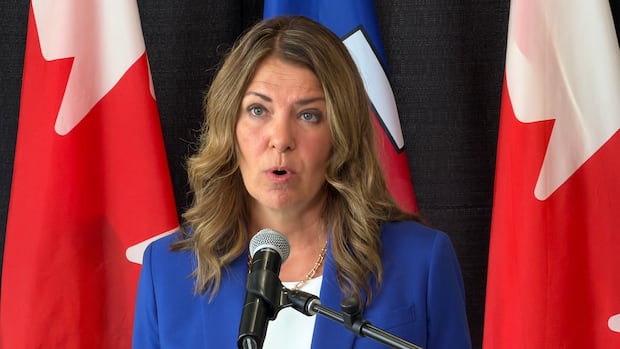
Alberta Premier Danielle Smith says Canadians must double down on their diplomatic efforts to convince U.S. lawmakers and citizens that the escalating trade war is destructive for everyone on both sides of the border.
“It means being more Canadian — too friendly, kind and helpful to resist,” Smith told reporters at a news conference in Grande Prairie, Alta., on Wednesday. The U.S. applied a swath of new tariffs on Canadian goods Saturday.
Smith said only pressure from governors, members of the U.S. congress and the American public will sway the opinion of U.S. President Donald Trump’s administration when it comes to that country’s tariff tactics.
“Canada will not win this battle through brute force,” she said. “We will win it through being smarter, more strategic, more agile and using our reputation and relationship with the American people to have these tariffs reversed.”
Smith also pushed back against calls from Ontario Premier Doug Ford, former conservative Alberta premiers Jason Kenney and Alison Redford, and Alberta NDP Leader Naheed Nenshi to use Canadian oil and gas — primarily from Alberta — as a bargaining chip in the trade war.
Smith painted a dark picture of what she says would be the consequences of applying steep counter-tariffs on oil, much of which is piped to refineries in the U.S.
“I cannot think of a more disastrous policy decision than cutting off or taxing Alberta’s oil to the United States,” she said.
Smith said she believes the U.S. would immediately respond with punishing tariffs on oil and gas, including on Canadian oil that must pass through the U.S. to reach Eastern Canada, and impose tariffs that would impact refined fuels the eastern provinces purchase from the U.S.
Her concerns echoed those of Saskatchewan Premier Scott Moe, who on Wednesday also warned oil and gas counter-tariffs would drive up gas prices in Eastern Canada.
Unlike the U.S., Canada does not have strategic oil reserves, Smith said.
“This would bring the economies of Ontario and Quebec to a grinding halt,” she said.
In the longer term, Smith said she believes using energy as a bargaining chip could see Canada lose the U.S. as an oil customer for good, and that she believes the country would turn to Venezuela and other cheaper sources of crude oil.
Smith said this would eliminate hundreds of thousands of jobs, lead to fuel shortages that ground airplanes and that the Toronto Stock Exchange would nosedive, along with the value of Canadians’ investments.
Paul Chastko, a professor at the University of Calgary’s history department, specializes in the North American petroleum industry. He said while it’s too early to tell what the consequences of using oil as a bargaining chip would be, Smith’s predictions on its impact to the Canadian economy could ring true.
Chastko said because Canada has no strategic oil reserves, it ‘s historically made the domestic energy sector unstable.
“If I were the premier, what I would say is, I would be trying to do everything I can to eliminate volatility from the province, to make it so that it is predictable,” he said in an interview.
“It is more or less implicit in her tactics and strategy, … the belief that at some point the trade relationship between Canada and the United States will be restored to the status quo ante.”
Chastko said it’s unclear how permanent Trump’s impact on the North American petroleum industry could be, but that it’s imperative for the provincial and governments to consider other approaches to international trade.
Focus on internal trade barriers
While speaking to reporters on Wednesday, Smith called on the federal government to expedite the approval process for a new bitumen pipeline to the West Coast, and for taxation changes to incentivize investment in Canada.
She asked other Canadian premiers to agree immediately to equal markup across the country of all Canadian-made alcohol products.
“No more protectionism,” Smith said. “Stop talking about it and just do it.”
Smith said she has struck a new tariffs cabinet committee, co-chaired by Finance Minister Jason Nixon and Jobs, Economy, Trade and Immigration Minister Joseph Schow, to consider the province’s response to the new tariffs.
She said the province will launch an online portal for businesses to share feedback, and assemble a business advisory committee.
Smith said the cabinet committee would consider a move Moe announced Wednesday. He said Saskatchewan will apply a 50 per cent tax on U.S. alcohol products as a de facto counter-tariff.
Saskatchewan and Alberta are the only provinces that allow U.S. liquor sales amid the trade tiff.
Smith’s place on Team Canada
Elizabeth Smythe, a political science professor emeritus at Concordia University of Edmonton, said in an interview with CBC News that she believes Smith is trying to counter questions about her loyalty to what some politicians call “Team Canada” by emphasizing how oil counter-tariffs would cause economic harm in Eastern Canada.
“She’s trying to pitch her resistance to this idea in a more national kind of framework,” Smythe said.
Other premiers may hear that message with some skepticism knowing that Smith’s role is to defend Alberta’s interests, Smythe said.
“We don’t know, necessarily, how the Trump administration would react, but she’s assuming they would react in a way that she claims would hurt the rest of Canada,” she said.
Smythe said she believes Smith is also trying to deflect criticism from other moderate conservative leaders, and deflect suspicion about her loyalty to Canada.
In a statement issued Wednesday, Nenshi reiterated what his party is calling on the government to do.
“What we need right now is tough decisions and action,” he said. “Ban American booze and cancel the referendum.
“For more than a year now we’ve been talking about the need to strengthen Canadian markets, forming a more strategic relationship with the United States, diversifying our global trade relations, attracting global talent, and, most of all, protecting Alberta’s workers.”
On Wednesday, Smith reiterated her commitment to proceeding with a provincial referendum on Oct. 19, which includes a question about whether Alberta should remain in Canada or begin the process of holding a binding separation referendum.
“This is an important time for us to be looking at the benefits that come from being a part of Canada,” Smith said. “That’s what I’ve been advocating. That’s why I’m voting to remain [part of Canada].”
Smith repeated calls for the federal government to return to the negotiating table with the U.S. before Canadian tariffs on $27.6 billion worth of U.S. goods take effect in about two weeks.
Read the full article here