




An apology isn’t enough.
That’s the message the head of the Assembly of First Nations (AFN) has sent the prime minister this week, rejecting the RCMP’s recent statement of regret for a secret surveillance program that targeted hundreds of Indigenous people starting in the late 1960s.
In an April 13 letter to Mark Carney demanding greater accountability, National Chief Cindy Woodhouse Nepinak said a recent CBC Indigenous investigation into the RCMP Security Service’s so-called “Native extremism program” has angered First Nations across the country.
“Canada’s efforts to suppress our rights and our voices clearly constitute extremely serious violations of the most basic collective and individual civil and political rights,” Woodhouse Nepinak wrote in the letter obtained by CBC News.
“It is also clear that Canada’s domestic laws, policies and practices have long failed to protect the rights of First Nations when we assert and exercise our rights.”
The RCMP Security Service was Canada’s domestic intelligence agency until 1984, when it was replaced by CSIS, which revived the Native extremism investigation in 1988.
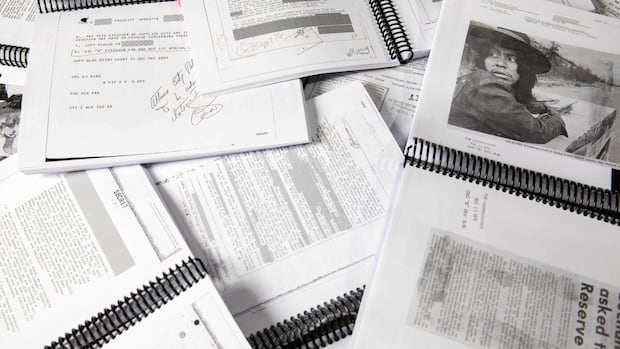
A CBC News review of 6,000 pages of declassified documents revealed the Security Service was casually monitoring Indigenous political activity as early as 1968, amid concerns about outside influences from radicals and communists.
Its posture changed in 1973, after being caught unprepared by the arrival of the Red Power movement, and the Mounties’ Indigenous surveillance efforts evolved into a sprawling dragnet that used physical observation, electronic eavesdropping and paid informers to infiltrate legitimate groups into the early 1980s.
Call for class action lawsuit
Prominent targets included future national chiefs like Noel Starblanket, Dave Ahenakew, Georges Erasmus and Phil Fontaine. Future national chief Ovide Mercredi also appears in the files.
“For me, this is deeply personal. It’s a form of intimidation, I think, on the part of the Crown,” Mercredi said Thursday in Winnipeg at a news conference hosted by the Assembly of Manitoba Chiefs (AMC).
Mercredi, who led AFN from 1991 to 1997, has numerous questions about when the surveillance began and when it ended.
“I am prepared to take legal action for the violation of my own personal security, but also the violation of my right to privacy,” he said.
“Ideally, it would be good if other leaders who have been spied on would join me and we do a class action.”
In her letter, Woodhouse Nepinak expressed concerns that the Carney government’s focus on major project development could put First Nations at risk of similar methods today.
“Consequently, mere statements of regret from the RCMP, or promised apologies from Canada, are not a sufficient response to this massive pattern of severe human rights violations,” the letter continued.
“Apologies will not end the actual problem which has a name — ‘systemic racism.'”
‘I don’t know how they would clean that up’
The AFN and AMC are calling for the release of all records unredacted, with proper measures to protect privacy of First Nations individuals, and the establishment of a national inquiry into federal policing and surveillance of First Nations, according to the letter.
“If this government truly believes in transparency, if it truly believes in rebuilding trust, then this is the moment to prove it,” AMC Grand Chief Kyra Wilson told reporters at the news conference.
Woodhouse Nepinak’s letter was copied to Amnesty International Canada, which is backing the calls for redress.
“This is appalling. It’s a complete violation of Canada’s obligations,” said Ketty Nivyabandi, secretary general for Amnesty International Canada’s English section, in an interview in Ottawa.
“The truth must come out, and in addition to that we must ensure that there is full access to effective remedies.”
This comes after RCMP Commissioner Mike Duheme issued a statement of sincere regret for this history, but didn’t fully apologize. Carney has called the surveillance program a “reprehensible practice” and agreed there should be an apology.
In a statement Thursday, Public Safety Minister Gary Anandasangaree’s spokesperson said the RCMP will be inviting Indigenous leadership to Ottawa in the coming weeks “to help chart a clear, collective course of action that ensures accountability and rebuilds trust.”
After reading the Dene Nation file, Erasmus, who later co-chaired the Royal Commission on Aboriginal Peoples, dismissed any apology as useless.
“There is so much garbage in what they’ve collected and written. If it was all out there, it would be completely misinformation,” he said in a February interview in Yellowknife.
“It’s an attempt to ruin many people’s image and reputation. So I don’t know how they would clean that up.”
In Manitoba, Mounties were monitoring Fontaine’s movements as early as March 1973 when he was chief of Sagkeeng First Nation. One report called him “an influential person within the Manitoba Indian Brotherhood.”
Internationally respected Secwépemc leader George Manuel was under intensive surveillance while leading the AFN’s precursor from 1970 to 1976. A code-numbered covert operative, A-828, infiltrated the National Indian Brotherhood and leaked sensitive information, while an official with the Pierre Trudeau government authorized electronic surveillance.
After 1976, the Security Service shifted its focus to the Dene Nation in Yellowknife, where Erasmus was president until 1983. Mounties had five informers on the payroll — including a full–time spy being paid a monthly salary, an hourly wage, plus expenses — in 1978.
Dene leaders said in interviews they discovered an electronic listening device in their office ceiling in the late 1970s, which also would’ve required approval from Pierre Trudeau’s solicitor general.
Read the full article here