




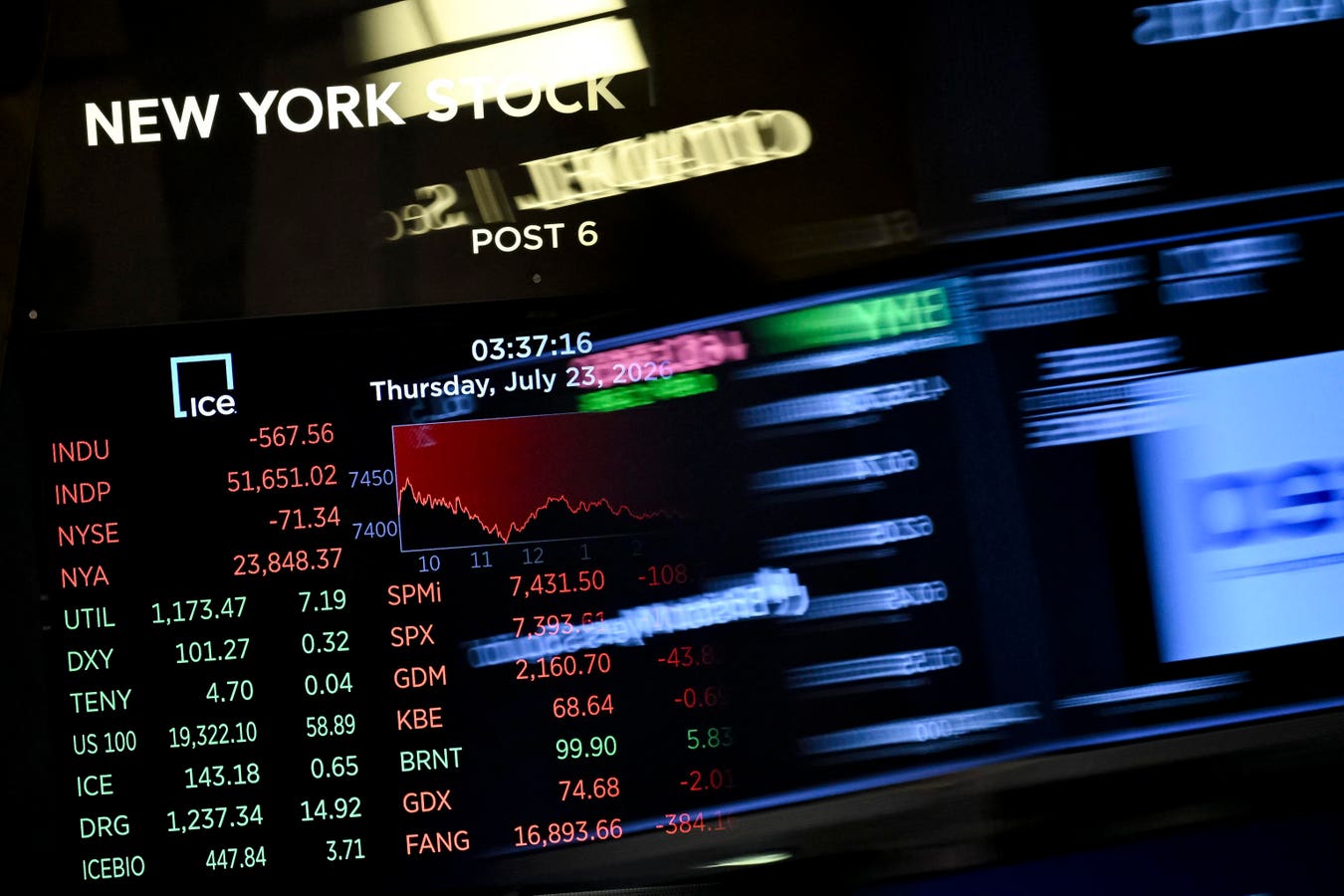
Many of the so-called Magnificent Seven — Alphabet, Amazon, Apple, Meta Platforms, Microsoft, NVIDIA, and Tesla — are filing their quarterly financials through the end of July. The early results from Alphabet and Tesla are concerning and alarming investors, if you look at the signals of stock prices.
Alphabet continues to have a boatload of liquidity. Total cash and short-term investments on June 30, 2026 (end of Q2 2026), were just $242.47 billion. Short-term investments jumped 51.7% year over year, from $55.05 billion to $186.56 billion. Cash and equivalents grew from $21.04 billion in Q2 2025 to $55.91 billion in Q2 2026, up 65.8%. Figures come primarily from S&P Global Market Intelligence.
Even the quarter-over-quarter change was phenomenal. Cash and equivalents were up 46.89% from Q1 to Q2. Short-term investments jumped 110.1%.
Looking further, quarter-over-quarter revenue went from $109.90 billion to $119.80 billion, an increase of 9%. Year-over-year, it was 24.2%. Net income grew quarter-over-quarter 79.2%, from $62.58 billion to $112.19 billion; year-over-year, it was a 297.9% increase from $28.20 billion.
Nothing to complain about, right? Except, on July 22, 2026, the stock price at the end of the trading day was $341.91. Then came the earnings announcement and shares dropped by the end of Thursday, July 24, to $318.34, a 6.9% fall.
What worried investors was the increase in capital expenses as well as the change in levered free cash flow, what is left from net income after deducting operating costs, reinvestments, and financial obligations.
Barron’s reported that on the Wednesday evening Alphabet earnings call, the company said it expects 2026 capital expenses (capex) to end up between $195 billion and $205 billion. Previous guidance was between $180 billion and $190 billion. Alphabet also expects capex to increase “significantly” next year.
As for levered free cash flow, Alphabet defines it as “net cash provided by operating activities less capital expenses,” which delivers a number higher than the GAAP definition in use here. That is why Alphabet listed free cash flow as -$5.86 billion rather than the -$6.52 billion provided by S&P Global Market Intelligence.
We’ll go with the S&P Global numbers as they are easier to compare to other companies. The month-over-month change was from +$5.67 billion in Q1 2026 to -$6.52 billion, a negative swing of $12.19 billion. The graph below shows the larger trend for levered cash flow. (Blank spots are where data was unavailable.)
Then there was Tesla on Wednesday, where capital spending was up 142% year-over-year to $5.8 billion and shares dropped about 15% by yesterday. Levered free cash flow was a loss of $1.77 billion in Q2 2026, compared to a positive $2.8 billion in Q1. Year-over-year was another loss of $1.4 billion. Tesla’s levered free cash flow is more erratic over time, so doesn’t offer the same sharp comparison over time as Alphabet.
“Capex investment continues to scale among the hyperscalers, as Google raised its 2026 capex spend guidance again, and continues to see material growth in 2027 as compute remains constrained, demand remains strong, and component pricing continues to increase,” Wedbush analyst Ygal Arounian wrote on Thursday, according to Barron’s. “We expect to see similar trends with Amazon capex spend as well.”
Expect other stock hits, and questions from investors.
Read the full article here