




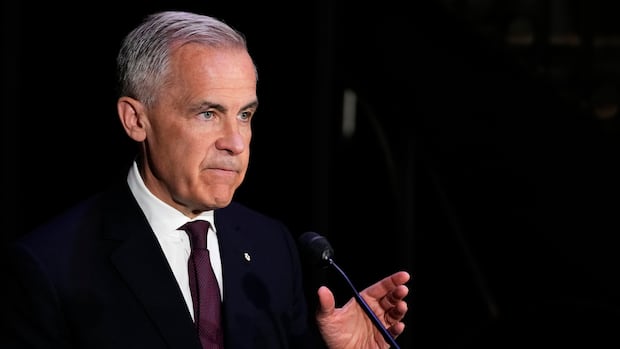
Prime Minister Mark Carney said on Monday his government will create a sovereign wealth fund — the first of its kind, at least at a federal level.
The government says the new Canada Strong Fund will work in partnership with private industry to serve as an investment vehicle for the major national projects this government has expressed interest in.
Carney described the sovereign wealth fund as a “national savings and investment account” that will help grow wealth for future generations of Canadians.
But how do these funds work, and what makes this one different from a usual sovereign wealth fund?
Here’s what you need to know.
What is a sovereign wealth fund?
A sovereign wealth fund is a chunk of money owned by a state and invested in financial assets.
Usually they’re used when a country has extra money. Rather than keeping the funds in a central bank or spending it within the country to help the economy, a sovereign wealth fund allows the country to invest that money and see a return on it.
These kinds of funds vary significantly in how they work and their goals. The Kuwait Investment Authority, for example, was set up using oil revenue with the goal of diversifying their economy, which is heavily reliant on energy exports. Singapore’s GIC sovereign wealth fund on the other hand was set up using that country’s foreign reserves (assets held by the government in things like foreign currencies and gold) and the goal is to preserve the country’s purchasing power.
Prime Minister Mark Carney announced on Monday the Canada Strong Fund, the country’s first national sovereign wealth fund, with an initial federal government investment of $25 billion over three years. Carney said the fund is ‘designed to grow wealth for future generations of Canadians.’
But they all have a common goal: taking some extra money and investing it on a national level to make a return for the country.
Is this a first in Canada?
Sort of. It’s the first at a national level, but Alberta has had the Alberta Heritage Savings Trust Fund since the 1970s.
It was created to collect some revenue from the oil and gas industry in that province, with an initial investment of $1.5 billion. The goal is to provide the greatest return on those savings from the oil industry for current and future generations of Albertans, according to the province.
That fund has since grown to be worth $31.9 billion, as of the end of 2025.
Who will put the money in?
The government will put in $25 billion initially over three years — though Carney didn’t say where exactly his government will get that money to put in the fund.
Finance Minister Francois-Philippe Champagne was also asked where the money would be coming from and did not answer directly, but he said the federal government’s relatively strong fiscal standing internationally would allow it to borrow at favourable rates.
That’s one unusual thing about this fund — normally, a country sets up a sovereign wealth fund with excess money they have, according to Brett House, a professor of economics at Columbia Business School. But he points out that Canada has debt, rather than extra money laying around.

Conservative Leader Pierre Poilievre called Prime Minister Mark Carney’s plan for a Canada Strong Fund a ‘sovereign debt fund,’ speaking to the media on Monday. ‘Borrowing yet another $25 billion out of the economy to subsidize projects that the government still cannot figure out how to approve will only cost hard-working Canadians,’ Poilievre said.
That’s not necessarily bad, according to Bernardo Bortolotti, executive director of the Transition Investment Lab at New York University. He says as long as the country makes more through its investments than it spends in interest on that debt, investing in a sovereign wealth fund makes sense.
Another unusual detail? The fund will be open to Canadians to invest in directly. House says sovereign wealth funds in other countries are usually not open to outside investment — the government alone usually takes their own extra cash and invests it under these funds.
Instead, the government says the Canada Strong Fund will allow Canadians as well as foreign investors to participate directly in it through a new retail investment product.
How is it different from other kinds of investment products?
How investing in the Canada Strong Fund compares to putting your money in something like government bonds or ETFs is still unclear, because so few details are available.
The government did say this financial option would be easily accessible to Canadians across the country, and that one’s initial investment would be protected.
House says it will be interesting to see what kind of guarantee investors will receive on their returns, and the timeline around how long it might take for Canadians to see a return on their money.
Bonds — another kind of investment that people can make — represent a fixed-income debt security which will be paid back at a certain date. Many offer a guaranteed rate of interest. Bonds issued by the government are typically safe, compared to something like stocks, where your returns are based on how well a company performs.
The new Canada Strong Fund will be open to individual Canadian investors to finance major projects, including energy, mines, agriculture and technology. Central 1 Credit Union chief economist Bryan Yu told BC Today host Michelle Eliot that the fund could advance such projects. But he said at this point it’s still too early to tell how much Canadian investors will benefit.
Whether there will be some kind of guaranteed return similar to a government bond is unknown, according to House, “and that has very different implications for how this fund will work” for Canadians.
Who manages it?
The planned fund will be managed by a new Crown corporation led by a CEO and an independent board of directors at an “arms length” from the government.
Where these funds can get into trouble, Bortolotti says, is when they’re invested based on “short-term political objectives” rather than on making money for the country in the long term.
For that reason, he says independence between those managing the fund and the government will be critical.
“Everything will boil down to the governance, to the rules … and of the leadership of the fund itself,” Bortolotti said.
John Ruffolo, founder and managing partner of Maverix Private Equity, agrees. Without proper management, he says Canada risks this turning into a “government slush fund.”
The good news, Ruffolo says, is that Canada has great examples of good management with the Canada Pension Plan and the Caisse de dépôt et placement du Québec, another Canadian pension fund. He says the Canada Strong Fund should be managed in a way that’s similar to those entities in order to make sure it’s a success.
What will the money be used for?
The funds will be used to invest in a number of nation-building projects across Canada, though which exact ones might get that investment are still up in the air.
Infrastructure projects, manufacturing, energy and mining were all mentioned in the government’s announcement, and Carney mentioned that the investments would go beyond oil and gas.
House says the best kind of projects for the fund to be invested in would be ones that have struggled to attract private investment, and which might not otherwise receive any investment — though it’s not immediately clear where those opportunities exist.
Read the full article here