




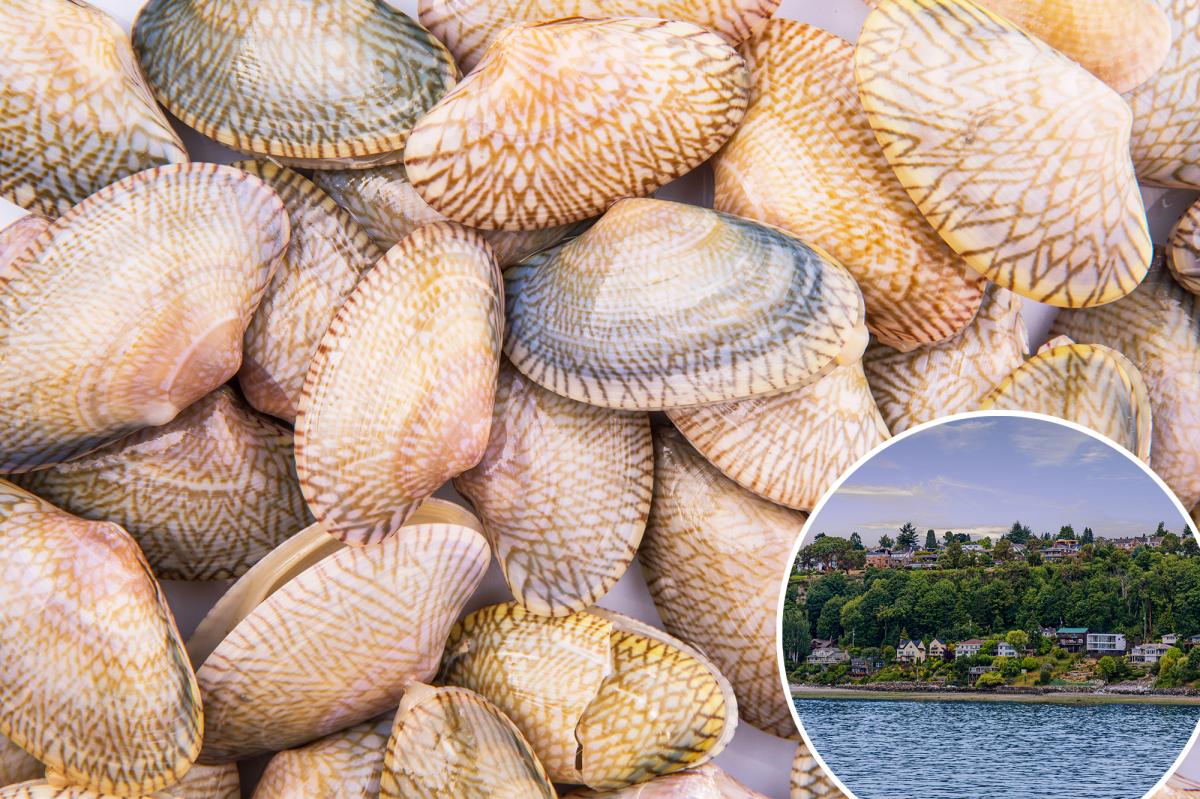
These clams are in a jam.
Scientists warn that along the West Coast, legions of soft-shell clams are contracting a deadly, highly contagious cancer.
Known as bivalve transmissible neoplasia, the cancer is spread when living cancer cells pass from one animal to another through seawater.
While the disease has previously been found in soft-shell clams along the Atlantic Coast, this is the first time it has been identified on the West Coast.
A study published last month revealed that more than three-quarters of clams at two locations in Washington state waters were affected by the cancer, making it one of the most grievous outbreaks ever documented.
Clams and other shellfish found naturally and farmed in the chilly inland waterways of the Pacific Northwest are prized by top restaurants all over the country and beyond.
The cancer was first detected in Washington’s Puget Sound in 2022, when 45% of the clam population was affected; however, that number jumped to 75% in just two years.
While the disease has no impact on humans and experts underscore that the clams are safe for consumption, the cancer is taking its toll.
“We were surprised to find a transmissible cancer spreading at this level in Pacific Northwest clams,” said Michael Metzger, Ph.D., senior author of the study and Associate Investigator at Pacific Northwest Research Institute (PNRI).
“The scale of the outbreak makes it an important system for understanding how these rare cancers emerge and move through wild populations.”
Scientists underscored that the disease threatens not just the clams but the ecosystem as a whole, as clams filter both plankton and bacteria, making them a vital part of the marine environment.
Researchers noted that the affected clam species are not native to the West Coast and “were likely intentionally introduced from the Atlantic populations of clams in the 1870s.”
The study also revealed that soft-shell clams in Puget Sound include hybrids of two closely related species: Mya arenaria and Mya japonica. Early evidence suggests that the Japanese species may resist the cancer more effectively, a finding that raises new questions about how genetics influences cancer transmission and immunity.
Cancer aside, clams and other shellfish populations are increasingly in peril due to pollution and climate change-driven heat and acidification.
Case in point, a 2021 heat wave triggered a shellfish megadeath on beaches in Washington, with several species being cooked alive on the shore.
Concerningly, increased heat and pollution make clams even more vulnerable to cancer.
Similarly, scientists previously linked a mysterious cancer that has decimated California’s sea lion population to toxic chemicals and herpes.
Experts warn that while clam cancer could spread down the West Coast to Oregon and beyond, the risk is low.
Fortunately, the current outbreak is believed to be in its early stages, and while scientists may not be able to stop it from spreading, this timeline allows them to observe how clams respond to the disease in the wild.
Evidence suggests the cancer in question stemmed from Atlantic Coast populations, but experts are not certain how it made its way West.
“The most likely explanation is accidental human-assisted transport of an infected clam or seawater containing cancer cells, but we don’t yet have evidence that allows us to determine the precise route, “ said Metzger. “Understanding how transmissible cancers move between regions will be critical for monitoring and managing future outbreaks.”
In addition to cancer, Washington clams have been spreading the norovirus.
In March, the Food and Drug Administration issued a recall of clams and raw oysters due to concerns that they were contaminated with norovirus, a contagious virus commonly known as the stomach flu.
The recalled Manila clams were harvested by the Lummi Indian Business Council and were distributed to restaurants and food retailers in nine states, including Arizona, California, Florida, Georgia, Illinois, Nevada, New York, Oregon and Washington.
Read the full article here