




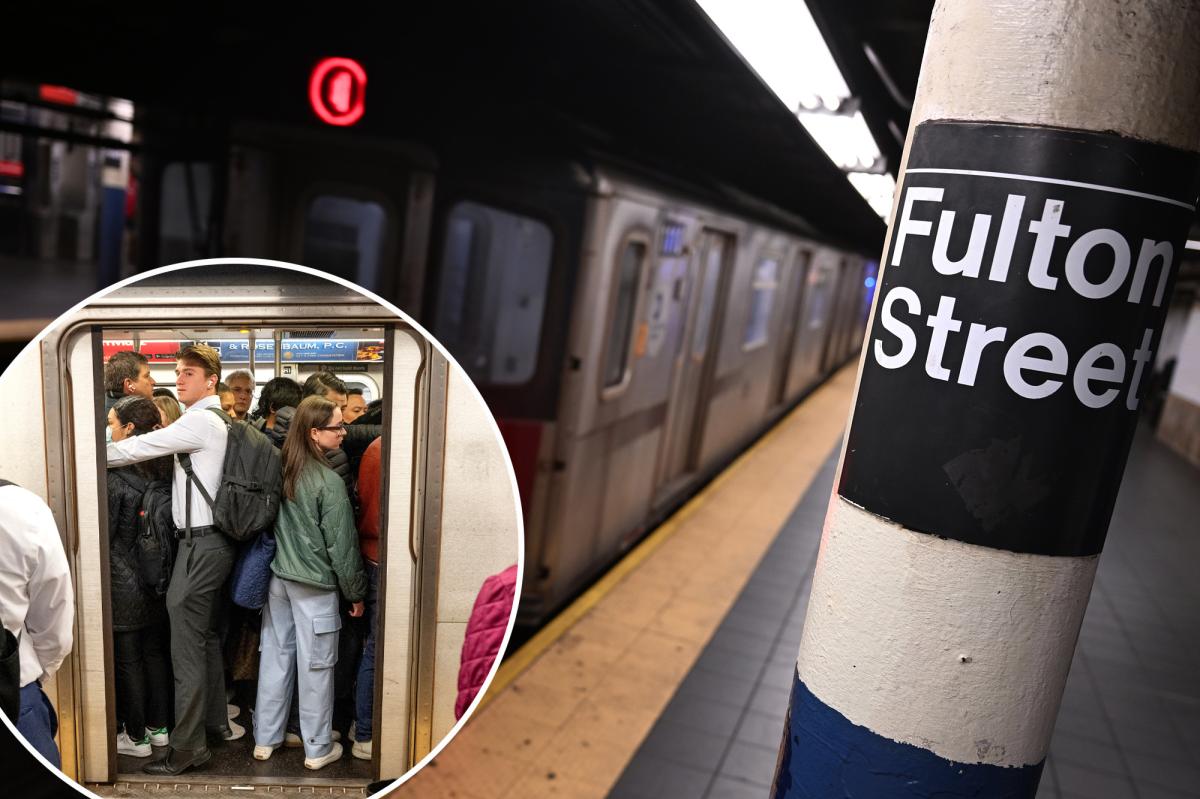
Lower Manhattan’s Fulton Street subway station is supposed to be a commuter’s dream: a sprawling transit hub linking the 2, 3, 4, 5, A, C, J and Z trains in one central location.
Instead, for many straphangers, it’s a labyrinth.
The station stitches together four once-separate systems — the IND 8th Avenue Line, IRT Lexington Avenue Line, BMT Nassau Street Line and IRT Broadway–Seventh Avenue Line — all funneled through the gleaming Fulton Center hub along Broadway and Nassau Street in FiDi.
On paper, it’s seamless. In practice, it’s more like a choose-your-own-adventure gone wrong, where even seasoned New Yorkers get tripped up.
The most confusing part of this enormous station for city dwellers and tourists alike? Finding the Brooklyn/Queens-bound J/Z platform.
Content creator @worlds.worst.detective went viral in February when he posted a video of himself offering to help confused riders struggling to find the hated platform.
He wore a sign that read, “Looking for Brooklyn & Queenz JZ? Ask me how to get there,” but the creator found that many locals would rather skip the station entirely or even cancel plans than attempt the wildly confusing transfer.
Jeffrey Cipriano of Bushwick is one of these people.
Considering only one hard-to-find staircase leads to the Brooklyn/Queens-bound J/Z platform, the 34-year-old revealed that he once got lost trying every staircase, practically in tears, before finally locating the platform on his fourth attempt.
“I avoid the station almost always for this reason — it’s so confusing and annoying.” The Brooklynite added that he’d pick “walking 15 minutes over it,” and joked for those brave enough to transfer at Fulton St.: “My advice is to pray to the train gods that you make the right choice.”
He’s far from alone in his subway saga.
“I’ve never been able to find it; it might not even exist,” fellow Brooklyn resident Corena Mixson, 26, agreed.
While once trying to transfer to the Brooklyn-bound J, she told The Post that she “wandered around the station for far too long before giving up” and calling an Uber.
“Luckily, I don’t have to travel to that station often. But if I did, I would avoid it.”
For others, it’s not just one elusive platform — it’s the entire experience at the station.
“There are many frustrating and confusing parts about navigating Fulton Street station, primarily the four flights of stairs to transfer from the C to the 4 and 5 trains,” New Yorker Morgan McGovern, 26, told The Post.
“I’ve gotten lost there many times. I once was so lost that not even locals nearby could give me an answer of how to escape.”
The Fulton Street station didn’t become a commuter headache overnight as it traces back to 1905, when the original IRT lines first opened — before decades of add-ons and patchwork expansions turned it into a full-blown maze.
Nowadays, Gothamites regularly bond over the shared trauma of navigating this head-scratching station.
“The J/Z is like the train to Hogwarts and you need certain magic to make the entrance appear,” one joked on Reddit.
“Fulton St station is a Frankenstein combination of multiple lines that were not built with the intention of being connected,” another wrote in the same thread. “It’s a walk in the park compared to pre-renovation.”
Transit expert Andrew Lynch, a New York City-based activist and cartographer, argues the chaos isn’t just bad signage — it’s baked into the system’s DNA.
“When Duke Ellington wrote ‘Take the A Train,’ he wasn’t talking about Brooklyn,” Lynch wrote in a 2023 blog post titled “End of the Line: The Unfinished Fulton St Subway.”
Lynch noted the line’s evolution into the city’s longest and most complex route.
He explained the Fulton line was originally designed as part of the Independent City-Owned Subway System — a “massive passenger sorter” meant to funnel riders from across the city.
But decades of half-finished expansions, shifting priorities and funding shortfalls left it in limbo.
“The sorry state of the A train in Brooklyn wasn’t supposed to be this way,” Lynch wrote, describing the IND Fulton Line as “the last subway that the city built in the borough of Brooklyn, left unfinished, with dreams of better service long forgotten.”
And while the MTA, which The Post reached out to for comment, has plans to modernize signals and improve service, the fundamental issue remains: the system was never fully completed the way planners envisioned.
So commuters are left doing what New Yorkers do best — improvising.
For some, that means budgeting extra time. For others, it means avoiding the station entirely.
And for a growing number of frustrated riders, it means making the ultimate New York sacrifice: ditching the subway — and the plans — altogether.
Read the full article here