




Topline
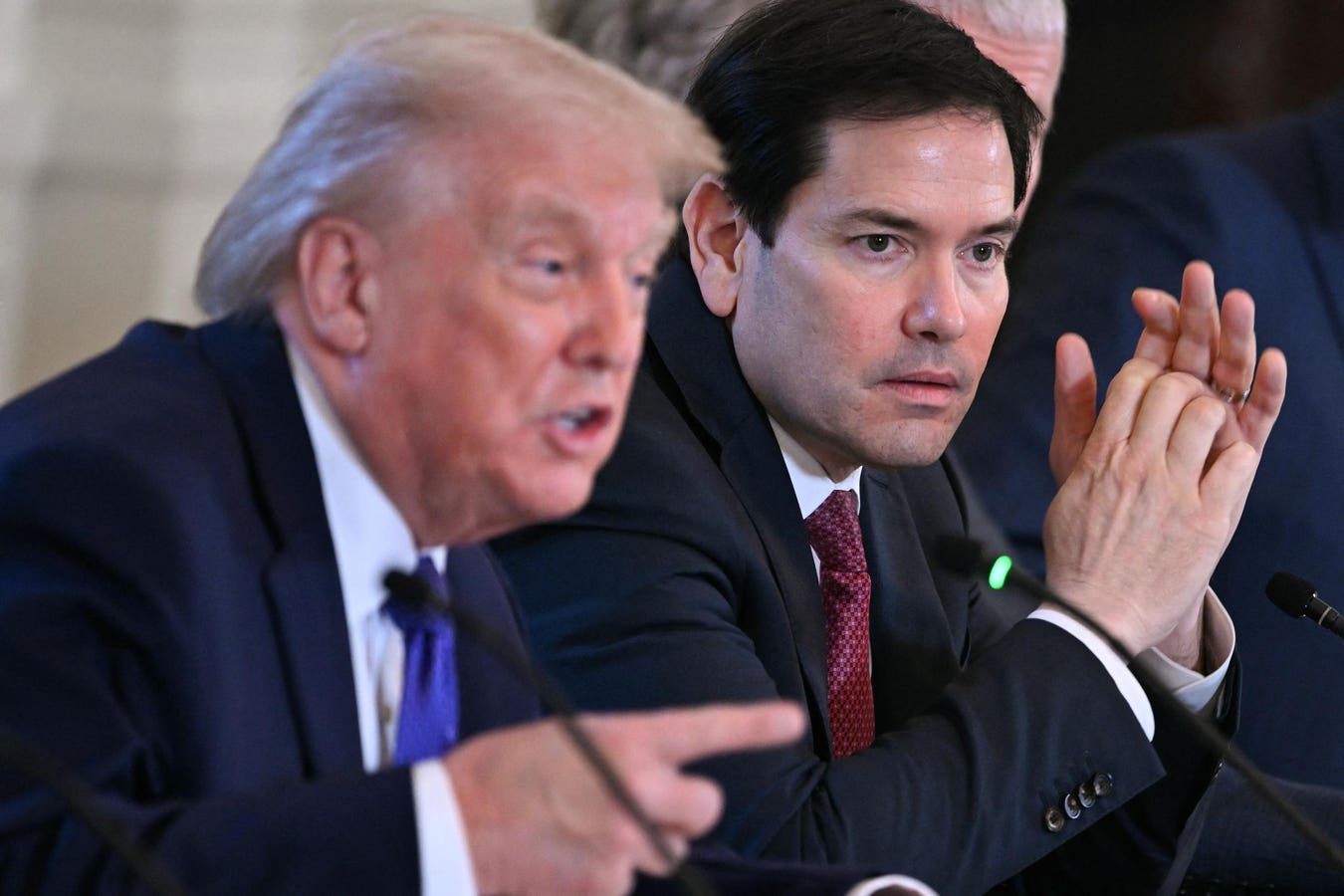
President Donald Trump and Secretary of State Marco Rubio suggested Thursday that strained relations with Cuba may not improve through diplomacy, commenting on the island nation as the Trump administration has placed more economic and political pressures on it as the country’s leadership has denied allegations it is hosting foreign adversaries and terrorists.
Key Facts
Rubio told reporters Thursday that Trump’s preference is “always a negotiated agreement that’s peaceful,” but noted, “With Cuba, the likelihood of that happening, given who we’re dealing with right now, is not high.”
Rubio accused Cuba of acquiring weapons from Russia and China, as well as hosting agents from the two countries, noting the designation of Cuba as a state sponsor of terrorism brought back by Trump in 2021.
On Wednesday, Rubio published a video message to Cuba offering the country $100 million in food and medicine on the condition it is distributed by charitable groups, saying the country’s elite, not U.S. economic embargoes and blockades, are to blame for Cuba’s energy, food and medicine crises.
Trump said in an Oval Office appearance Thursday, “Other presidents have looked at doing something for 50, 60 years, and it looks like I’ll be the one that does it,” regarding action on Cuba, adding he “would be happy to do it.”
Asked if the deployment of a massive U.S. aircraft carrier to the southern Caribbean was meant to intimidate the Cuban government, Trump responded, “No, not at all,” saying it was his priority to help the Cuban people.
Chief Critic
Cuban Minister of Foreign Affairs Bruno Rodríguez blasted Rubio in an X post, accusing him of lying “to instigate a military aggression that would provoke the shedding of Cuban and American blood.” Rodríguez shot down claims that Cuba is a national security threat to the U.S. and said the Trump administration “has engaged in provoking desperation among the population and the collapse of the economy by prohibiting fuel imports and reinforcing the extraterritorial nature of the blockade.”
Tangent
The U.S. has ratcheted up political pressures against Cuba this week. The Supreme Court ruled in favor of a U.S. port business that is seeking compensation for the alleged seizure of some of its dock property in the 1960s, when Fidel Castro was in power. The Justice Department also announced Wednesday an indictment that included a murder charge against former Cuban President Raúl Castro, 94. The charges revolve around a 1996 incident in which the Cuban government shot down two civilian planes belonging to a group of Cuban exiles whose goal was to rescue refugees in rafts in the waters between Cuba and Florida. Two aircraft belonging to the group were shot down, killing three American citizens and a green card-holder.
Key Background
U.S.-Cuba relations have become even more strained in recent months as the U.S. continues its longstanding economic embargoes against Cuba, in addition to a tightened energy blockade signed off by Trump in January. The president said in an executive order Cuba posed an “unusual and extraordinary threat” and reiterated claims the country is providing a place for terrorist groups to operate out of. Cuban President Miguel Díaz-Canel has rejected claims the country hosts or financially supports terrorist groups and said last week Cuba is open to receiving aid from the U.S. Trump has suggested a “friendly takeover” of Cuba as it navigates its energy crisis and said in March he would have the “honor of taking Cuba… that’s a big honor.” While Trump has not suggested a military invasion, Díaz-Canel has been wary of one, emphasizing it would be met with “impregnable resistance” and that he would be “willing to give my life for the revolution.”
CIA Director John Ratcliffe Visits Cuba—As Country Runs Out Of Oil And Trump Floats Takeover (Forbes)
Read the full article here