




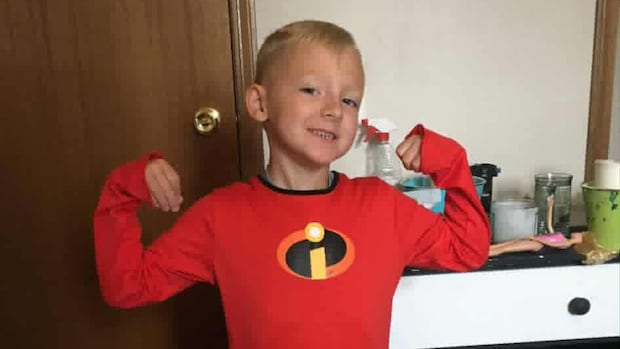
An Edmonton woman who owned two large dogs that killed an 11-year-old boy in 2024 will serve a conditional house arrest sentence of two years less a day, a judge decided Thursday.
Crystal Jean MacDonald, 46, was found guilty of criminal negligence causing death in May following a judge-alone trial at the Edmonton Court of King’s Bench. Kache Grist was killed on April 1, 2024 after MacDonald’s two Cane Corsos attacked him.
Justice Eric Macklin sentenced MacDonald on Thursday. Her conditions include a lifetime ban on owning, supervising or controlling dogs. She can apply for a leave on this condition in 10 years.
She is also to complete 200 hours of community service.
Macklin listed aggravating factors that include MacDonald not properly training her dogs, the dogs’ previous attacks on humans and their role in the deaths of two pets, the age and vulnerability of Kache, and the manner of death being “horrific.” But Macklin noted MacDonald had shown concern for Kache, there was no intent on her behalf and she had demonstrated “great remorse.”
“While the gravity of the offence is significant, that alone does not place her moral blameworthiness at the high end of the moral blameworthiness spectrum,” he said. “Ms. MacDonald knew that her two dogs were capable of killing Kache, but she never expected that they would do so.
“She did not deliberately set out to cause injury to Kache nor did she ever intend for him to be harmed, let alone killed.”
MacDonald will serve her sentence in Penticton, B.C.
Crown prosecutors had sought a five-year prison sentence, while the defence sought a conditional sentence for two years less a day.
Defence lawyer Evan McIntyre spoke to reporters outside the courthouse and said MacDonald has applied to appeal her conviction.
“[Despite the appeal], it’s not necessarily contradictory to say that she feels incredibly remorseful,” he said. “But it’s also exercising a legal right to have that … responsibility determined by a higher court.
“This whole process has been extremely emotional for her.
“In the Indigenous impact report, there’s talk of how this has affected her. I would imagine that, you know, nobody’s happy about being sentenced, but she, I think, is pleased with the sentence.”
Court heard information from an Indigenous background report that described MacDonald as Métis and affiliated with the Mi’kmaq band.
The report said MacDonald has memories of her parents being violent towards one another and noted she “suffered numerous adverse childhood experiences” such as poverty, physical and sexual abuse, neglect and child welfare involvement.
During sentencing Wednesday, court heard an emotional victim impact statement delivered virtually from Kache’s father, Wesley Grist, who described his son as the most important person in his life and part of his identity.
“The grief is constant,” he read to the courtroom, adding that he believes the situation was a tragic circumstance.
He told the court that he never wanted revenge for his son’s death and MacDonald will be carrying the weight of his death.
“At no point was my testimony given with anger,” Wesley said. “I never wanted harm to come to her [MacDonald]. I know she loved Kache.
“Nothing about this feels like a victory to me.”
MacDonald was also given the opportunity to address the court. Through tears she explained the guilt, grief and shame she feels.
“I love Kache deeply,” she said. “I think about him every single day.
“I don’t know how to explain what it feels like to be standing here because of the death of a child that I love.”
Kache’s mother, Kendrah Wong was present in the courtroom Wednesday. Wong submitted a victim impact statement but requested for it to be read privately.
Trial testimonies
MacDonald owned two Cane Corso dogs, Khaos and Khairo, which have since been euthanized. Court heard Khaos weighed about 56 kilograms (124 pounds) and Khairo weighed more than 49 kilograms (109 pounds) at the time of the attack.
During the trial, court heard Kache was visiting his father, Wesley, in Edmonton from Osoyoos, B.C., for spring break and was staying at MacDonald’s south Edmonton home.
Wesley testified that on April 1, 2024, his son briefly left the home to buy snacks at a nearby Circle K.
MacDonald was not home at the time.
Wesley said he was working in the garage while the dogs remained inside. Kache returned from the convenience store and went inside to play video games. Wesley later found his son lying on the kitchen floor.
Wesley testified that MacDonald had previously warned him to keep Kache away from the dogs and not to leave him alone with them.
An autopsy found Kache died from a dog-bite injury to the neck. The autopsy also documented injuries to his upper back, shoulders and arms.
During the trial, court heard about previous attacks involving the dogs, including an attack on MacDonald herself, an acquaintance and a former tenant. The dogs had also fatally attacked two pets.
MacDonald testified that she knew the dogs had shown aggressive behaviour before Kache’s death, but believed she had taken steps to manage them, including kennelling them and seeking professional training.
She maintained that some of the previous attacks could have been prevented if people had followed the rules she had established for the dogs.
When Macklin delivered his decision in May, he found the most significant cause of Kache’s death was the failure of MacDonald to take the reasonable steps to ensure that he was not harmed by the two untrained and unpredictable dogs.
Read the full article here