




The European Union’s lending arm said on Thursday that it expects to spend at least €4 billion on security and defence projects in 2026 – the same as it did last year after effectively quadrupling its financing in the area.
Overall, the European Investment Bank (EIB) spent 5% of its financing in the EU on security and defence projects last year, a target it had initially planned to reach only in 2026.
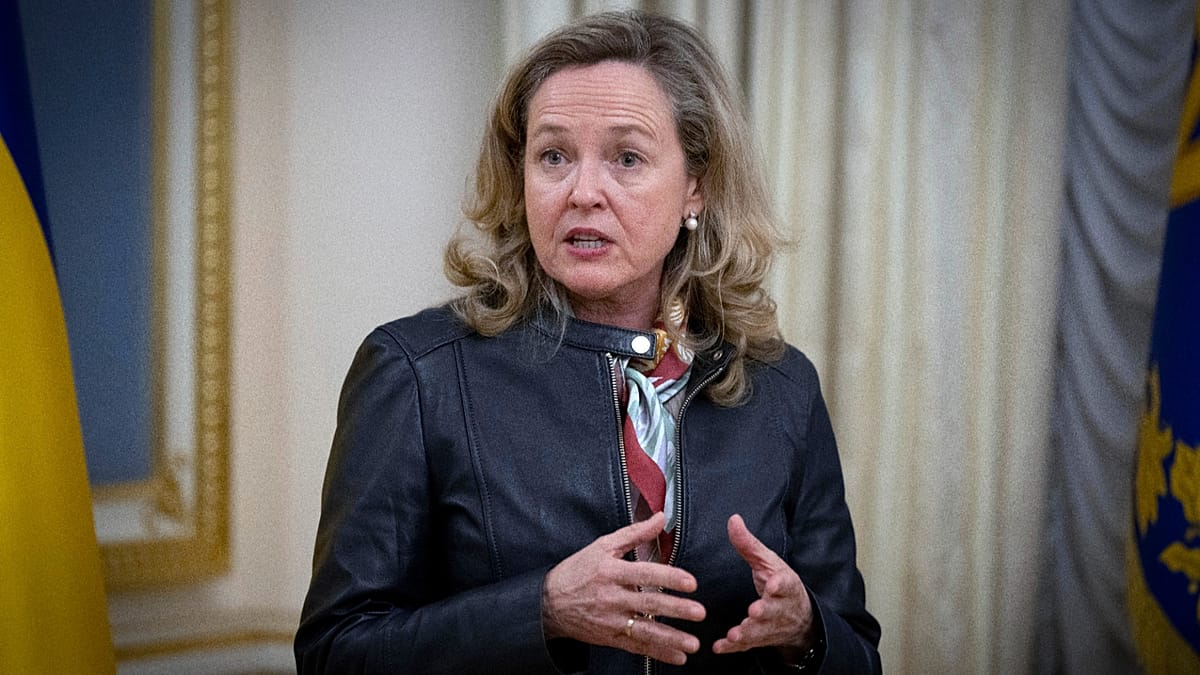
EIB President Nadia Calviño told reporters in Brussels this represented a “step change” for her institution, which expanded the scope of eligible activities to pure military investments, and that she is “confident” the target will be met again in 2026 thanks to a “robust pipeline of projects”.
These include funding large critical infrastructure to boost military mobility and facilities – among them a military campus in Lithuania and a port expansion for military vessels in Denmark – boosting homegrown industrial capabilities, financing research and development for new security and defence technologies, and improving access to financing for SMEs in the sector through partnerships with commercial banks and venture capital funds.
The EIB, whose shareholders are the EU’s 27 governments, is the world’s largest multilateral financial institution by assets and maintains a robust AAA credit rating.
Since 2024, it has revised its lending policy several times to allow for greater financing of security and defence projects as member states and the European Commission look to boost defence spending across the bloc, both to support Ukraine’s war efforts and to prepare for a possible military attack from Russia.
Some intelligence agencies have warned this could take place before the turn of the decade.
Streamlining the sector
Asked if the EIB’s €4 billion funding is enough given the EU’s defence spending need – estimated by the Commission at roughly €500 billion over the next decade – Calviño defended her institution, stressing that “the European Investment Bank Group is not a defence ministry”.
“Financing plays an important part, but not only. It is very important to standardise techniques, to have joint procurement, to streamline the way the whole security and defence sector is working in Europe,” she said.
“The European Investment Bank Group is making a difference because we are focusing in those areas where we can really have strong value added. For example, large infrastructures, large-scale investments that require long-term loans in good financial conditions; for example, nurturing the ecosystem which is emerging of private venture capital funds, investment funds, through the European Investment Fund.”
Overall, the EIB invested a record €100 billion in 2025, with roughly 60% going to green projects.
On the energy front, it provided a record €33 billion in financing, Calviño said at her press conference, contributing to €108 billion in total investment, which corresponds to more than a quarter of total investment in the EU in 2025.
That figure includes grid investments, with a record €11.6 billion for power infrastructure and storage, including the Bay of Biscay interconnector between the Iberian Peninsula and France, a crucial project to increase Portugal and Spain’s connectivity with the rest of the continent.
Future projects are expected to support the construction of about 56,000 kilometres of power cables, the EIB’s chief said, stressing the continued goal to deploy more wind and solar power.
Calviño also referred to energy efficiency investments that will back more than 350,000 SMEs in reducing their energy bills, as well as efforts to decarbonise heavy industries such as steel and aluminium.
She also highlighted investments made into the development of new net-zero technologies and fuels, such as Europe’s largest lithium production project, the Lionheart Project in Germany, and nuclear power in Finland.
Read the full article here