




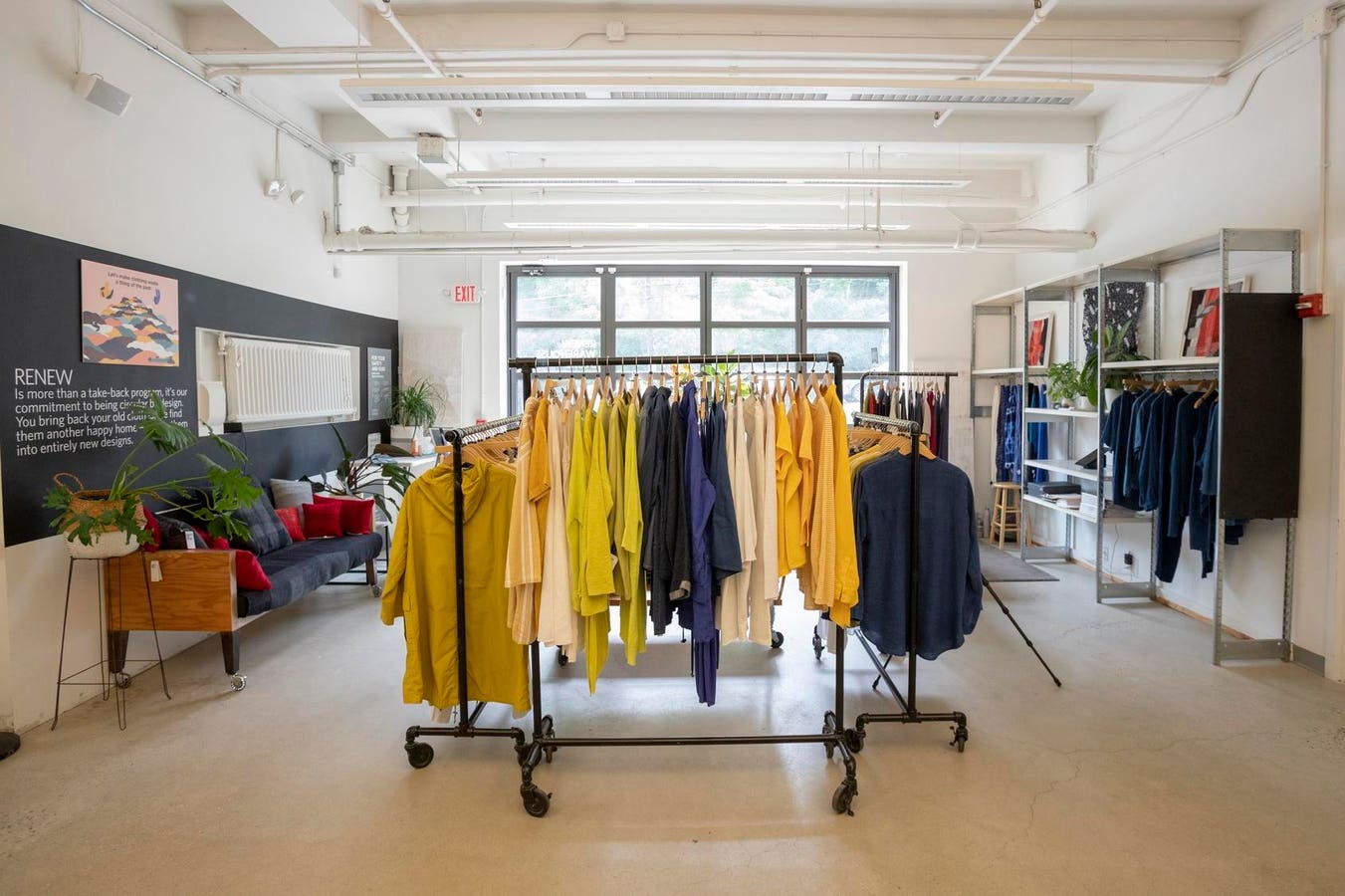
Eileen Fisher has come full circle.
The company’s Renew take-back program reached a milestone of three million items returned, Eileen Fisher said.
Renew, Fisher’s circular label, is made up of donations of clothing and other products from earlier seasons. Customers get a $5 credit per piece, which by the company’s own admission, isn’t much, but speaks to the interest in sustainability among shoppers, the company said.
Launched in 2009, Eileen Fisher Renew was one of the earliest brand-led resale programs in the fashion industry. It helped set a new standard for circularity and paved the way for broader industry adoption.
In a sign of Renew’s growth, sweaters and bottoms will be integrated later this summer into Eileen Fisher’s main e-commerce site, creating a more seamless online shopping experience where new and old are sold side-by-side, the company said.
Online resale is complicated because Eileen Fisher sells pieces from as far back as 1986. “There’s a commitment to integrating Renew into Eileen Fisher online, which involves looking at every style,” said Lilah Horwitz, director of Renew content and marketing. “It’s a very manual effort.”
What started as a way to extend the life cycle of clothing has inspired innovative ways of rethinking waste, maximizing material use, and designing for a more sustainable future in fashion.
“We thought what if we buy clothes from our customers and refurbish them,” said Horwitz. “Renew was ruled a 501C3 in the beginning. It was a real non-profit. It started as a way to raise money for the Eileen Fisher Women and Girls Initiative and bloomed into this important circular program.”
Circular Apparel Market Hits $6.48 Billion
The size of the circular fashion market in the U.S. reached $6.48 billion in 2025 and is expected to grow to $9.84 billion in 2030 at a compound annual growth rate of 8.7%, according to The Business Research Company. The main growth driver is rising environmental and social concerns, but there’s little financial incentive on the part of brands and retailers to put in the work and justify the cost, Business Research said.
“We need more established business cases like Eileen Fisher to encourage more participation in circularity by fashion brands and retailers,” said Sheng Lu, Ph.D., Professor and Director of Graduate Studies, Department of Fashion and Apparel Studies University of Delaware. “Hopefully, the newly implemented regulations such as the extended producer responsibility, can create financial incentives and level the playing field.”
“While three million is an impressive number, it accounts for only a tiny fraction of the billions dollars in clothing sold in the U.S. each year. The success of Eileen Fisher’s Renew brand and why scaling up recycling has been challenging is not the recycling technology, it’s the so-called ‘reverse logistics,’ said Lu, referring to the supply chain process of moving backward from the end buyer to the retailer or manufacturer.
Putting Donated Merchandise Into Three Buckets
Fisher built all the models for sorting, inspecting, grading and redistributing the clothes before models existed. “We’ve spent so much time with teams figuring out what to do with damages and how do we donate our clothes,” Horwitz said.
About one-third of returned items are deemed good enough to resell. The damaged pieces are processed in the “Tiny Factory” where seamstresses repair, remanufacture, or transform the products into new goods. The program accepts items in any condition. The outcome of the process impacts labor time, textile waste, transaction price and margins.
“If an item has a little too much wear for resale, sometimes a life repair can be done. That’s a tricky spot for us, but we see a lot of opportunity,” said Horwitz, adding, “The middle third is donated to the organization Soul4Souls. The final third is too damaged to be sold and goes, depending on the fabric, to one of the organizations we work with.”
Renew started with clothes from Fisher’s own closet, then employees of the Lab, a sustainable, experimental and second-hand store in Irvington, N.Y., pitched in. The Lab remains in operation and a store in Seattle exclusively sells Renew. A unit in Yonkers, N.Y. closed.
Eileen Fisher’s store business is robust and some units feature small Renew spaces. The company is investing in the brand. It recently moved its systems to a new warehouse in Secaucus in push for modernization.
“We’ve definitely seen huge exponential growth since we started,” said Horwitz. “There was a stigma behind used clothes and that’s really fallen away in the last 10 years. We have the younger generation to thank for that. Our Renew customer skews younger.”
Over the years, the endeavor has evolved to include programs such as the Mended Collections, which focuses on singular pieces with visible mending, and the Indigo Overdye Collections, created in partnership with Botanical Colors, which uses natural dyes, among other creative efforts to give garments new life.
“Even for Eileen Fisher, the question remains: how soon can it achieve the next milestone?” Lu said. “Renew is also a reminder that business innovation and driving market demand are as critical as technology. There’s often a lack of interest in textile recycling because fashion companies can’t make sustainable profits, especially when consumers continue to favor cheap, trendy fast fashion.”
Small Percentage Of Total Products Get Recycled
“My concern is that 10% of everything that they’ve ever made has been renewed, and only a fraction of what’s collected is getting re-sourced,” said Disney Petit, CEO of LiquiDonate, which offers automated donation solutions.“The rest is being warehoused or donated or downcycled, which is still good.”
“Eileen Fisher is not greenwashing. Shein versus Everlane points up the people and values of Eileen Fisher. They were able to start the company with no strings and take it where they wanted to go,” Petit said, referring to the fact that Fisher didn’t use venture capital or private equity money to start, grow and maintain the business.
“It’s great that they’re still in business. The labor reality of what they’re doing really is admirable,” Petit said. “Consumers are being squeezed for money. Renew is out of reach for some people. Integrating Renew with Eileen Fisher’s main collection online is absolutely a good move. The more seamless the shopping experience is, the more likely consumers are to buy.”
Reflecting on Fisher’s total production over 40 years, Horwitz said, “Three million is a huge number – and a really small number.”
Read the full article here