



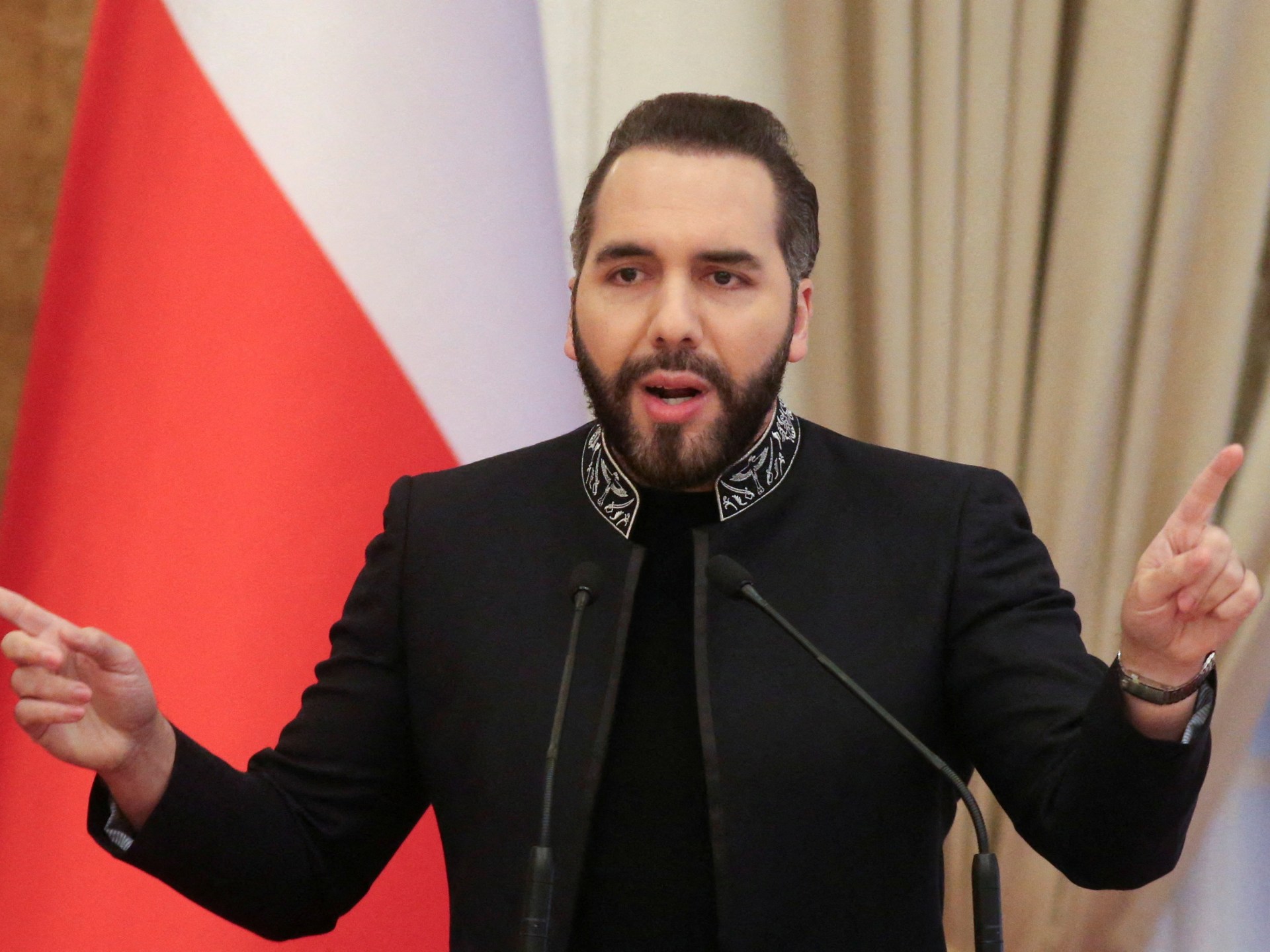
The new sentencing measure comes as President Nayib Bukele oversees a four-year-long state of emergency against crime.
El Salvador has published a new law that will allow authorities to penalise minors as young as 12 with life imprisonment for severe crimes, including homicide, terrorism or rape.
On Tuesday, the Salvadoran government released the law, which is slated to take effect on April 26.
The change is part of a suite of hardline policies designed to stamp out gang violence in El Salvador. But critics have warned that such measures risk perpetuating grave human rights abuses.
Since March 2022, El Salvador has been under a state of emergency that has suspended certain civil liberties in favour of greater police and military powers.
Initially designed to last 30 days, the state of emergency has been renewed dozens of times. And over that time, El Salvador’s government has carried out a campaign of mass arrest and imprisonment.
More than 90,000 people have been imprisoned. Groups like Human Rights Watch estimate that nearly 1.9 percent of the population is behind bars, one of the highest rates in the world.
Some detainees are held without charges. Others have been processed in mass trials, a process approved in 2023 to allow up to 900 people to be tried at once.
The life sentences for minors was approved as part of a constitutional amendment in March, championed by El Salvador’s President Nayib Bukele. The country’s legislative assembly is overwhelmingly controlled by Bukele’s Nuevas Ideas party.
On social media that month, Bukele denounced the amendment’s opponents as lenient towards violent crime.
“We shall see who supports this amendment, and who will dare to argue that the Constitution should continue to prohibit murderers and rapists from remaining in prison,” he wrote on March 17.
But in the days that followed its passage, groups including the United Nations Children’s Fund (UNICEF) voiced “deep concern” for the prospect that children could be sentenced to life behind bars.
UNICEF warned that imprisonment could result in severe, long-term consequences on child and adolescent development, and added that such measures were unlikely to reduce crime overall.
“The imposition of life sentences and excessively long detention measures on children and adolescents constitute a contradiction of the standards enshrined in the Convention on the Rights of the Child,” UNICEF wrote in a statement with the Committee on the Rights of the Child, a UN monitor.
“These minimum standards require that children in conflict with the law be treated in a manner that prioritizes their rehabilitation and reintegration.”
The new measure lifts certain legal protections for youth offenders, though it does allow for periodic sentence reviews and the possibility of supervised release.
Human rights monitors have repeatedly called on Bukele and the Salvadoran government to put an end to its state of emergency and related anti-crime measures, arguing they violate fundamental human rights.
Just last month, the International Group of Experts for the Investigation of Human Rights Violations under the State of Emergency in El Salvador (GIPES) published its final report, which alleged that crimes against humanity had been committed over the last four years.
The group pointed to comments from Bukele himself, acknowledging that “at least 8,000 detainees were innocent”.
“The figures speak for themselves,” said Jose Guevara, one of the experts included in the report. “These are not isolated cases, but a policy in which crimes are committed on a large scale and in a systematic manner.”
Read the full article here