




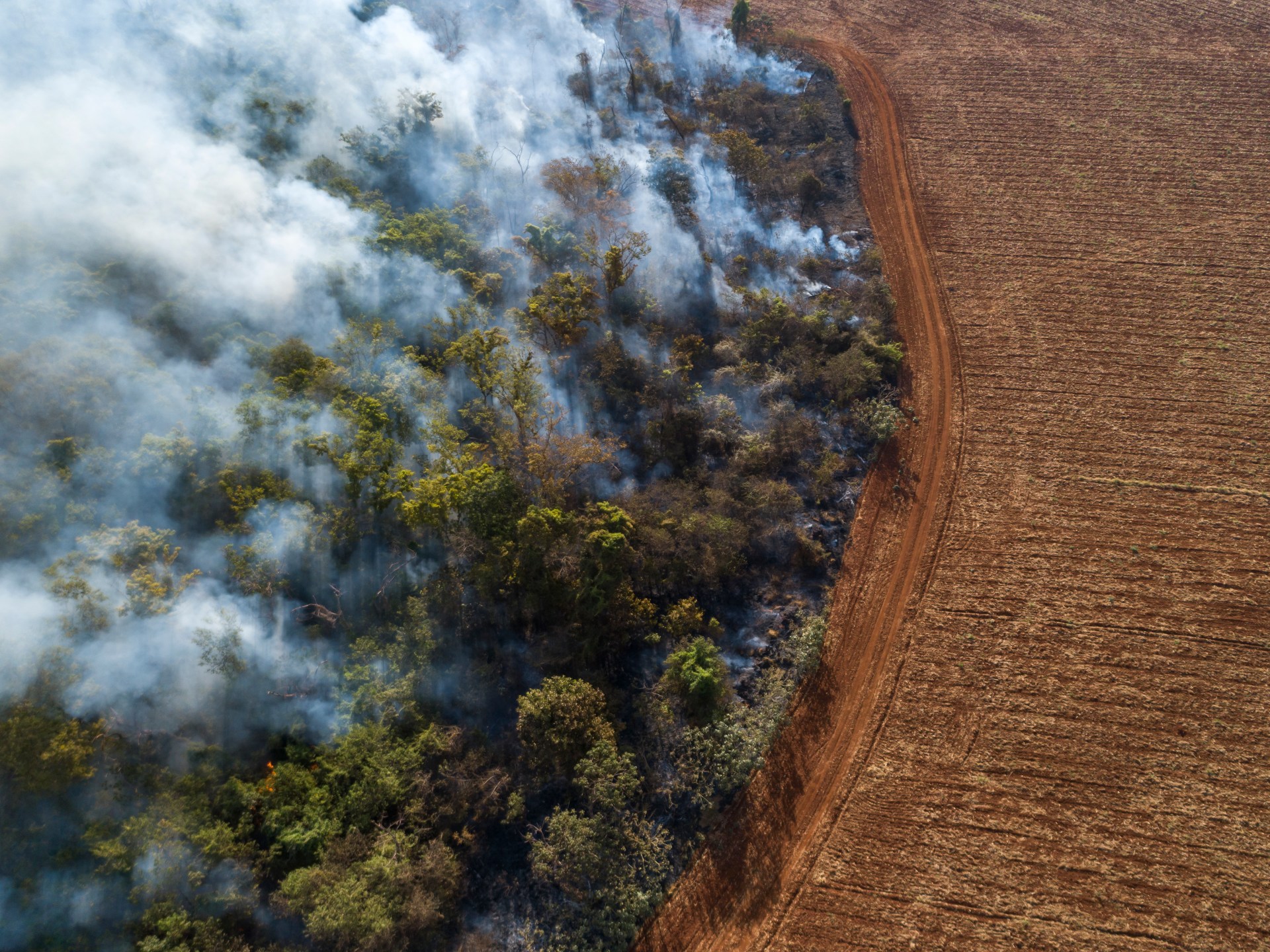
The researchers credit the slowdown to policies implemented by Brazil’s President Lula da Silva to curb deforestation.
Published On 29 Apr 2026
The pace of tropical forest destruction eased last year from a record high but has remained at alarming levels, according to a new study that praises “decisive government action”.
The world lost 4.3 million hectares (10.6 million acres) of tropical primary rainforest in 2025 – down 36 percent from the previous year, researchers from the World Resources Institute (WRI) and the University of Maryland said on Wednesday.
“A drop of this scale in a single year is encouraging – it shows what decisive government action can achieve,” said Elizabeth Goldman, co-director of WRI’s Global Forest Watch platform. “But part of the decline reflects a lull after an extreme fire year.”
The researchers also warned that fires prompted by climate change have become a “dangerous new normal”, which threatens to reverse recent gains made by government efforts to tackle deforestation.
The warming El Nino weather phenomenon is expected to return in the middle of the year, raising the threat of heatwaves, droughts and wildfires.
The researchers, who used satellite data for their report, noted that last year’s forest loss was still significant as it was 46 percent higher than 10 years ago.
Despite last year’s progress, global forest loss remains 70 percent above the level required to meet the 2030 goal of halting and reversing forest loss, the researchers said.
Much of last year’s slowdown was due to sharp declines in Brazil, home to the world’s largest rainforest.
Brazil’s forest loss, excluding fires, was 41 percent lower than in 2024 – its lowest rate on record.
“Brazil’s declines are associated with stronger environmental policies and enforcement since President Lula took office in 2023,” Goldman said in a news briefing, referring to Brazilian leader Luiz Inacio Lula da Silva.
Lula relaunched an anti-deforestation action plan and increased penalties for environmental crimes, she said.
But the country’s forests remain threatened by agricultural expansion for soya bean production and cattle ranches, and local efforts to weaken environmental protections, said the researchers.
Other countries also showed progress. Forest loss in neighbouring Colombia fell 17 percent, the second lowest year on record since 2016, thanks to government policies and agreements limiting forest clearing.
Tropical forest loss remained high in other parts of the world, including the Democratic Republic of the Congo (DRC) and Cameroon, the researchers said.
Global tree cover loss fell by 14 percent last year.
Fires also played a key role worldwide in tropical forest loss, accounting for 42 percent of the destruction.
While humans cause most fires in the tropics, climate change is intensifying natural fire cycles in northern and temperate regions, the researchers said.
Canada had its second-worst fire year on record last year as wildfires tore through 5.3 million hectares (13 million acres) of forest.
Rod Taylor, WRI’s global director for forests, said that although forests continue to be powerful carbon sinks helping to slow climate change, fires and droughts on a warming planet are increasingly turning these ecosystems into sources of greenhouse gas emissions.
“We’re on a kind of knife’s edge,” he added.
Read the full article here