




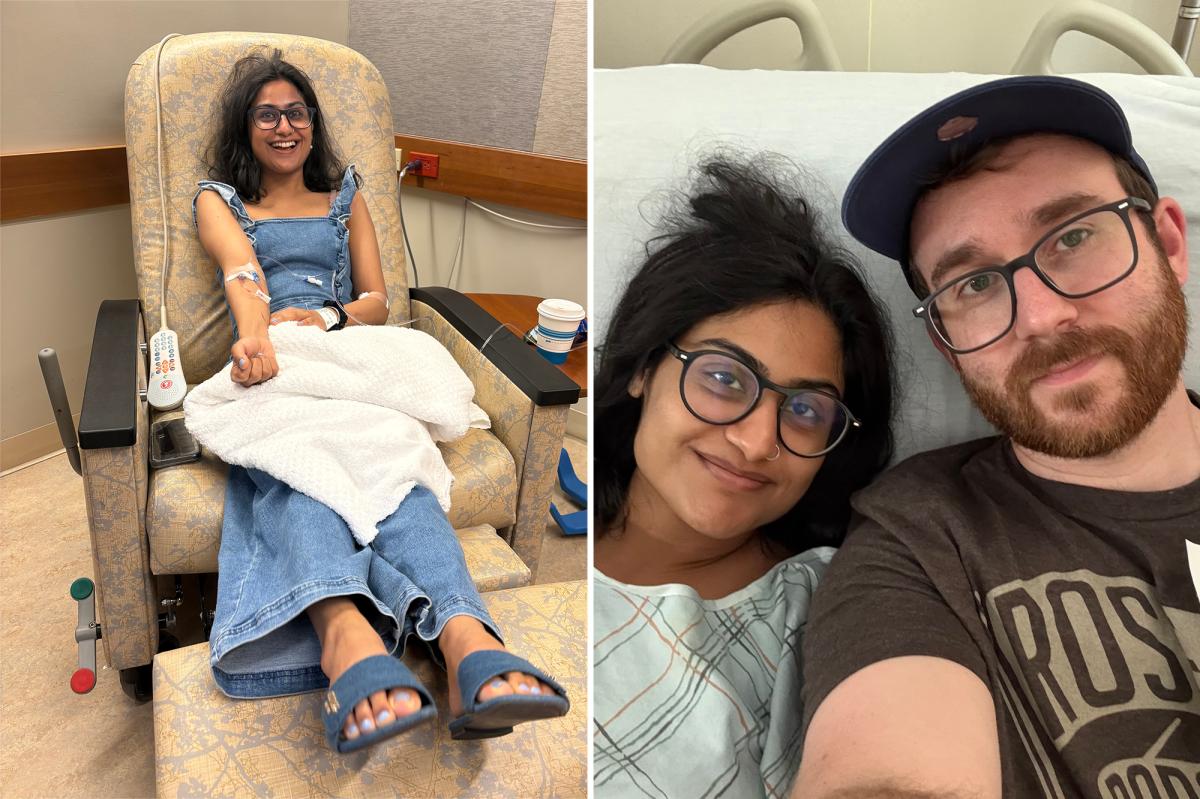
After getting engaged, the only words journalist Mrinali Dhembla expected to hear were “I do.”
Instead, she was told, “You have cancer.”
“When I first heard the words, ‘You have cancer,’ I was obviously very shaken because when you’re in your 20s, you just think that a little disturbance in your bowels isn’t a big thing. You can just live through it,” said Dhembla, 27.
Dhembla was diagnosed early last year with an aggressive Stage 3 rectal cancer that had already spread to her spine, part of a troubling rise in colorectal cancer among adults under 50.
Treatment would typically involve surgery, radiation and chemotherapy. But Dhembla got a very special invitation — she became one of the first patients to receive the one-two punch of nivolumab and ipilimumab.
The Food and Drug Administration approved the dual-immunotherapy drug regimen last year for advanced cancers such as melanoma, mesothelioma and colorectal cancer.
“We started this immunotherapy, and she’s had a pretty remarkable response,” Dr. Nicholas Hornstein, an assistant professor of medical oncology at the Northwell Health Cancer Institute, said of Dhembla.
“I am optimistic that, with the right patients, these new treatments can provide enormous benefits in a relatively short amount of time, something that would have been unlikely five years ago.”
A shocking diagnosis
Genetic testing revealed that Dhembla has Lynch syndrome, an inherited condition caused by mutations in genes that repair DNA replication errors.
“Think of these genes like a spellcheck system for your DNA,” Hornstein told The Post.
“When cells divide, small errors naturally occur, and these mismatch repair proteins are supposed to find and fix those errors,” he added. “In people with Lynch syndrome, that spellcheck system is broken, so DNA errors pile up over time, and that can lead to cancer.”
People who know that they have Lynch syndrome should begin colonoscopy screening between the ages of 20 and 25, or two to five years before the youngest age at which a family member was diagnosed, whichever comes first.
People at average risk should start colorectal cancer screening at 45.
Dhembla said she didn’t know she had Lynch syndrome. She didn’t undergo surveillance before her diagnosis, which came after she dismissed symptoms such as rectal bleeding, low-grade fevers and constipation that turned chronic.
Inside the cutting-edge therapy
The good news is that Lynch syndrome makes tumors highly vulnerable to immunotherapy.
The dual-immunotherapy drug regimen — which won the 2018 Nobel Prize in Physiology or Medicine — is specifically for patients whose tumors are “MSI-high.”
“That means the tumor’s DNA repair machinery is broken, which is exactly what we see in Lynch syndrome,” Hornstein explained.
“Only about 15% of all colorectal cancers are MSI-high, though the proportion is higher in younger patients and in those with Lynch syndrome.”
Dual immunotherapy breaks through the tumor’s protective barriers and empowers the immune system to fight cancer cells.
After only three infusions over four months, Dhembla’s scans and biopsies showed no evidence of disease.
Her circulating tumor DNA — molecules released into the bloodstream by cancer cells — decreased from 300 to zero. Dhembla was declared cancer-free in July 2025.
“[Dhembla’s] immune system did what surgery, chemotherapy and radiation may not have been able to do,” Hornstein said. “It is a profound example of precision medicine, matching the right treatment to the right biology.”
A new routine
If Dhembla had followed the “standard playbook,” she would have faced complex spinal surgery with risks of neurological damage.
She could have lost her rectum and gotten saddled with a permanent colostomy bag to collect her waste.
Instead, the side effects of the immunotherapy regimen are fatigue, thyroid dysfunction or inflammation of the GI tract and lungs.
“I take a pill for my hypothyroidism every morning, but it’s built into my routine now and does not cause any day to day troubles,” Dhembla told The Post.
She sees Hornstein every three months for enhanced surveillance.
“We are watching Mrinali very closely to make sure the cancer does not come back, without putting her through surgery,” Hornstein said.
“Since she achieved a complete clinical response, meaning no detectable cancer, we are using a combination of tools to monitor her.”
Those tools include visits with an oncologist, colorectal surgeon, GI specialist and endocrinologist.
She recently underwent a colonoscopy — she’s not due for another two years — and gets her rectum scoped every three months.
The long road to her wedding day
Dhembla relocated from New Hampshire to New York to be closer to Hornstein, and she’s settling into life as a New Yorker.
She has resumed planning her wedding to her fiancé, Chris.
They had intended to marry next month, “but decided that it’s best to let cancer be a distant memory” before walking down the aisle.
“Even though my cancer journey was short, it left a lasting impact. I need time to emotionally and mentally recover from it,” Dhembla said.
Read the full article here