




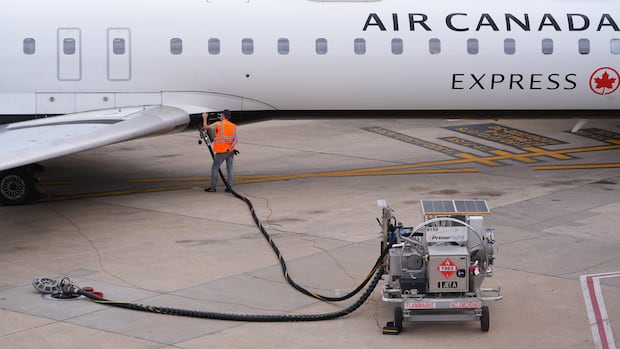
Airlines around the world are cutting flights as they face what some experts are calling the worst aviation crisis ever, with fuel shortages caused by the blockage of the Strait of Hormuz.
Several Canadian airlines have cancelled flights in the last week, and the list of carriers making cuts globally continues to grow as peak travel season approaches.
“This is just a start of airlines trying to really look at the future bookings they have for the summer,” said John Gradek, a faculty lecturer in aviation management at McGill University in Montreal. “More and more flights are going to be looked at under the lens and potentially cancelled as a result of these high costs of fuel.”
Amra Durakovic, head of communications at retail travel agency network Flight Centre Canada, said predicting how much worse the crisis could get is “a lot of speculation and uncertainty” at this point, because it will depend on what happens in the Middle East.
As of Wednesday, she said, fewer than one per cent of Canadian flights had been cancelled overall.
“I feel like, day to day, we all wake up to the same news headlines, and none of us know what’s going on. So it’s the same that would be happening with all of the decision-makers of the airlines, too,” she said.
The Strait of Hormuz has remained mostly closed since the U.S. and Israel launched strikes on Iran at the end of February. Oil tankers have been blocked from getting through the critical waterway, causing the price of jet fuel to more than double from where it was a year ago.
Last week, the head of the International Energy Agency said Europe has “maybe six weeks or so” of remaining jet fuel supplies and warned of possible flight cancellations.
The situation is not as dire in Canada in terms of supply, compared with Asia and Europe, which are more reliant on the Gulf, because Canada has more than a half-dozen refineries producing kerosene-based aircraft fuel. Gradek said 85 per cent of aviation fuel used domestically is produced by Canadian refineries.
“We have very little dependency on imported aviation fuel,” he said.
Prices rising
Shortages or not, Canada is still beholden to global price spikes. And one thing that seems almost certain is fares are only going to go up from here.
Air Canada, WestJet, Porter Airlines and Air Transat have all announced plans either to increase fares or add a surcharge to try to offset the rising cost of fuel, and experts have told CBC News that once prices go up, they likely won’t come back down even if the fuel shortage is resolved.
Durakovic said that is partly because airfare has not kept up with inflation.
With fuel prices more than doubling since the war in the Middle East began, one of the main places Canadians may feel the war’s impact is air travel. The head of the International Energy Agency says Europe has ‘maybe six weeks or so [of] jet fuel left.’ CBC’s Ashley Fraser speaks to travel experts about what to expect over the next few months.
“Prices will not drop. They will either stabilize or continue to increase,” she said.
She says the more cancellations happen, the more prices can be expected to rise for customers.
“When you have less seats, but you still have that same strong demand, prices will dynamically adjust,” she said.
Gradek says airlines are likely losing “hundreds of millions of dollars” as a result of the cost increases, a rate that could threaten their survival.
“I think that what we’re going to see over the next little while [is] that the airlines will keep pushing the envelope on fares until they see that it’s too much and customers won’t take it,” he said.
Here’s where the airlines are at with their changes:
Air Transat
Air Transat announced Wednesday it will cut about 1,000 flights, reducing its capacity by six per cent between May and October, its busiest travel season.
The airline will primarily be reducing flight frequency on some routes to Europe and the Caribbean. It has also extended its suspension of service to Cuba, which is facing a continued fuel embargo from the U.S.
In a statement, the airline’s parent company, Transat A.T. Inc., said it is “closely monitoring the situation.”
WestJet
WestJet announced Monday that it is cutting capacity by about one per cent in April, three per cent in May and nearly six per cent in June by consolidating flights on some routes and shortening the travel period for seasonal service to several destinations.
WestJet says it has not eliminated any routes so far, but it is “evaluating its summer schedule” and looking at possible cuts.
Earlier this month, the carrier announced a temporary fuel surcharge of $60 on bookings made through WestJet Rewards companion vouchers, and a fuel charge of $50 per person for Sunwing Vacations and Vacances WestJet Quebec.
Air Canada
Air Canada announced last week that it would suspend six routes that it said are “no longer economically feasible,” affecting routes across North America.
The airline says the cancellations will have a total impact of roughly one per cent of annual available seat miles.
Air Canada also announced higher baggage fees, increasing the fee to $45 from $35 for the first checked bag in its basic economy class on domestic, U.S. and sun destination flights.
Lufthansa
In Europe, Lufthansa cancelled 20,000 short-haul flights through October on Tuesday, reducing its summer capacity by one per cent.
The airline said this would save some 40,000 tonnes of jet fuel, adding it has secured its fuel supply for at least the “coming weeks.”
Read the full article here