




Investors are fixated on the AI computing competition, concentrating on which companies will capture market share. They are particularly focused on Nvidia (NVDA), AMD, and the hyperscalers who are developing their proprietary chips.
However, they are missing a crucial element. As AI chips become faster
and models expand, the “wires,” or the connections among them, must also progress.
By 2027, electricity will become too inefficient and excessively hot for transmitting AI data. Attention may shift toward a metric that has not been discussed: the interconnect tax.
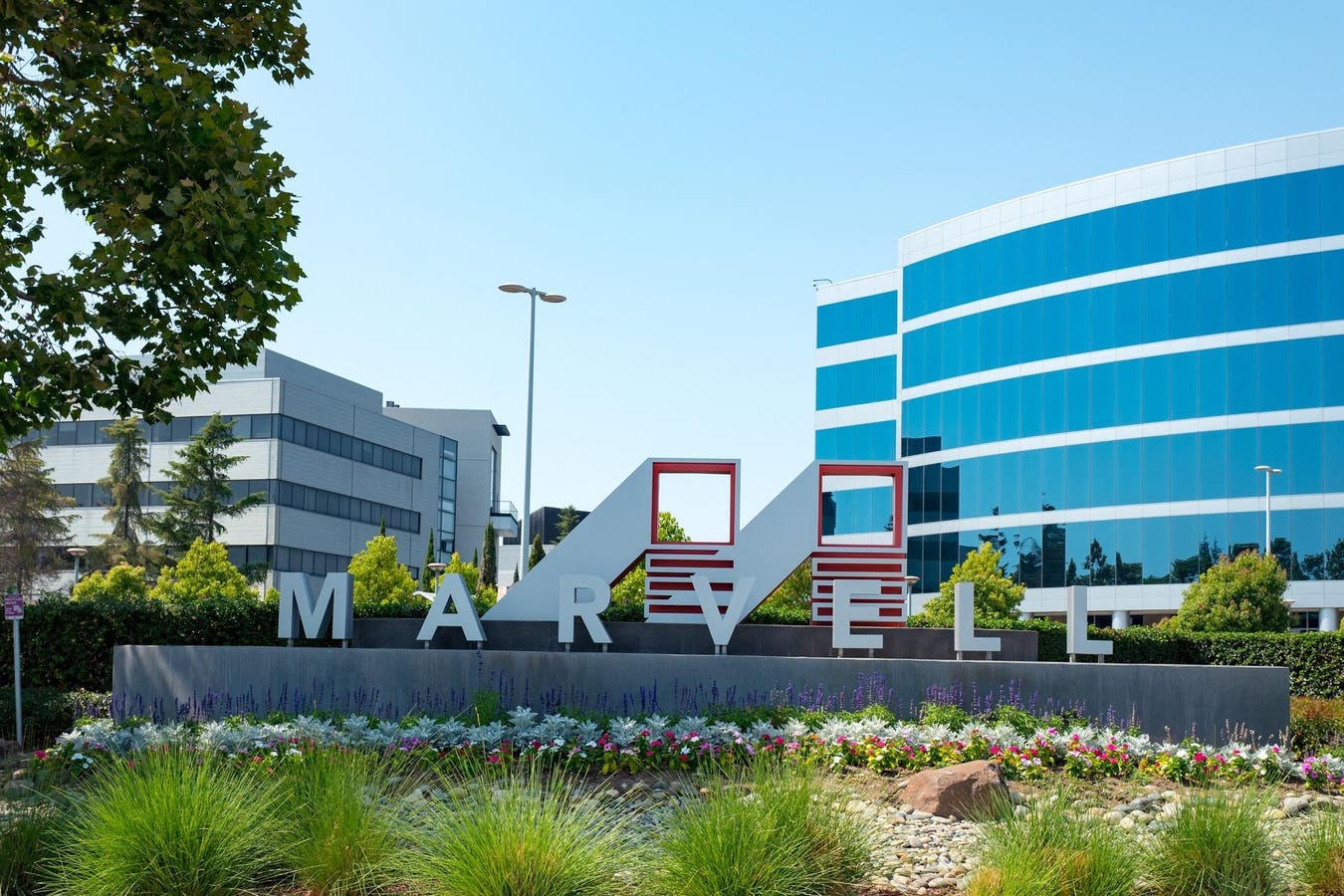
That’s where Marvell (MRVL) comes into play. It has already established a strong presence in data center networking and interconnect silicon and is taking initiatives to become the default architect of next-generation data center interconnects, allowing it to derive value from nearly every AI transaction, irrespective of the GPU or TPU managing the task.
Why Are Interconnects So Important?
The performance of AI relies on countless chips collaborating across servers. In this configuration, the movement of data is vital; otherwise, costly GPUs remain unutilized.
This is where the principles of physics become limiting. Electrical signals function effectively over very short distances, yet at the speeds required for AI, they consume excessive power, produce heat, and deteriorate over longer distances. The sector is progressively transitioning to optical connections as “Light” is significantly more efficient for transferring large volumes of data.
What fuels this surge in data? AI inference. In contrast to AI model training, which operates on localized clusters, “AI inference” (consider how you utilize Gemini, ChatGPT, Claude, etc.) necessitates a worldwide, low-latency network that stretches across distributed data centers. As models progress into always-on resources, the system must manage substantial, real-time traffic, prompting architectures to expand.
Apart from interconnects, CPUs are also expected to experience a revival as workloads from AI inference increase, and Intel is likely to benefit.
What Advancements Is Marvell Making?
Marvell is a primary contributor to the transition toward optical connectivity in AI data centers. It supplies optical DSPs utilized in pluggable modules that facilitate data movement between servers and commands a leading share in high-speed segments, such as 800G modules.
However, this is merely the initial phase. Current optical systems still depend heavily on signal processing to offset losses in electrical and optical channels. The forthcoming step is to lessen the amount of that correction needed by positioning optics closer to computation. This is where Celestial AI, a company acquired by Marvell last year, comes into play.
In time, this also allows for quicker access to memory and tighter integration at the system level. For example, this could imply that hyperscalers would need approximately 30% less HBM4 memory – which has dramatically risen in cost and remains scarce. [1]
What About the Competition?
Indeed, Marvell faces competition in both the interconnect and custom ASIC markets, the most notable of which is Broadcom (AVGO). Nevertheless, Marvell may possess an advantage. Broadcom’s significant price increases following its VMware acquisition serve as a subtle reminder to hyperscalers regarding vendor concentration risks. This situation opens a chance for Marvell to establish itself as a more neutral, strategic alternative to Broadcom, not only in terms of performance but also regarding long-term partnership reliability.
How The Stock Can Be Re-rated Higher
For FY’26, 74.4% of revenues originated from Marvell’s data center segment, which generated $6.1 billion, underscoring how critical AI infrastructure is to the business. Within this segment, Marvell’s interconnect product range is a primary growth driver, anticipated to increase by more than 50% in fiscal 2027. The firm has also revised its data center switch target to exceed $600 million, roughly double FY ’26.
However, the stock is currently trading at merely 26x consensus FY’27 earnings and only 18x FY’28 consensus earnings, despite projected revenue growth of over 30% annually over the next two years.
The valuation disparity is even more pronounced in absolute figures. Marvell’s market capitalization stands at around $85 billion, in contrast to Broadcom’s approximate $1.4 trillion, leaving significant potential for revaluation. Should Marvell succeed in securing interconnect and computing victories, its involvement in nearly every AI workload renders the present valuation increasingly conservative.
While Marvell’s opportunity looks compelling, if you want to deploy high-conviction, data-backed strategies across your entire portfolio without managing the day-to-day execution yourself, we can help. Our Trefis HQ strategy has outperformed its market benchmark (a combination of the S&P 500, S&P mid-cap, and Russell 2000) to produce over 105% returns since inception. Readers can see the full HQ performance metrics and 5 reasons why HQ outperformed.
Read the full article here