




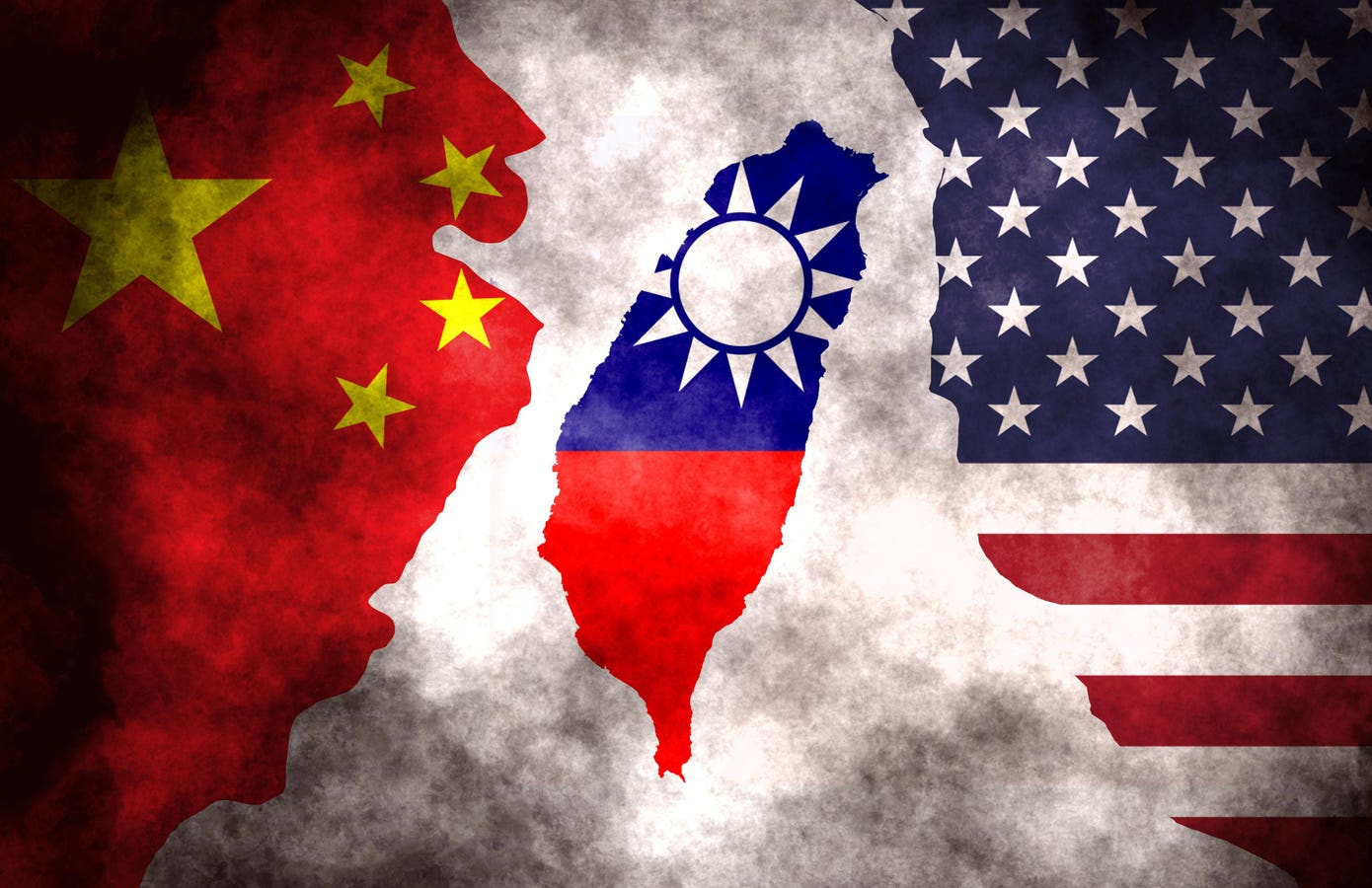
I’ve long been a student of game theory, the branch of mathematics that studies how rational actors make decisions when their outcomes depend on what everyone else does. It’s a helpful framework for understanding markets and geopolitics, and right now, there’s no better place to apply it than Taiwan.
The stakes couldn’t have been higher last week as President Donald Trump met with Chinese leader Xi Jinping in Beijing. Xi reportedly warned Trump that “conflicts” could emerge if the two powers mishandle Taiwan.
Meanwhile, Taiwan’s legislation just approved $25 billion in special defense funding. The U.S. cleared an $11 billion arms package last December, with another $14 billion package reportedly waiting in the wings.
Chicken on the World Stage
There’s a famous scenario in game theory called the game of Chicken. Two drivers race toward each other head-on. The one who swerves first loses face but survives. If neither swerves, both are destroyed. The dilemma is that each player wants the other side to blink first, but the cost of miscalculation is catastrophic.
That’s precisely what’s at stake across the Taiwan Strait.
China believes reunification with Taiwan is inevitable. Xi sees the island as the “core of China’s core interests,” and Beijing has never taken the use of force off the table.
On the other side, the U.S. has maintained military and political backing for Taiwan for more than 75 years. Abandoning that commitment would, as one analyst put it, trigger a “disastrous chain reaction” across America’s entire Indo-Pacific alliance system.
It would also mean surrendering the territory that produces over 90% of the world’s most advanced semiconductors.
In a textbook game of Chicken, the cost of collision is fixed. Both players know what mutual destruction looks like. But in the Taiwan Strait, the cost of a crash is growing exponentially, and that’s mostly due to artificial intelligence (AI).
Taiwan’s Semiconductor Dominance
To put things in perspective, the global semiconductor industry is projected to reach $975 billion in annual sales this year, $1 trillion next year. Generative AI chips alone will generate an estimated $500 billion in sales.
Taiwan Semiconductor Manufacturing Co. (TSMC) alone enjoys a roughly 70% global market share in this massive and increasingly important industry. This has helped make it the sixth most valuable company in the world, with a market cap exceeding $2 trillion.
Apple and NVIDIA alone account for almost 40% of TSMC’s sales. Add in their other customers—Microsoft, Amazon, Alphabet, Meta, Oracle—and the broader equipment supply chain, and you’re looking at roughly $30 trillion in market value directly or indirectly tethered to Taiwan’s chip fabrication. TSMC posted an incredible 58% jump in quarterly profits in the first quarter because of the AI boom.
Taiwan’s economy has likewise boomed. Its GDP grew nearly 14% in the first quarter of this year, a 39-year high. In March, exports hit a record of $80.2 billion.
The island’s chip dominance, in fact, has become a form of military deterrence many analysts call the “silicon shield.”
The Cost of War with China
In game theory, rational players weigh the costs and benefits before making a move. So what does the math actually look like if the so-called silicon shield fails?
Bloomberg recently modeled five possible scenarios, from outright war to rapprochement, and the numbers are sobering. In the worst case, a U.S.-China conflict would cost the global economy roughly $10.6 trillion in the first year alone, representing about 10% of global GDP. That would eclipse both the pandemic and the 2008 financial crisis.
Those figures may actually underestimate the damage. Remember the pandemic-era chip shortages, which led to empty car lots, appliance backorders and factory shutdowns? As stated by Eyck Freymann, a Hoover fellow and author of Defending Taiwan: A Strategy to Prevent War with China, the economic shock from a U.S.-China war over Taiwan “would dwarf anything we’ve seen in the [post-World War II] period.”
The rivalry has already cost the U.S. trillions even without a single shot being fired. A recent study from Brown University’s Costs of War project estimates that the U.S. government has spent approximately $3.4 trillion on its militarized rivalry with China between 2012 and 2024, or about $260 billion a year. That’s roughly 30% of total defense spending over that period, nearly double what the federal government spent on education, and 3.5 times the cumulative budget of the State Department.
CEOs at the Table
More than a dozen of America’s most powerful CEOs joined Trump’s delegation to Beijing, including Apple’s Tim Cook, NVIDIA’s Jensen Huang, Tesla’s Elon Musk and Goldman Sach’s David Solomon. The group’s combined net worth is nearly $1 trillion.
The summit doesn’t appear to have been a raving success for these U.S. mega-caps. Trump touted “fantastic trade deals,” and NVIDIA shares hit a new record on reports that Washington had cleared 10 Chinese firms to buy its H200 chips. But Beijing hasn’t said if it would permit those sales.
No breakthroughs were made on tariffs or Taiwan either. Xi’s warning about “conflicts” still hangs in the air.
An Insurance Policy Against Catastrophe
In game theory, when the cost of collision is high enough, rational actors are more likely to find ways to cooperate. Taiwan’s growing importance to the AI revolution, and the deepening economic ties between Taipei and Washington, may be the best insurance policy the world has against catastrophe.
But as any game theorist will tell you, rationality is an assumption, not a guarantee. Investors would be wise to keep an eye on the Strait.
Read the full article here