





This is our flagship newsletter Morning Wire. You can subscribe here and we’ll email it to you daily.
In the news today: Defense Secretary Pete Hegseth is rolling out a new screening program for “testosterone deficiency” among troops; wildfire smoke engulfs swaths of the Midwest and Northeast; and the U.S. expands its strikes into northern Iran. Also, why scientists are excited about finding sugar in outer space.
Secretary of Defense Pete Hegseth listens as President Donald Trump meets with Iraq’s Prime Minister Ali al-Zaidi in the Oval Office of the White House, Tuesday, July 14, 2026, in Washington. (AP Photo/Julia Demaree Nikhinson)
Hegseth announces new policy to test troops for low testosterone
Defense Secretary Pete Hegseth announced Wednesday that he is rolling out a new screening program for “testosterone deficiency” among troops, calling it necessary to allow them to operate at their “absolute best.” Read more.
Why this matters:
- The move comes as other Trump administration officials have begun to advocate for men to have easier access to testosterone replacement therapies, but the messaging from Hegseth and others blends known science on the hormone with broader, and less substantiated, claims. The Pentagon did not respond to questions about what research or academic studies underpinned the move.
- Over the past several years, special operations troops — and specifically Navy SEALs — have come under scrutiny for their use of testosterone and similar substances to enhance performance. The death of a SEAL recruit during training in 2022 led to the discovery of substances including testosterone in his possession, and revealed far more rampant drug use among the elite program than was previously acknowledged.
- Rep. Chrissy Houlahan, a Pennsylvania Democrat and Air Force veteran, said it “proves that Secretary Hegseth takes direction from the far corners of the manosphere.”
Related coverage →
Vance says Trump administration ‘screwed up’ communications around Epstein files
ICE should keep making traffic stops despite recent shootings, Trump says
Report: Detainees at ICE facility in Texas report frequent beatings and other human rights abuses
After six years, Trump brings his election obsession to primetime at the White House
CDC nominee says she won’t betray science — while declining to challenge Kennedy’s actions
Trump immediately fires the new court-appointed top prosecutor in Seattle
Donald Trump endorses ‘Pillow Man’ Mike Lindell for Minnesota governor
New York Times files motion to quash subpoenas served on journalists over Air Force One coverage
George Santos’ next gig? Reality TV show contestant
US Mint produces a $1 coin bearing Trump’s face
Drained Reflecting Pool reveals Trump’s ‘American flag blue’ liner is now closer to gray
Heavy smoke from wildfires blankets the US Midwest and Northeast, prompting evacuations
Thousands of visitors were told to evacuate a remote Minnesota wilderness area accessible only by boat as wildfires send dangerously heavy smoke over the U.S. Midwest and Northeast this week. More than 100 wildfires are burning in Canada. Winds are carrying the smoke southeast. Read more.
What to know:
- Warnings about unhealthy air conditions Wednesday extended from Minnesota through Toronto and into New York. Unusually hot summer temperatures were expected, too. The best advice is to stay indoors to avoid both the smoke and the extreme heat, said Tyler Hasenstein, a meteorologist with the National Weather Service in Chanhassen, Minnesota.
- Dan Westervelt, associate professor at Columbia University’s Climate School, said severe drought conditions combined with heat in Canada and the U.S. have created “a perfect storm for really dry conditions to provide a lot of fuel for these wildfires to burn.” Research shows warming temperatures from burning coal, oil and gas are making fires more frequent and intense.
Related coverage →
WATCH: Train crew in Canada surrounded by intense flames
Busy wildfire season tests US fire bosses
Flooding forces evacuations in parts of South Texas as slow-moving storms swamp the region
What living in one of the world’s hottest towns feels like
US expands strikes into northern Iran
The United States intensified its strikes on Iran early Thursday, hitting targets further north as American forces also fired on a ship the U.S. accused of trying to break its naval blockade on the Islamic Republic. Iran retaliated with missile and drone fire targeting U.S. allies in the region before dawn and warned its attacks may escalate. Read more.
Why this matters:
- American strikes also reached into areas around Iran’s capital, Tehran, for the first time in this latest round of violence, showing a widening set of targets. Days of back-and-forth strikes by the U.S. and Iran across the Middle East — and renewed threats to the Strait of Hormuz — have shredded the interim deal to end the Iran war and could tip the region back into all-out war.
Related coverage →
More than half of House Democrats vote to cut Israel aid in growing split
Human rights groups sue over Trump administration’s sanctions on ICC for investigations into Israel
Lebanon and Israel move toward implementing withdrawal agreement, US officials say
IN OTHER NEWS
Clock change: America already tried permanent daylight saving time. It lasted less than a year
Mississippi: Family of Black teen found dead after boat trip agrees to inspect his cellphone with DA
MS-13: Mass trial of alleged gang members wraps up
Ohio: Carbon monoxide present in vehicle where 3 died, official says
Movie Review: In Christopher Nolan’s ‘The Odyssey,’ an ancient epic is reborn
World Cup: Final is set, with Messi and Argentina facing Yamal and Spain
Today in History: In 1951, ‘The Catcher in the Rye’ by J.D. Salinger was first published
WATCH
Boston: Why a traffic cone got a hero’s welcome
Face-to-face with ancient Rome: Exhibition brings forgotten people to life
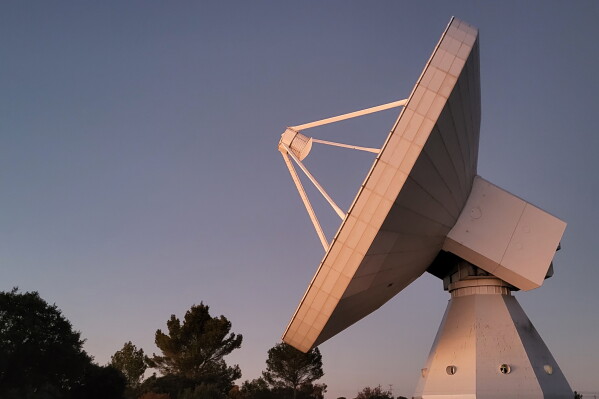
This Dec. 2023 photo provided by Pablo de Vicente shows a radio telescope at Yebes Observatory in Yebes, Spain. (Pablo de Vicente via AP)
Astronomers find sugar lurking in the space between stars
Astronomers have detected a type of sugar in space that’s also found in raspberries. Sugars are a key ingredient for life as we know it, so scientists say they might help us understand how life got started on Earth. Did faraway comets or space rocks deliver the essential ingredients to us, or were the essential components already here that eventually gave rise to our solar system? The new sugar discovery lends evidence to the latter theory. Watch our video with one of the scientists for more.
This is our flagship newsletter Morning Wire. You can subscribe here and we’ll email it to you daily.
Read the full article here