




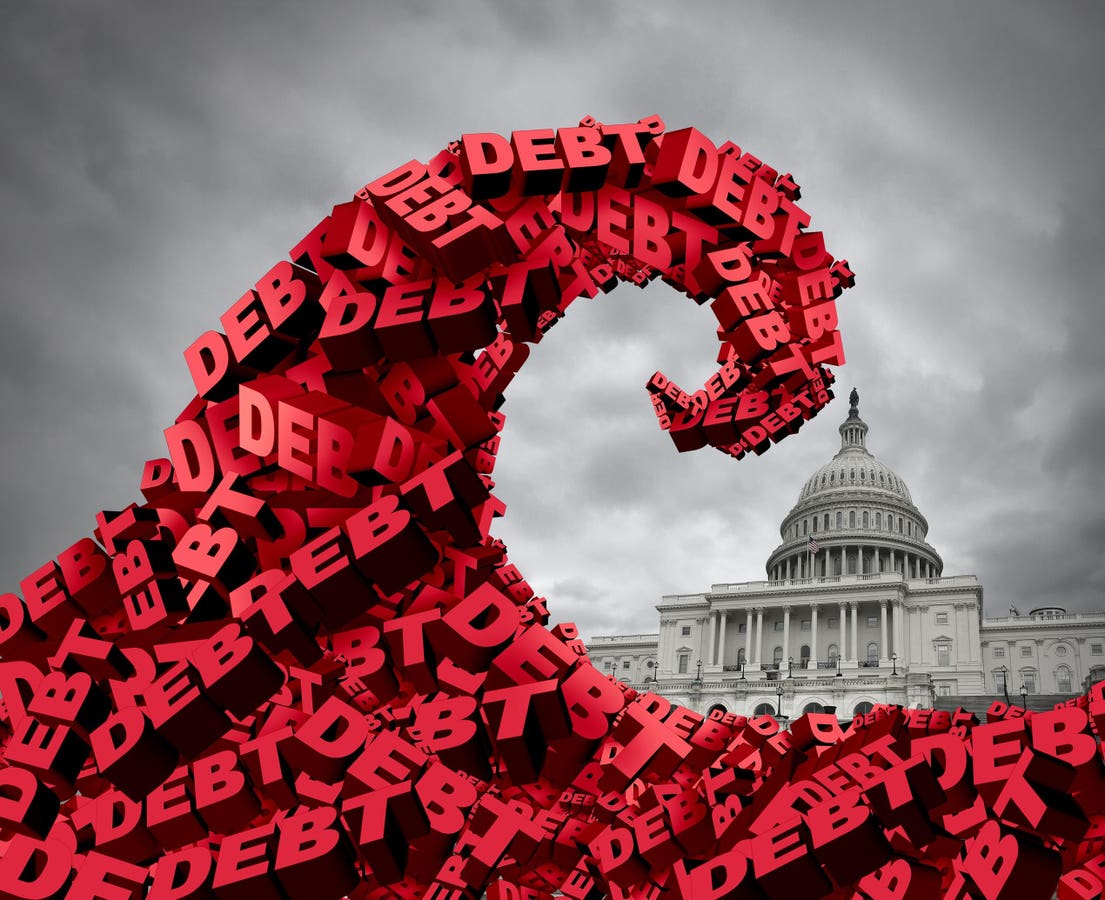
The national debt, which the federal government has largely ignored in every practical way, is racing out of control. The national debt as of Jan. 26, 2025, was $38.5 trillion dollars. By 2030, at a 10-year annual growth average of $2.01 trillion, the national debt will be $48.9 trillion. Substitute the growth rate over the last five years, $2,5 trillion, and you can mark up the debt by another $2 trillion to $50.9 trillion.
What might that mean? It’s complicated, with multiple categories of risk according to a new report from the nonprofit, non-partisan Committee for a Responsible Federal Budget. Each of the categories ultimately come crashing down on the heads of everyone in the country without a safety net.
CRFB’s paper explained that when things go very badly in a country, the result is called a fiscal crisis, also known as a sovereign debt crisis, and is “a sharp economic shock or downturn caused or sparked by high levels of current or expected public borrowing.”
There are six categories of fiscal crisis, virtually all of which are a direct or indirect result of national debt:
- Financial — There is reduced confidence in short- and long-term bond issuance. Yields (the interest rates those bonds must offer to get buyers) rise sharply. Traders get wary of falling bond values and possibly panic internationally. Credit in general slows or freezes. Key financial institutions fail.
- Inflation — A government tries to manage exploding debt through what CRFB called monetization, but which is a set of manipulative techniques, including pushing interest rates low in an artificial way or what they called “financial repression,” any or all of which could drive quickly rising inflation, far more than happened in 2021 and 2022.
- Austerity — Historically, one of the ways governments try to deal with debt (and, I’d add, save wealthy interests) is through austerity programs, sharply increased taxes and heavily cut spending. The results are bad recessions and suffering by most of the population.
- Currency — The status of a country’s currency is threatened by too much debt. When markets get wary, the value of the currency drops, because value is really a function of perception. There was a time in the 19th to 20th centuries when you could have bought a Van Gogh or Picasso for a song. Now they’re worth a lot. But changes run the other way as well. The U.S. dollar is the primary global reserve currency, providing many advantages to the entire country and everyone who lives here that would disappear.
- Default — Constitutionally, via the Fourteenth Amendment, the U.S. is not allowed to default on its debt. But then, many things that happen aren’t supposed under the Constitution. As someone explained to a former congressional staffer, who once shared the analogy to me, from a financial viewpoint, a U.S. default would be like having every single nuclear weapon set off simultaneously. The question is whether every living thing would be wiped out (maybe other than some cockroaches) or if the impact would be something merely unthinkably horrible.
- Gradual — In CRFB’s words, “Living standards and fiscal and monetary flexibility could gradually erode in response to rising debt, potentially causing as much or more long-term damage than an acute crisis.”
There are many more details and historical examples worth looking at in the report. No one can predict how calamitous this could be. However, in my “too long, didn’t read” take, this would be worse than any financial calamity the country has ever seen. Far worse than the Great Recession/Global Financial Crisis. Far worse than the Great Depression. Far worse than anything you would want to imagine, let alone live through.
Read the full article here