




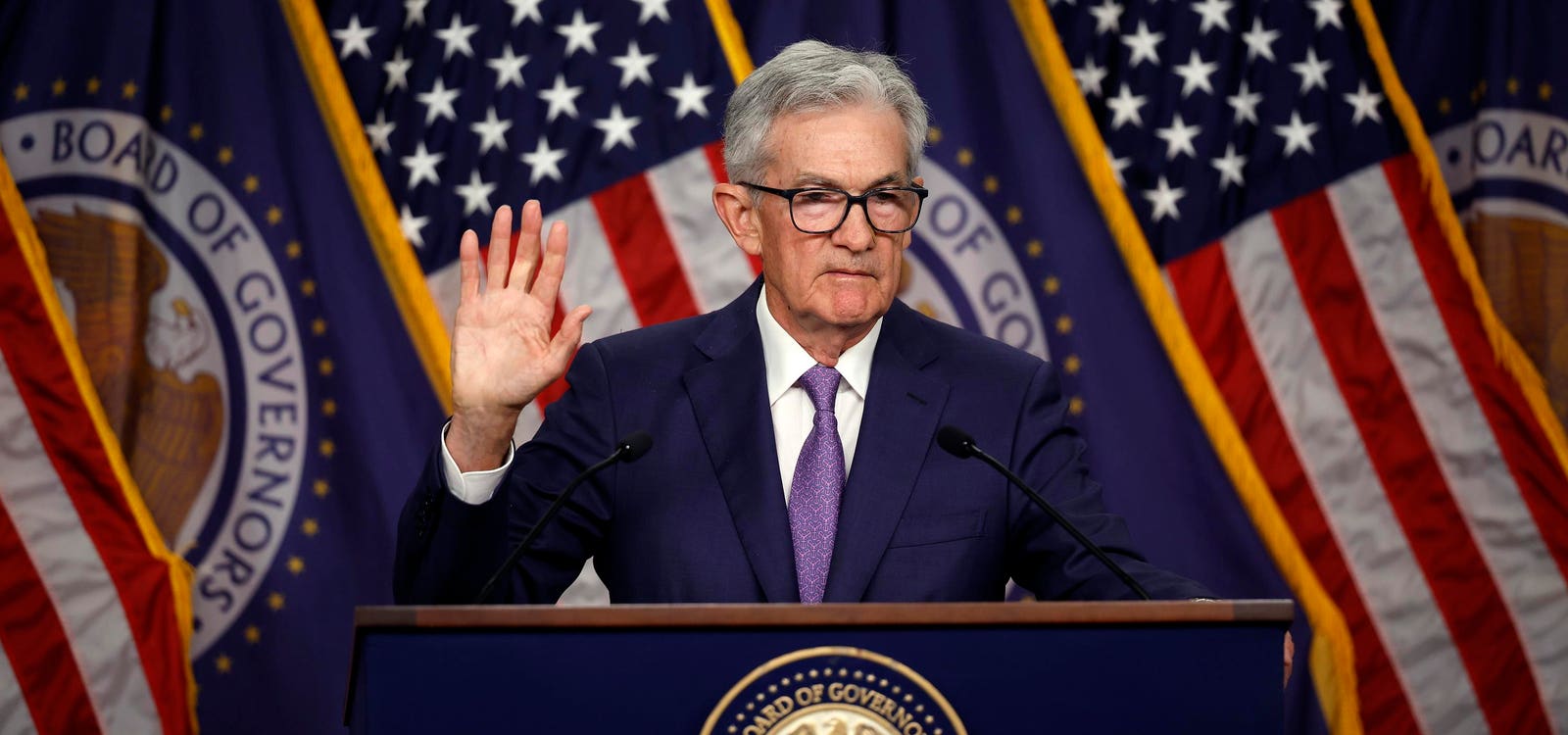
Jerome Powell’s term as Federal Reserve Chair ended Friday, May 15, 2026. For the millions of Americans whose retirement savings sit in 401(k) plans, the moment invites a natural question: How did balances actually perform on his watch compared with those of his recent predecessors?
The Fed doesn’t directly manage 401(k) accounts, of course. But its decisions on interest rates and bond purchases powerfully influence stock and bond markets, the engines of most retirement portfolios. This article examines S&P 500 total returns (price appreciation plus reinvested dividends) during each tenure, a widely used proxy for 401(k) growth given that the typical plan is heavily weighted toward equities. Annualized S&P 500 total returns were approximately 7.6% under Greenspan, 3.9% under Bernanke, roughly 11% under Yellen, and 13.3% under Powell as of Friday’s market close.
We’ll also cross-check against real participant data from Vanguard and Fidelity. According to a Barron’s analysis published toward the end of Powell’s term, the results show meaningful differences shaped by everything from the dot-com boom to the global financial crisis, the COVID-19 pandemic, and the inflation fight of the 2020s.
The Greenspan Era (1987–2006): Steady Bull-Market Gains
Alan Greenspan presided over nearly two decades of relative economic calm known as the “Great Moderation.” Inflation stayed low, the economy expanded, and the stock market enjoyed one of its longest bull runs on record. The S&P 500 delivered strong annualized total returns of approximately 11% for much of the period, even after the 1987 Black Monday crash (a 22.6% one-day drop that quickly recovered) and the late-1990s tech bubble and bust.
For 401(k) savers, this translated into consistent balance growth. Participants who contributed regularly and stayed invested saw their accounts compound steadily through the 1990s and early 2000s. Vanguard’s historical data from the era shows average balances rising as both contributions and market appreciation worked in tandem. The main risk for late-period investors was the dot-com collapse, but those who held through the recovery still ended the Greenspan years well ahead. The era proved that a long, steady bull market can be a powerful friend to retirement savers.
Crisis and Recovery Under Bernanke (2006–2014) and Yellen (2014–2018)
Ben Bernanke took office just before the global financial crisis hit. The S&P 500 suffered a brutal bear market in 2008–2009, but aggressive Federal Reserve intervention, including zero interest rates and multiple rounds of quantitative easing, engineered a powerful rebound. According to Barron’s, the S&P 500 posted an annualized total return of roughly 3.9% during Bernanke’s full tenure.
Janet Yellen inherited the recovery. Markets continued to climb in a low-rate environment, delivering solid annualized returns of roughly 11% over her shorter term. Vanguard and Fidelity data from the mid-2010s show average 401(k) balances recovering strongly after the 2008–2009 drawdown. The key lesson: Severe market drops can slash balances by 30–50% in a matter of months, but staying invested and continuing contributions allowed participants to participate in the subsequent multi-year rally. By the end of Yellen’s tenure, many savers had not only recovered but moved well past their pre-crisis highs.
Powell’s Record (2018–May 15, 2026): Pandemic Shock, Inflation Battle, and Robust Rebound
Jerome Powell’s eight-year run was defined by extremes. The COVID-19 pandemic triggered the fastest bear market in history in early 2020, followed by the fastest recovery on record thanks to massive fiscal and monetary stimulus. Then came the 2022 inflation surge and the Fed’s most aggressive rate-hiking cycle in decades, which caused another sharp (but shorter) drawdown.
Yet the overall numbers are impressive. Barron’s described Powell’s tenure as delivering a “historic run” for stocks, with the S&P 500 posting strong cumulative gains even after accounting for volatility. Fidelity’s Q4 2025 retirement analysis reported average 401(k) balances reaching new records at $146,400. Vanguard’s How America Saves 2026 preview showed average participant balances rising 13% in 2025 to $167,970. Full Powell-era annualized S&P 500 total return: 13.3% as of market close Friday.
Compared with his predecessors, Powell’s era produced the strongest nominal 401(k) growth for investors who remained disciplined. The pandemic crash tested nerves, but the rebound and continued contributions delivered results that outpaced the longer but steadier Greenspan years and the crisis-scarred Bernanke/Yellen period on a total-return basis.
These figures are correlation, not causation. Global events, fiscal policy, corporate earnings, and individual saving behavior all play enormous roles. The Fed influences the environment but does not guarantee outcomes.
The bottom line for retirement savers is reassuringly simple. Powell’s tenure, like those of Greenspan, Bernanke, and Yellen before him, showed that time in the market and consistent contributions matter far more than trying to time the chair’s policy moves. As a new Fed leader takes over, the best strategy remains the same: keep contributing, stay diversified, rebalance regularly, and let compounding do the heavy lifting regardless of who is in the big chair at the Eccles Building.
The opinions expressed in this commentary are those of the author and may not necessarily reflect those held by Kestra Advisor Services Holdings C, Inc., d/b/a Kestra Holdings, and its subsidiaries, including, but not limited to, Kestra Advisory Services, LLC, Kestra Investment Services, LLC, Kestra Private Wealth Services, and Bluespring Wealth Partners, LLC. The material is for informational purposes only. It represents an assessment of the market environment at a specific point in time and is not intended to be a forecast of future events, or a guarantee of future results. It is not guaranteed by any entity for accuracy, does not purport to be complete and is not intended to be used as a primary basis for investment decisions. It is not intended to provide specific legal, tax or other professional advice. The services of an appropriate professional should be sought regarding your individual situation.
Securities offered through Kestra Investment Services, LLC, (Kestra IS), member FINRA/SIPC. Investment Advisory Services offered through Kestra Advisory Services, LLC, (Kestra AS) an affiliate of Kestra IS. Beacon Financial Services is not affiliated with Kestra IS or Kestra AS. Beacon Financial Services does not provide legal or tax advice. https://www.kestrafinancial.com/disclosures
Read the full article here