




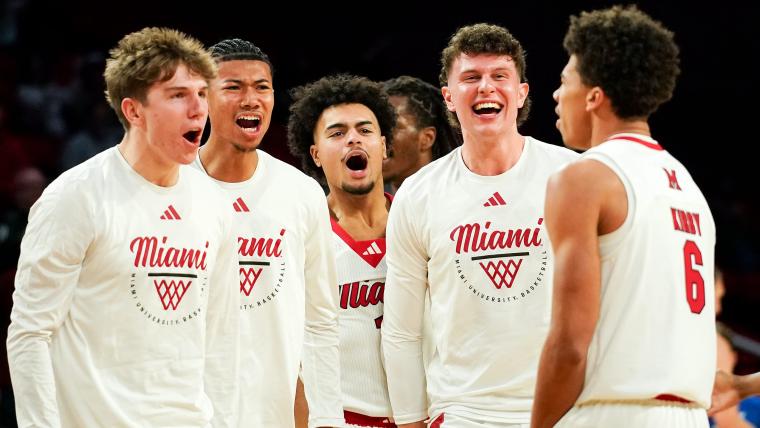
How good is Miami (Ohio) basketball? Breaking down undefeated RedHawks’ March Madness outlook originally appeared on The Sporting News. Add The Sporting News as a Preferred Source by clicking here.
The objective of a basketball game is to win, and Miami (Ohio) has met that objective in every single game. So, why are some questioning whether they belong in the NCAA Tournament?
The RedHawks still control their tournament fate. If they finish the MAC Tournament with an undefeated record, it will mean they secured the conference’s automatic bid and took any decision out of the selection committee’s hands.
After 2020-21 Gonzaga, 2014-15 Kentucky and 2013-14 Wichita State all received No. 1 seeds in the NCAA Tournament, however, Miami is headed for a much lower seed even in the best-case scenario.
Is it justified, or is that just evidence that the deck is now stacked against mid-majors more than it once was?
Here’s a complete breakdown of what the numbers — and wins — say about Miami (Ohio) basketball.
MORE:History of teams entering March undefeated
How good is Miami (Ohio) basketball?
The number in Miami’s loss column is zero. As long as that’s true, what anyone else thinks won’t be very relevant.
However, the reason the RedHawks aren’t getting the kind of respect Wichita State did in 2014 or Gonzaga did in 2021 isn’t entirely the result of bias against small schools.
Miami is 89th in KenPom’s team ratings, which take into account a team’s margin of victory and strength of schedule. The RedHawks are considerably higher (53rd) in NET rankings and even higher (30th) in Wins Above Bubble (WAB), a newer metric now used by the selection committee.
That still pales in comparison to 2013-14 Wichita State, which finished sixth in KenPom ratings. Gonzaga finished the 2020-21 season as the No. 1 KenPom team, even after suffering its first loss in the national championship game.
Miami’s low rating is the result of multiple factors: a weak non-conference schedule and a lack of blowout wins.
The MAC is rated as a middle-of-the-pack mid-major conference, certainly better than some of the worst at the Division I level, but Miami’s non-conference slate ranks 360th out of 365 D-1 teams, according to KenPom. The RedHawks faced only two top-200 KenPom teams in non-conference play: No. 155 Wright State and No. 197 Marshall. Beating up on weak non-conference teams didn’t do much to boost Miami’s metrics, nor did it do much to pad the team’s resume in the event it doesn’t receive the MAC’s automatic bid.
You might ask why it matters whether a team is winning a game by 20 points or by two if the result is still the same. In many ways, it doesn’t. All of Miami’s wins counted toward securing the top seed in the MAC Tournament, and they have the RedHawks potentially positioned for an NCAA Tournament at-large bid despite metrics that rarely put a team into the field.
But, the metrics do matter when many of the teams under consideration by the selection committee play in different conferences and don’t have head-to-head results. It’s pretty clear a 29-2 team in the MAC, hypothetically, would not be as good as a 29-2 team in the Big 12. When a team plays in a weaker conference, the best measure of a team’s strength might not be whether they are just beating the teams around them, but whether they are routinely overpowering the teams around them.
Miami hasn’t often overpowered teams, but if the objective is to win, no team in the country has met that objective better than the RedHawks. Miami can also make the case that winning close games is a skill. While the RedHawks have had plenty of comfortable wins, they have had enough close wins to say their record isn’t simply a coincidence. It takes good coaching, sound execution and a certain amount of levelheadedness to consistently meet the moment in high-pressure situations, and the case can be made that Miami shouldn’t be penalized for being the better team in those moments time and time again.
DeCOURCY: Why expanding the NCAA field is pointless
MAC basketball standings 2026
Here are the MAC standings entering the final day of conference play. Only eight teams qualify for the MAC Tournament.
|
Rank |
Team |
Record (MAC record) |
|
1 |
Miami (Ohio) |
30-0 (17-0) |
|
2 |
Akron |
25-5 (16-1) |
|
3 |
Kent State |
22-8 (13-4) |
|
4 |
Toledo |
16-14 (10-7) |
|
5 |
Ohio |
15-15 (9-8) |
|
6 |
Bowling Green |
17-13 (8-9) |
|
7 |
Buffalo |
17-13 (7-10) |
|
8 |
UMass |
16-15 (7-11) |
|
9 |
Ball State |
11-19 (6-11) |
|
10 |
Central Michigan |
10-20 (6-11) |
|
11 |
Western Michigan |
10-20 (4-13) |
|
12 |
Eastern Michigan |
10-20 (4-13) |
|
13 |
Northern Illinois |
9-20 (4-13) |
With a head-to-head win over Akron in their only matchup, Miami (Ohio) has already clinched the No. 1 seed in the MAC Tournament regardless of its regular season finale.
MAC basketball strength of schedule
The MAC itself is far from one of the nation’s worst conferences, which might be a misconception some have when they read about Miami’s strength of schedule. By average NET rating, the MAC ranks 17th out of 31 conferences and 12th out of the 26 conferences outside the conventional “power five” leagues.
Miami actually isn’t the top-ranked team in the conference, according to KenPom, which places Akron more than 25 slots above the RedHawks. Miami won its head-to-head matchup with Akron but did so at home and did not play the Zips on the road.
Miami also only faced Kent State once, so it did not have a two-game series against either of the MAC’s top two teams behind it in the standings.
Outside of the conference, Miami’s schedule ranked among the weakest in the nation. KenPom ranks Miami’ non-conference schedule 360th out of 365 D-1 teams, and the RedHawks played only two teams outside the KenPom top-200 in non-conference play: No. 155 Wright State and No. 197 Marshall.
Undefeated teams in college basketball history
Here’s a look at every team to put together an undefeated regular season in college basketball history and their NCAA Tournament result:
|
Team |
Coach |
Record |
Tourney record |
Final record |
Result |
|
1950-51 Columbia |
Lou Rossini |
21-0 |
0-1 |
21-1 |
Lost in first round |
|
1955-56 |
Phil Woolpert |
25-0 |
4-0 |
29-0 |
Won championship |
|
1956-57 |
Frank McGuire |
27-0 |
5-0 |
32-0 |
Won championship |
|
1960-61 |
Fred Taylor |
24-0 |
3-1 |
27-1 |
Lost championship |
|
1963-64 |
John Wooden |
26-0 |
4-0 |
30-0 |
Won championship |
|
1966-67 |
John Wooden |
26-0 |
4-0 |
30-0 |
Won championship |
|
1967-68 |
Guy Lewis |
28-0 |
3-2 |
31-2 |
Lost in Final Four |
|
1967-68 |
Larry Weise |
22-0 |
1-2 |
23-2 |
Lost in regional semifinals |
|
1970-71 |
Al McGuire |
26-0 |
2-1 |
28-1 |
Lost in regional semifinals |
|
1970-71 |
Dick Harter |
26-0 |
2-1 |
28-1 |
Lost in regional finals |
|
1971-72 |
John Wooden |
26-0 |
4-0 |
30-0 |
Won championship |
|
1972-73 |
John Wooden |
26-0 |
4-0 |
30-0 |
Won championship |
|
1974-75 |
Bob Knight |
29-0 |
2-1 |
31-1 |
Lost in regional finals |
|
1975-76 |
Bob Knight |
27-0 |
5-0 |
32-0 |
Won championship |
|
1975-76 |
Tom Young |
28-0 |
3-2 |
31-2 |
Lost in Final Four |
|
1978-79 |
Bill Hodges |
29-0 |
4-1 |
33-1 |
Lost championship |
|
1990-91 |
Jerry Tarkanian |
30-0 |
4-1 |
34-1 |
Lost in Final Four |
|
2013-14 |
Gregg Marshall |
34-0 |
1-1 |
35-1 |
Lost in second round |
|
2014-15 |
John Calipari |
34-0 |
4-1 |
38-1 |
Lost in Final Four |
|
2020-21 |
Mark Few |
24-0 |
5-1 |
31-1 |
Lost championship |
Miami (Ohio) March Madness projection
Miami (Ohio) won’t have the same luxury as undefeated teams of the past, even if it easily earns a bid to the NCAA Tournament.
The RedHawks are currently projected to be a double-digit seed, largely due to their weak non-conference schedule and metrics issues.
Miami slots in as the top No. 11 seed in the Bracket Matrix’s average of more than 130 projections, with nearly an equal number of No. 10 and No. 11 seed projections. SN’s Bill Bender projects the RedHawks as a No. 10 seed in his latest forecast.
If and when Miami does get into the NCAA Tournament, expect it to start out as an underdog. Betting lines heavily rely on the metrics, including KenPom, and there is no doubt the RedHawks will rate considerably lower than any team they might face in the first round. That doesn’t mean an upset isn’t possible — the history of the tournament tells us it is absolutely possible — but the path to a win or two in the big dance won’t be easy.
Read the full article here