




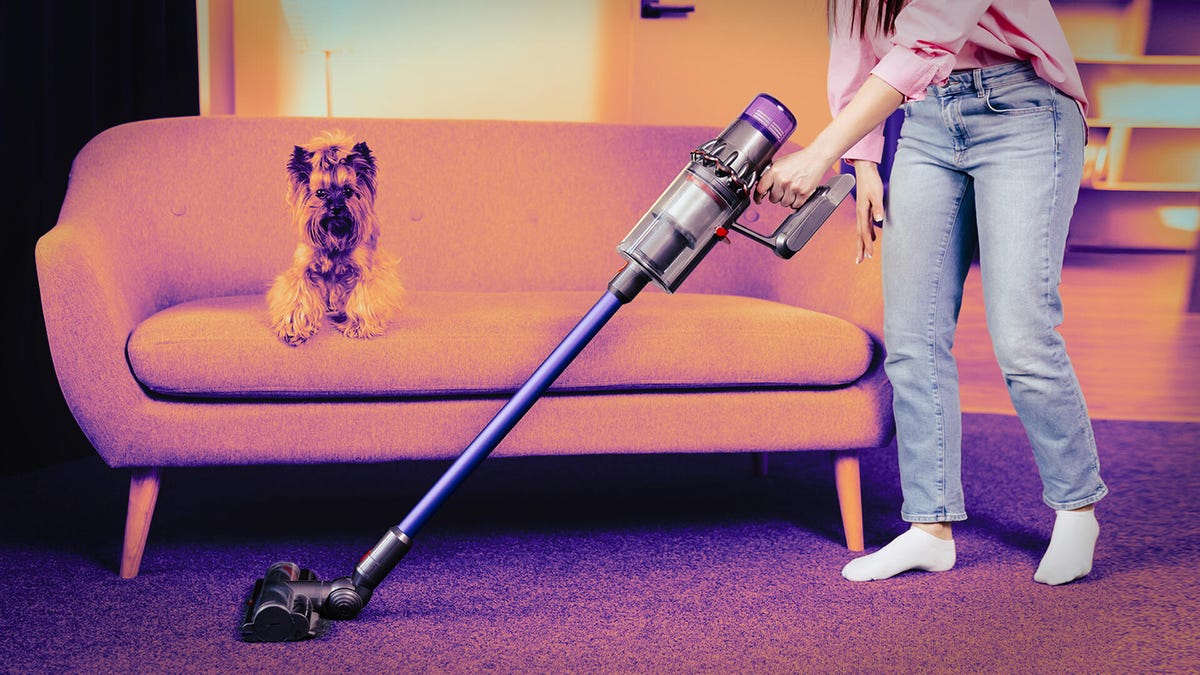
We test all sizes and shapes of vacuums here at CNET. From lightweight cordless alternatives to increasingly advanced robot vacuums, we’ve put hundreds of models across every category through their paces. Our cordless vacuum testing takes place at the CNET test lab in Louisville, Kentucky. Each cordless vacuum goes through a gamut of tests across different flooring types, along with evaluations of features, battery life and overall usability. Here’s how we do it.
How we test cordless vacuum cleaners at CNET
All the vacuums on CNET’s best lists are tested and evaluated in our state-of-the-art test labs. CNET Testing Labs go beyond product specifications to test in real-world conditions with real-life messes. Over the years, our experts have tested 50 cordless vacuums and counting.
Here’s a breakdown of how we measure cordless stick vacuum performance.
We test the vacuums on both hardwood and two diffrent types of carpet.
Cordless vacuum scoring methodology
The main test we use on all vacuums is a straight-line test across different flooring types (hardwood floors, low-pile carpet and midpile carpet). The test involves vacuuming at a standard suction level, along with calculations to ensure it’s fair for all the models that pass through our lab.
Our process is closely aligned with the standard established by the International Electrotechnical Commission. The goal of a straight-line test is to measure what percentage of dirt the vacuum is capable of picking up. We use play sand and pet hair as our primary test materials, along with our dust area adjuster to measure how much we disperse on the floor.
undefined
| Subrating category | Weight | What we look for | |||||
|---|---|---|---|---|---|---|---|
| Performance | 30% | Performance score extrapolated from the average sand score on hard flooring, low-pile carpets and midpile carpets. | |||||
| Value/price | 25% | Retail price rating considering all other features. Does this price seem fair for the value offered? | |||||
| Running time | 20% | How long does the battery last when cleaning at medium setting? (No ECO, turbo, MAX, etc.) | |||||
| Features | 15% | Overall comfort and handling of the product (e.g. weight, comfortable grip handle). | |||||
| UX (Comfort, ease of use) | 10% | UX – All aspects of comfort. Does it have a good grip/handle? Is it heavy to operate/lift? How easy is the setup? Does it come with smart home functionality? Smartphone app? Voice assist? |
Awarding the highest performers
The Eureka ReactiSense 440 costs just $180 but offers the best performance we’ve seen in a cordless vacuum.
After running all the tests below, we award the best cordless vacuums an Editors’ Choice or a lab award in the category where they excel. Most recently, the Eureka ReactiSense 440 earns our lab award for the best suction on carpet at 98.53% sand pickup from low-pile carpet and 92.16% from midpile carpet. It also earns an Editors’ Choice award for its unbeatable value as our best overall cordless vacuum. Similarly, the Dreame Z30 earns not one, but two separate lab awards; it excels in multiple categories across our lab testing. It takes both our lab award for the longest battery life at 110 minutes and the highest suction score on hardwood at 98.77%.
Inside CNET’s Testing Labs: How we test cordless vacuums and why the sand scores matter
Our team of experts and engineers uses play sand to mimic dirt and dust. Each vacuum is tested on a low-pile carpet, midpile carpet and a hard surface with play sand. This test reveals exactly how much physical debris a vacuum is able to pick up off the floor.
Sand pickup
Our rig to distribute soil across the test bed.
Using the dust area adjuster (what we use to disperse sand or pet hair onto the floor), we subtract one inch from the measured nozzle width to give the stick vacuum ample coverage and opportunity to pick up all debris on the carpet or hardwood. We use different nozzle widths and amounts of debris based on the floor sample size and square footage.
During testing, we set controls to ensure each vacuum undergoes the same test. For example, each vacuum is set to the same nozzle width, and we measure and lay down the exact same amount of debris each time.
We test on both low-pile and midpile carpet to see how well cordless vacuums are able to remove sand from them.
At minimum, we conduct three cleaning runs on each floor type. We rerun test cycles if there’s an obvious outlier among the three tests, such as one result that’s much higher or lower in pickup percentage. We also conduct separate cleaning tests with pet hair (acquired from a nearby groomer) on each surface type, photographing and visually evaluating how much pet hair, if any, remains after running the vacuum over it.
We weigh the dustbin before and after each run. From there, we can calculate the percentage of debris pickup for every cleaning run and the average amount of soil a vacuum manages to remove.
Pet hair
We measure a precise amount of pet hair to evaluate pickup performance, but use before-and-after visuals to assess results instead of weighing the dustbin.
Our pet hair test is the simplest. We use 2 grams of pet hair sourced from a local groomer, spread across each test bed, and take before-and-after photos for visual comparison.
For pet hair, we don’t weight the pet hair after the test; we use before and after pictures of the cleaning run to subjectively evaluate the effectiveness of the cordless vacuum at picking up pet hair.
Cordless vacuum battery life and running time
We test battery life by running the vacuum on standard suction until it’s drained.
To test battery life, we fully charge the vacuum battery, then run it on the medium setting until it drains, avoiding Max or Eco modes. We repeat the test three times and average the results. The longer the duration, the better the score. Most of the vacuums on our list have a battery life of 25 to 40 minutes before needing another charge, although many models are starting to offer higher-capacity batteries with running times of 60 minutes per charge.
Several of the vacuums we’ve tested can do even better, including the Shark Stratos (80 minutes) and Dreame Z30 (110 minutes). In truth, needing more than 40 minutes for a single vacuuming session is rare, and the prevalence of charging docks makes it easy to recharge between cleaning runs.
With its 110 minutes tested cleaning time, the Dreame Z30 is a great option for large homes.
Most cordless vacuums we recommend now feature replaceable batteries, so you can buy an extra if you need more runtime or are concerned about battery degradation over time.
Several of the graphs below show the relationships we discovered in our study between battery life and suction, battery life and price and battery life and weight. A recent lab data study revealed that most cordless vacuums with stronger suction power also have a shorter battery life. Even so, you don’t need to spend a lot to get a high-performing vacuum.
Cordless vacuum warranties
Using the Shark Stratos in the test lab on hardwood flooring gave us impressive scores for sand pickup.
Cordless vacuum warranties vary by manufacturer and model, but the majority of models we’ve tested offer at least a year of coverage, and many offer two years. The best warranty we’ve seen comes from SharkNinja, which offers a five-year limited warranty on its cordless vacuums. A longer warranty period is good because it means your vacuum is covered if a part breaks or something is defective.
Filters and air quality
Most cordless vacuums have a filter that prevents dust from being blown back into the room while you’re vacuuming. Most of the best cordless vacuums come with replaceable HEPA filters (commonly found in air purifiers) that can filter particles as small as 0.3 microns, while cheaper models may have a more basic cloth filter. One recent innovation we’re seeing from SharkNinja is the incorporation of an anti-allergy seal and anti-odor capsules that help keep your vacuum and dustbin from developing odors, though this requires odor-releasing pods that add extra cost.
User experience (ease of use and comfort)
The Aero base station charges the vacuum and self-empties it into a 3.5-liter dust bag.
While it’s not a primary factor, the ease and comfort of using a cordless vacuum and emptying its dustbin still play a role. We consider this part of the overall user experience. We like cordless vacuums that can stand upright on their own and models with charging docks or self-emptying features, since both reduce the amount of maintenance required. Strong bonus points go to a vacuum docking station that empties dust into a bag rather than a bagless dust canister because it means that dust is less likely to get all over your newly vacuumed floors when you empty it into the trash.
What about handheld vacuums?
I obtained the vacuums in this test through retail purchases and manufacturer samples.
Most, if not all, of the cordless vacuums on this list can be broken down into handheld units, making them suitable for cleaning your car or upholstery. However, we use a slightly different testing methodology for handheld vacuums, so we recommend checking our recently updated list of the best handheld vacuums to see our recommendations for use cases ranging from cleaning cars to pet hair. Plus, many handheld vacuums weigh as little as 1.2 pounds, putting them in a different weight category from these cordless vacuums.
Other features
The Shark Stratos has useful LED headlights to help it find dust.
As new cordless stick vacuum models emerge, we’re seeing the ability to detect dirt types and floor types and adjust suction power accordingly. “This means that when a large amount of dirt is detected, suction increases and when less dirt is present, suction decreases,” says CNET’s lab engineer Gianmarco Chumbe. Chumbe, who’s been testing home tech products at CNET labs for eight years, says the latest vacuum tech can sense floor type and adjust suction power accordingly. “The main benefit of this feature is increased battery efficiency, resulting in a more effective and longer-lasting cleaning experience.”
Consumers shopping for vacuums today, Chumbe says, should consider the cost-to-value ratio. “Ask yourself, does the price justify the performance, features and comfort it offers?” CNET writers and editors use price and value in our vacuum scoring precisely for this reason.
Cordless vacuum weight, size and bin capacity
The PencilVac rollers are designed to eject hair to avoid tangling.
Most of the cordless vacuums we tested weigh between 4 and 8 pounds. When a vacuum weighs 10 pounds or more, we consider it unwieldy. Most of the vacuums on this list were also very similar in height and overall size. They also come with accessories that can be attached and detached to give you flexible cleaning options. For instance, a common tool is a crevice-cleaning attachment that lets you fit the vacuum nozzle into tight spaces and corners where a larger brush head can’t reach.
For the dustbin size, we consider anything of 0.6 liters or bigger to be good. Generally, anything less than 0.5 liters will require you to empty it after every cleaning session. A large dustbin means you can go longer without emptying. However, if the cordless vacuum comes with a self-emptying charging dock, it can often store dust and debris for 30 days or more, minimizing the amount of dust you’re faced with when vacuuming.
Read the full article here