




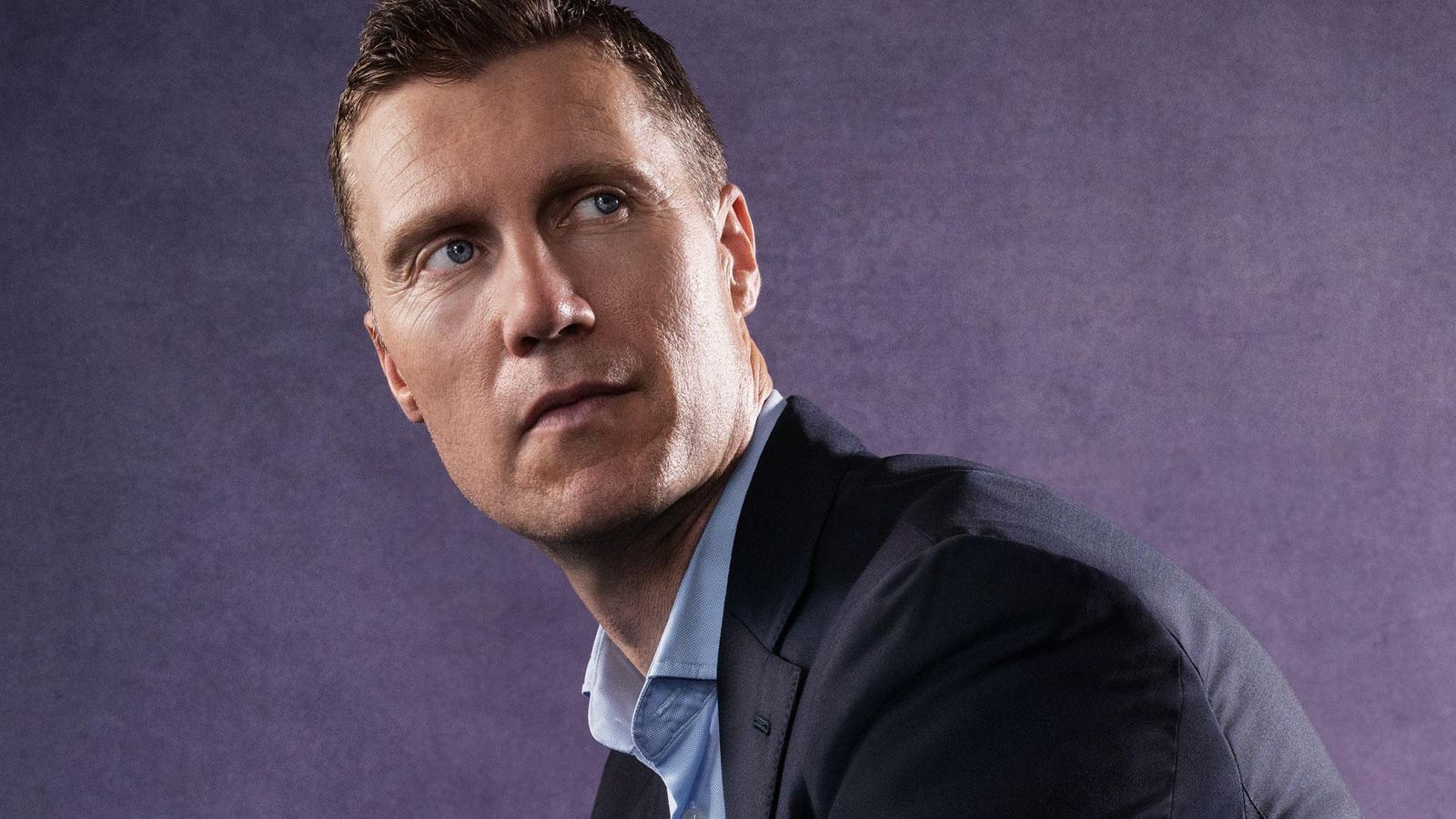
How did Graeme Forster, a mathematician from Wales, wind up in Hamilton, Bermuda, running a stock portfolio? His curriculum vitae is a bit unusual. So are the incentive fees collected by his employer, Orbis Investment Management, on the $7.5 billion he looks after. Unusual, especially, is his quirky collection of 65 stocks.
Forster is betting on antibody-based drugs with an unusual twist, on stockholder empowerment in Korea, on runaway inflation and, counterintuitively, on movie theaters. This looks nothing like an index fund. If it did, Orbis, compensated for beating indexes, would starve.
Forster landed a Ph.D. from Cambridge in 2007 by investigating the options embedded in farmers’ gut-instinct decisions about when and where to spend on pest control. No sooner was the ink dry on his thesis than he was working at Orbis, a global money manager that in hiring cares more about cleverness than Wall Street experience. At age 31 Forster was handed the reins of the international equity strategy.
Orbis was founded by the late billionaire Allan Gray, whose charitable foundation now pockets most of the profits. Gray chose, as the famous fund manager John Templeton did before him, an Atlantic island as the place in which to do his unconventional thinking. So it is that Forster, at 45, finds himself in an out-of-the-way place where there’s not much to do except think, tend to three kids and play golf.
Yes, there is a connection between those embedded options and the payoff on a stock. Forster’s target: a company with enough profits to justify its share price but also an implicit option on a potentially gigantic payoff if the marketplace moves in its direction. Putting this in mathematical terms, he says he wants a stock whose future price has a probability distribution with a positive skew. Most of the probable outcomes are clustered around a middling return, but there’s a fat tail on the right.
Forster has $240 million in Genmab. This Danish outfit has developed a technique for joining two antibodies, one primed to grab onto a cancer cell, the other equipped either to deliver a toxic payload or call for assistance from the patient’s immune system. Genmab is priced below the value of drugs now in use. The implicit call options are on future drugs, from either Genmab or a licensee, that use the antibody platform.
The Orbis portfolio includes shares in SK Hynix, a suddenly hot manufacturer of memory chips feeding artificial intelligence. Hynix was already cheap, and Forster got in even more cheaply via SK Square, a holding company trading at a deep discount to the value of its portfolio. The long-shot bet is that Korea’s insiders will eventually unwind the holding companies and cross-ownerships through which they control conglomerates like SK. If they do, they will deliver a bonanza to shareholders.
What if dollar inflation, recently 3.8%, zooms higher? Forster has a stake in Glencore, the miner and commodity trader, that will pay off if prices go crazy. Glencore pulls copper from the ground at a net cost that Forster estimates, after subtracting the value of the gold that comes out as a byproduct, at $2.50 a pound. Recent price of copper: $6.47.
Now picture a world in which the profligate U.S. government prints money to pay its bills. Gold, which has recently doubled in price, doubles again, lowering the effective cost of copper mining. Imagine that copper, in demand for electric cars and data centers, also doubles in price. Glencore would be minting money. Metal producers (including gold miners, also in the Orbis collection) are collections of call options. The strike price is the cost of extraction.
How To Play It
By William Baldwin
The U.S. has been running up trade deficits that are matched, as they arithmetically must be, by an inflow of foreign capital. That flood of money has propped up domestic stocks, which until recently have been outrunning overseas stocks. If trade deficits recede, Graeme Forster speculates, foreign savers will be putting more of their capital to work at home, allowing foreign stocks to catch up. Capitalize on this theory with an exchange-traded fund: either State Street SPDR Portfolio Developed World ex-US (expense ratio, 0.03%) or Vanguard Total International Stock (expense, 0.05%). The SPDR fund, with 2,438 holdings, omits emerging-market and small stocks found among Vanguard’s 8,794 holdings.
William Baldwin is Forbes’ Investment Strategies columnist.
Forster holds shares in Cinemark, the movie theater chain, and Imax, which licenses a giant screen movie format. In a world of streaming, these bets look foolhardy. Look again, he says. These companies are making decent money as ticket sales recover from the Covid bust. Meanwhile, streamers like Amazon and Netflix are discovering that a theatrical release boosts the streaming audience. Forster speculates that producers will compete to get into theaters’ schedules. If he’s wrong, he has a business with a middling return. If right, a winning lottery ticket.
Orbis itself, and its stock pickers, are gamblers. Instead of paying a small percentage of assets under management, a client can pay a large percentage of the amount by which an account beats an index. Since its inception in 2009, the international equity strategy has averaged a 14.6% annual return, six points ahead of its benchmark. The clients are keeping four percentage points of the excess return, Orbis two points.
Two percent sounds like a stiff fee, but it’s a much better deal than what you get from hedge fund operators, Forster says. Those guys get a percentage of gains but give nothing back when they lose. Orbis does give money back when it underperforms.
Investors are gamblers. Don’t they chase lottery tickets? Don’t they bid up long shots, leaving no bargains for Orbis?
They love growth stocks, Forster says, but miss the value in companies like Genmab. “Humans have evolved to believe in narratives,” he says. “Investors love stories. That’s why securities like Tesla get to crazy multiples. It’s the narrative; it’s not the numbers.”
Tesla trades at 208 times expected earnings. Forster is a skeptic. “Their business today is still electric vehicles. You’re paying a huge premium for the option on robotaxis and robots. With Genmab, you have underwritten the present with the existing portfolio of drugs. You’re paying nothing for the future.” In his world, successful investing comes down to this: Consider your options, carefully.
More from Forbes
Read the full article here