




The Hypershell X Ultra S exoskeleton is designed to optimize your performance, whether you’re hiking or biking.
I’m in Arizona, traversing a narrow path in the Grand Canyon, with outdoor exoskeleton maker Hypershell’s new $1,999 Hypershell X Ultra S strapped to my waist and legs. I’m waiting to become a superhero, or at the very least, gain the ability to join the Alien franchise and toss a giant xenomorph extraterrestrial out of an airlock, but I can barely haul my 50-year-old, 270-pound body up this 100-foot trail climb.
I look up at my counterpart, my 15-year-old daughter, and I’m filled with a whole lot of pride, and if I am being completely honest with myself, a bit of jealousy. This climb is no problem for her, but I’m the robot. I’m supposed to be the one flying through this. It’s just not fair. The climb continues.
Climbing is a part of hiking (or so I’m told), so we came down this trail, a sort of natural staircase if you will, just to see how well we could climb back up. As it turns out, she does so with the grace of an athlete. I, even with my robot legs, don’t fare as well. I don’t really want to pass out, but at this point, I can’t say I’d hate doing so.
It’s really not fair.
As it turns out, I’ve fallen victim to one of the most common misconceptions surrounding this product. Hypershell will not, in fact, turn you into a superhero. Angus Fan, Hypershell’s chief product officer, told me in an exclusive interview, “The tech will be ready eventually, but for now, we have more humble aspirations of endurance extension.” Fair enough.
Getting back to my daughter, she’s been a competitive athlete pretty much since she could walk. First in gymnastics and most recently in varsity soccer as a freshman in high school, she is on the exact opposite end of the human spectrum from me.
I also have spinal stenosis, a narrowing of the spinal canal that puts pressure on my nerves, and walk with a cane for anything longer than 5,000 steps. I was at the Grand Canyon, on the rim of the largest natural formation on Earth, to find out if an exoskeleton could help me keep up with her. We’ll get to that, but for now, here’s what Hypershell offers.
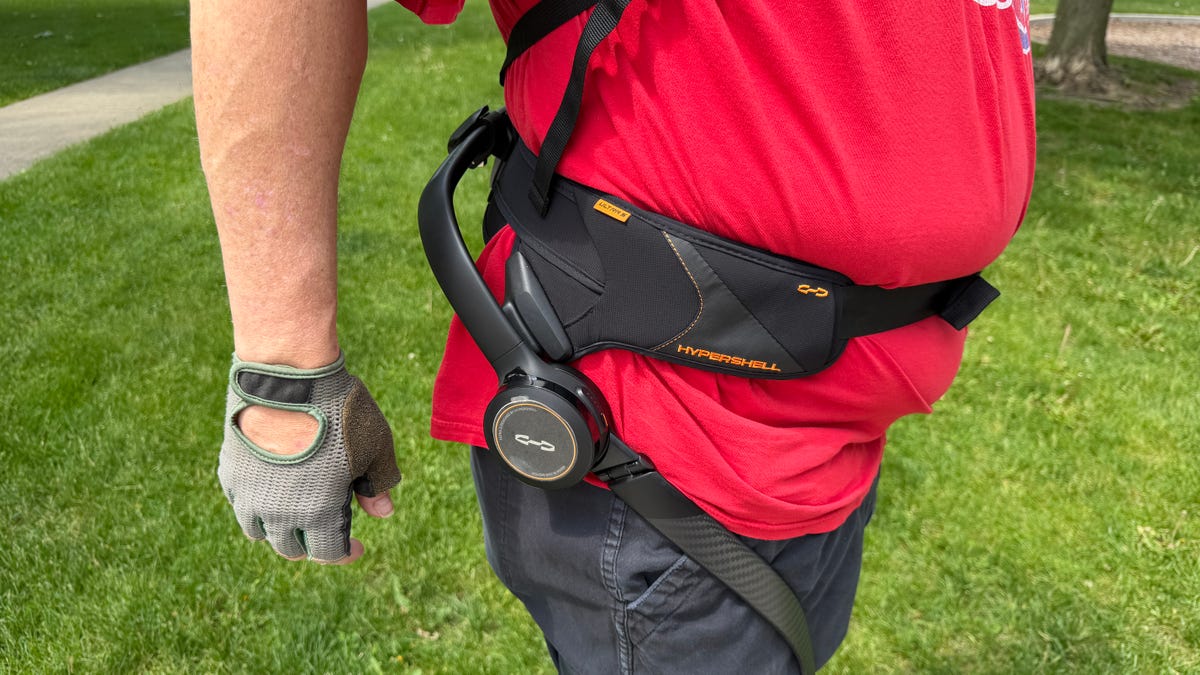
The exoskeleton’s battery sits in the small of your back.
The Hypershell hardware
Today, the Hypershell X Ultra S launches alongside the $1,499 X Max S and $999 X Pro S, which offer different levels of support, terrain capability and range.
For now, Hypershell’s technology straps around your waist. A battery sits in the small of your back and powers the two arms that buckle to your legs. The whole machine is fairly lightweight at just under five pounds, which is a necessary feature if it is ever to be widely adopted. It’s built of carbon fiber and titanium — premium, durable materials — for that very reason.
The battery on the back has two arms that extend out and around your hips, where the motors reside. The arms are adjustable, so you can get the right fit; I needed to extend them all the way out because I’m a big guy. I actually exceeded the recommended weight limit, since the measurement chart on the company’s website stops at 227 pounds for my 6-foot frame, and I’m 50 pounds over that. But it still fits.
At each hip is a motor attached to arms that extend down the front of your thighs, and those arms are held in place with straps around your thighs. Ideally, those thigh straps attach about two to three inches above your knees.
Making the climb with my exoskeleton strapped on.
One important note: Front pockets are a nonstarter while wearing this Hypershell device. They, and indeed the lower pockets on my cargo pants, are all blocked. That’s why I wore a vest with readily available pockets.
Speaking of nonstarters, don’t plan to sit down while wearing this exoskeleton. You can, but the large battery in the small of your back prevents you from leaning back. So, unless grandma was always proud of your perfect posture, sitting (and especially riding in a car) isn’t the most pleasant experience.
The whole unit is powered by a 5,000-mAh battery, which runs for around 30 kilometers (about 18.6 miles), and the exoskeleton comes with a spare battery. The idea is that its motors will help you pump your legs to allow you to go farther than you could on your own. You lift your leg, and it feels lighter. You push down, and the machine pushes down to assist you. It’s simple biomechanics.
Where the arm connects to the thigh strap.
App-powered power
The exoskeleton is app-controlled via Bluetooth, and a button on the right hip powers the machine on and off and helps you switch between modes. Hypershell offers Eco, Hyper, Transparent and Fitness modes. Eco and Hyper determine the level of assistance you get. Transparent sets the machine to idle, so you can pause assistance if you don’t need it.
Fitness mode does the opposite: It provides resistance when you’re training. Instead of assisting you, it will push down on your legs, create more friction as you walk, hike, run or ride, helping you gain strength. It’s a fun concept, and one I didn’t play with too extensively, since I definitely needed help, not hindrance.
The app also controls what activity it helps with. One new feature of the Hypershell X Ultra S is Hyperintuition. It uses an algorithm to detect what activity you’re doing and switches automatically as you walk, ride your bike or climb stairs, for example. Previously, you could choose which activity you would do, and the exoskeleton would help as needed. Hyperintuition eliminates that need, so it’s far more convenient.
In terms of how it helps you, Hypershell’s assistance feels very much like you’re a marionette on strings. Leg movements are definitely lighter and easier, and you mostly feel it when you’re lifting your legs.
I also tested the machine on a bicycle, and definitely felt the assistance pushing down on my legs while pedaling. It was much more obvious in this scenario than on the trail, especially as I was climbing up that hated hill.
I found the Hypershell X Ultra S’s functionality more obvious on a bike than on a trail.
The benefits of Hypershell
One would assume that this biohack would make your legs stronger, and it does, but not in terms of raw strength. “Our key goals are to increase endurance and reduce fatigue, helping users feel more confident taking on physical challenges,” says Fan. Instead of making it possible for you to lift a car or jump between buildings, Hypershell’s exoskeletons are designed to push you along and keep you moving, even if your legs start to protest.
In addition to the 100-foot climb, we took a two-mile hike along the rim of the Grand Canyon. In total, I ended up with about 12,000 steps for the day, and I intentionally left my cane behind in my hotel room. I wouldn’t consider a two-mile hike “strenuous” per se, but the climb was, and the 12,000 steps were certainly above my typical average. That’s about an average CES day for me, but the kicker is, at CES, I always use a cane.
I was able to hit 12,000 steps without the use of my cane while wearing the Hypershell exoskeleton.
The X Ultra S results
Quantifying results in a situation like this is not easy, but whenever possible, I always turn to the data. In this case, there wasn’t a ton to work with, so I landed on heart rate as a metric.
For the climb, my daughter and I checked our heart rates at the beginning, halfway through and at the end of it. I used the Pixel Watch 4 for monitoring, while she used the Apple Watch Series 9. My daughter started at 86 beats per minute, checked in at 94 bpm and ended at 130 bpm. Meanwhile, I started at 89 bpm, hit 107 bpm at the halfway point and ended at 136 bpm. That’s not a huge difference.
For the two-mile hike, she started at 98 bpm and actually dropped to 92 bpm by the end. I started at 106 bpm, since I hadn’t recovered from the climb yet (more on that in a bit) and ended at 118 bpm. At the end of the day, these are not terribly divergent numbers. They’re certainly closer than I expected. But that’s when I realized there was one key difference between my daughter and me.
My daughter and I making the climb while I wore my exoskeleton.
After the climb and the hike, I took 27 minutes and 15 minutes, respectively, to start to feel human again. My daughter was bright-eyed and bushy-tailed within two minutes both times. When it comes to recovery, it was a night-and-day difference, and I’m not sure the Hypershell helped all that much.
But there is one very important consideration. The day after I did all this hiking and walking, my back showed no ill effects. Spinal stenosis is a tricky thing. Some activities will destroy me while others don’t, but walking a ton will reliably make my back hurt. Yet after using the exoskeleton, I didn’t have any back pain the following day. I’m not saying this device will or should replace my cane, but it’s an interesting observation to say the least.
The main takeaways
So, no superhero status for me — but Hypershell isn’t designed for that. I also couldn’t keep up with my daughter, but honestly, nobody really expected me to. This is not a magic device that can cure 30 years of drinking too much soda and eating whatever I want, whenever I want. There’s also the elevation factor: The Grand Canyon sits at around 7,000 feet above sea level, while my hometown is closer to 700 feet.
When I asked Fan about my experience, he replied frankly but fairly, “An exoskeleton is not designed to completely replace a person’s inherent physical capability. Instead, it works in tandem with your baseline fitness level to optimize performance, helping to lower oxygen consumption and reduce heart rate under strain.”
As noted, I have no baseline fitness level. Maybe after a summer of hiking and biking, I can approach this experiment again in the fall to see how my experience develops after properly training my body to not be a couch potato.
Overall, my takeaway is that this can be a good device for people who regularly exercise. This is not a magic machine that’ll turn you into an ultramarathoner, just like drinking one Coke Zero will not melt the fat away. Fitness is a lifestyle choice, and Hypershell can help you along with that choice — for a fairly hefty price. (Right now, the most affordable Hypershell model is the $699 X Go.)
If you want to go hiking, it will help you hike farther. If you want to start cycling, it can help you cycle farther. But expect incremental improvements, not wholesale changes. It’s a tool, not a solution.
Editors’ note: The author’s travel costs related to the launch of the Hypershell X Ultra S were covered by Hypershell and Finn Partners. The judgments and opinions of CNET are our own.
Read the full article here