



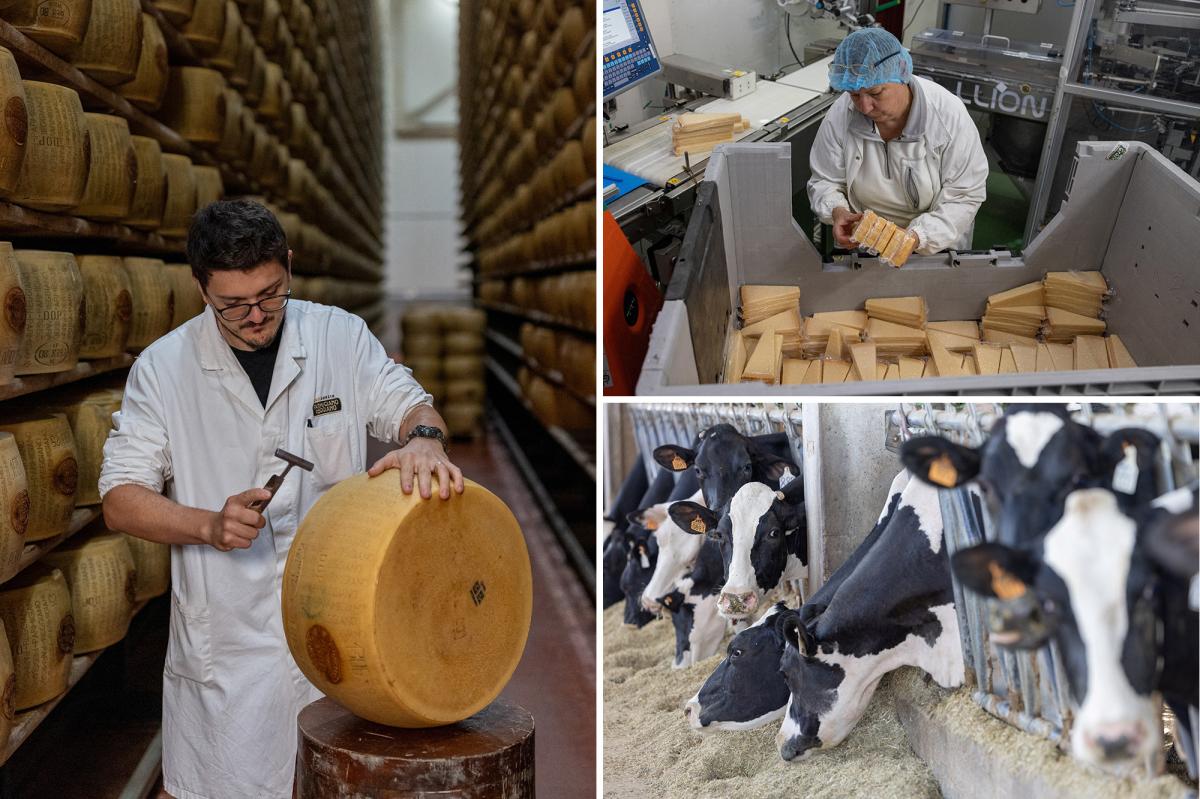
Italians have long been able to secure loans with wheels of Parmesan — but the vaults where banks store AUD $572 million (approx. $405 million USD) worth of cheese are under strain.
The system dates back to the 1950s and is tailored to the unique cashflow needs of Italian dairy farmers.
One Australian economist calls it an “amazing story” with few parallels elsewhere in the world.
It emerged because farmers who produce young wheels of Parmigiano Reggiano can have a hard time paying their operational expenses.
Under strict regulations, the cheese has to age for at least 12 months before it can be certified and sold.
Instead of applying for a traditional unsecured business loan, the farmers use their young cheese wheels to back the loan.
They either physically ship the cheese to the bank’s highly secure, climate-controlled warehouses, or use blockchain technology to pledge the wheels even as the cheese remains in their own facilities.
The physical cheese matures along with the financial loans.
“It is a form of the banks taking collateral in order to secure their loans, but goes much further than Australian banks do – at least to my knowledge – in that they actually have it physically and look after it,” AMP Chief Economist Shane Oliver told news.com.au.
“That said, I suppose Australian banks do take physical control of land titles as part of a mortgage – but that’s just a piece of paper.
“It sounds like it evolved that way because of a specific issue that made it possible; storing wheels of cheese is easier than storing a cow.
“I doubt Australian banks are going to go down the path though!”
In their high-tech cheese vaults, the banks take over the aging process; and because they store cheese on such a massive scale, it works out cheaper than if the farmers did at themselves.
Machines or human workers regularly brush and turn the wheels in climate-controlled vaults.
That arduous process might seem like overkill to outsiders, but the cheese is extremely valuable.
An authentic wheel of aged Parmigiano-Reggiano is worth roughly 700 euros ($809 USD), and bank vaults hold about half a million wheels as collateral, putting their total value at almost $405 million USD.
In total, Italy’s parmesan industry is worth AUD $6.5 billion ($4.6 billion USD), sustained by 300 certified dairies.
The vault system has been in place for decades but it’s under threat this year as record heat waves in Europe increase the cost of keeping the cheese at both the right temperature (64 degrees Fahrenheit) and humidity to prevent spoilage.
This week, Italy is sweltering under its fourth heat wave of 2026, with dozens of cities under red alert.
The cheese warehouse for one local bank, Credito Emiliano, recently saw daily energy costs spike by 30 percent and was forced to upgrade its cooling systems.
The extreme summer heat in Europe is also impacting the earlier stages of Parmesan’s production cycle.
It causes cows to expend more energy keeping cool, harming both the quantity and quality of the milk they produce.
Read the full article here