




A COLD War warship once commanded by King Charles III is rotting away and slowly sinking into the seabed – but a group of ex-sailors are battling to save her.
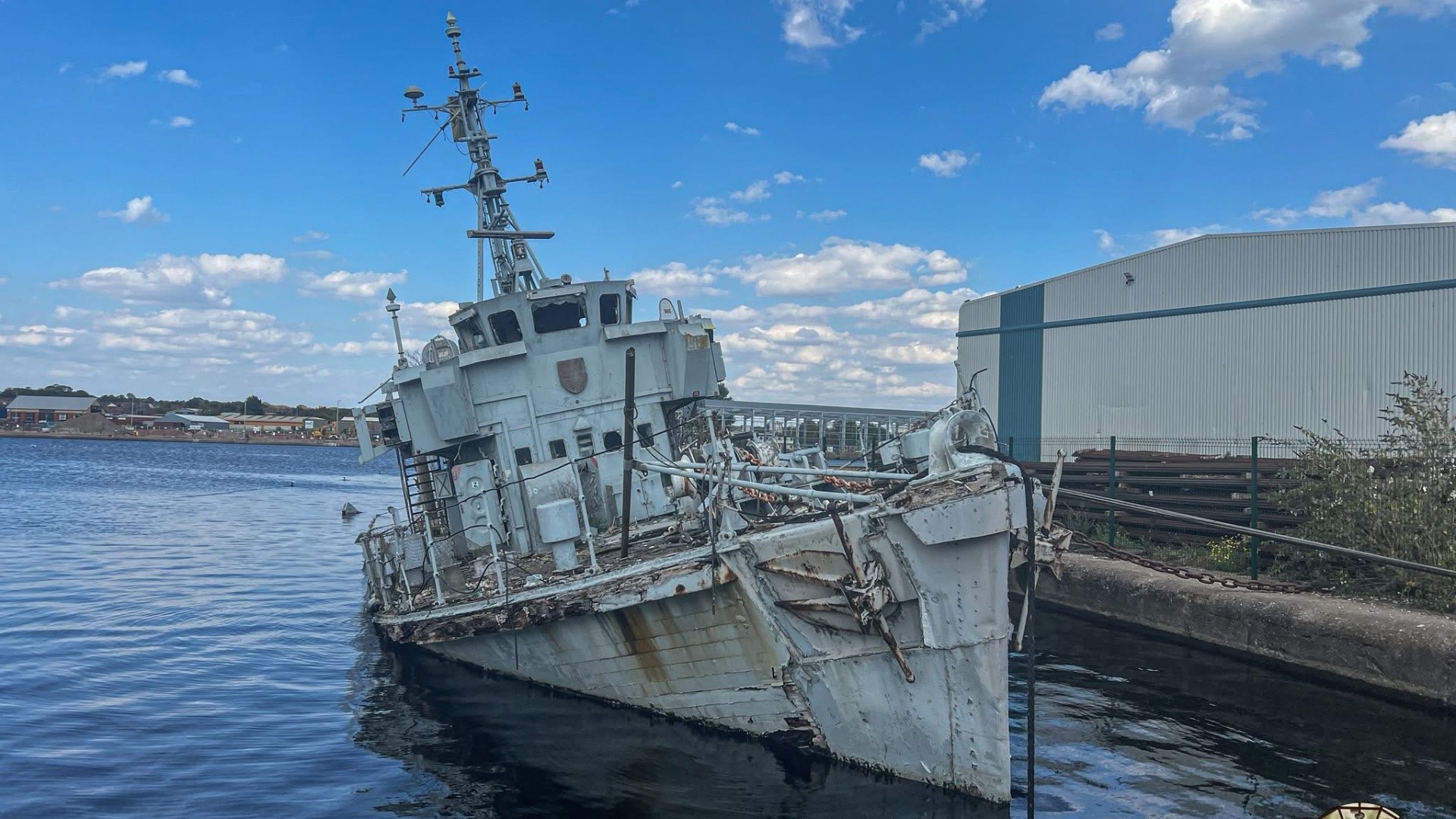
The historic minesweeper HMS Bronington has been abandoned for nearly two decades and now sits decaying in a dock on the Wirral.
Once a cutting-edge Royal Navy vessel packed with secret Cold War technology, the ship is now partially submerged – her smashed windows, peeling paint and rotting decks a far cry from her glory days.
Staggering pictures show the front of the boat under roughly three metres of water as the bow rests on the seabed.
Green algae is growing up the walls and debris lies strewn across the floors.
King Charles III commanded the vessel in 1976 and told The Sunday Telegraph that he had “many fond memories” of his time on board and was “delighted” by the efforts to save it.
MEDI VAC PLANS
Navy prepares floating hospital to evacuate Brits as Iran war spirals
MASTER & COMMANDER
Russell Crowe awarded military rank as Royal Navy chief challenges actor
The HMS Bronington Preservation Trust, formed in 2021, is trying to raise funds via GoFundMe to repair and preserve the vessel.
Trustee Mike McBride, 71, hopes to restore the ship to her former glory and reopen her as a floating museum.
He said: “She’s a brilliant piece of kit and well worth saving for our maritime heritage.”
But Mike has his work cut out for him.
Last summer an urban explorer – goes by the name of Silent Structures – managed to climb aboard the ship and was stunned by the state she was in.
He said: “As an urban explorer for eight years, it was extremely sad to see part of our wartime heritage rotting away – especially a vessel with as much history as HMS Bronington.”
The 152ft-long ship is currently moored near Vittoria Dock in Birkenhead where she has been left to decay for 20 years after the Warship Preservation Trust that was looking after her collapsed in 2006.
Bronington was first launched from Hull in 1954 and spent 34 years hunting down deadly sea mines lurking beneath the waves.
Using sonar, the crew could spend up to 5 days at sea scanning huge stretches of ocean searching for hidden explosives – including acoustic mines triggered by sound, magnetic mines that reacted to metal ships and tethered mines anchored to the seabed.
Mike served in the Royal Navy from 1971 to 1997 and worked on Bronington’s sister ship HMS Iveston.
He said: “Often we worked alongside HMS Bronington doing minesweeping and mine-hunting exercises around the globe, clearing Second World War ordnance from the seabed.
“She saw the development of mine-hunting sonar, which was top secret at the time.
“She led the world with state-of-the-art sonar and stealth technology thanks to her anti-magnetic degaussing and quiet engines.”
Mike believes restoring the ship could help inspire STEM students and future naval engineers.
But pictures shared by the urban explorer show the once state of the art equipment is now broken and rusting due to holes in the ceiling allowing rain water in.
The wooden decks are also badly sun-damaged, with many planks missing.
The explorer said: “It was surreal walking around it, but difficult because more than 50 per cent of the ship is now underwater.”
After his visit he shared the pictures of the wrecked vessel on social media, revealing just how badly the once-proud warship had deteriorated.
But Mike and the determined group of retired naval officers and volunteers have launched a rescue mission to stop the historic vessel from being scrapped forever.
Mike said: “At the moment we’re trying to bring her back to Portsmouth – her spiritual home where she was based in the 1970s and 1980s.
“But first we need to lift her off the seabed and get her onto a slipway.
“Then we’d have to decontaminate the vessel because there is asbestos and various oils still on board.”
If that proves impossible, they plan to salvage key historic components such as her sonar equipment.
However, if the funds cannot be raised, the historic ship could be scrapped, which Mike warns would be a devastating end for such a unique piece of Britain’s naval history.
The History of HMS Bronington
THE WARSHIP was first launched in 1954 and originally served with the Royal Navy’s 101st Minesweeping Squadron in Hull.
At the time she was known as HMS Humber.
Using sonar, crews would locate a sea mine and divers would swim down, attach explosives and detonate it remotely to destroy the threat.
Bronington was fitted with advanced stealth technology to avoid triggering the mines herself.
Thanks to her wooden hull and aluminium frame, the ship was almost completely non-magnetic – making her invisible to magnetic mines.
The structure was also strong enough to withstand the shockwave from nearby explosions.
She could reach speeds of up to 15 knots, but also creep silently at just five knots so her engines produced minimal noise – helping the ship evade acoustic mines.
The cutting-edge technology helped the vessel win the prestigious Thornycroft Trophy for minesweeping excellence.
She was later refitted and recommissioned in 1965 as part of the 5th Minesweeping Squadron at HMS Vernon in Portsmouth.
For the next eight years, the ship searched for mines around the coasts of Britain, north-west Europe and Scandinavia during the height of the Cold War.
After a major refit in Gibraltar, Bronington returned to UK waters as part of the 1st Mine Counter Measures Squadron.
In 1976 she was commanded by King Charles III, then the Prince of Wales, who served on board as a Royal Navy lieutenant for around ten months.
The posting marked the future King’s final active naval command.
During that time the ship was visited by Queen Elizabeth The Queen Mother, Andrew Mountbatten-Windsor and Queen Elizabeth II.
After further mine-hunting missions around the Mediterranean, Bronington eventually returned to Britain and was retired from service in 1988.
Read the full article here