




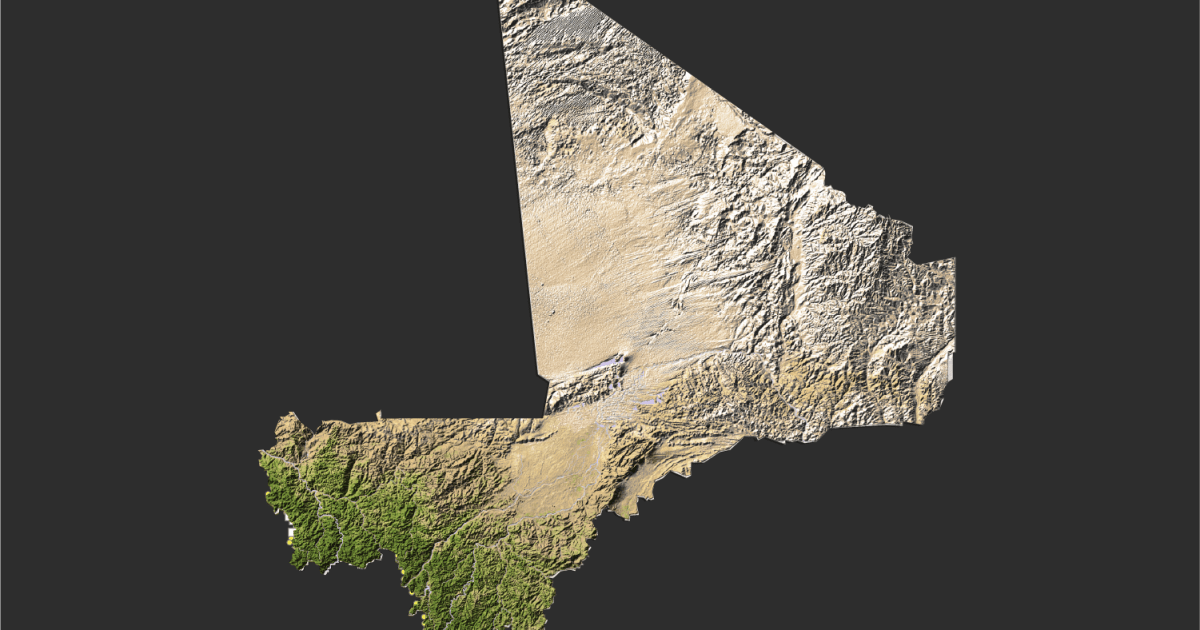
The West African country holds Africa’s third-largest gold reserves, plus vast lithium and uranium deposits.
Mali has been gripped by a succession of coups, political instability and a security crisis since at least 2012.
In the most recent upheaval on April 25, an al-Qaeda-linked armed group joined forces with Tuareg separatists to launch simultaneous attacks on targets across the country, killing Defence Minister Sadio Camara and prompting armed groups to declare a siege on the capital, Bamako.
Recommended Stories
list of 4 itemsend of list
Amidst this struggle for security and control, Mali’s 24 million people are sitting atop a vast, untapped gold resource, estimated at about 800 tonnes of proven reserves, the third largest in Africa after South Africa (5,000 tonnes) and Ghana (1,000 tonnes).
Mali’s government has claimed geological gold potential could be as much as 2,000 tonnes.
More than two million people depend on the mining sector for income, with most gold mines concentrated in the southern regions of Sikasso and Koulikoro and the western region of Kayes, along the Birimian volcanic belt.
According to World Gold Council estimates, Mali produced about 100 tonnes of gold in 2024, including artisanal output, making it Africa’s second biggest producer after Ghana (140.6 tonnes) and just ahead of South Africa (98.9 tonnes).
This figure far exceeds Mali’s official annual output of roughly 57 tonnes, with the gap largely explained by widespread smuggling and undercounted artisanal production.
Gold is by far Mali’s largest export, accounting for nearly 80 percent of total exports and generating about $4.3bn in 2024, according to the United States Department of Commerce and the International Monetary Fund.
According to the Observatory of Economic Complexity, after gold, Mali’s biggest exports include raw cotton, refined petroleum, oily seeds and iron ore.
Mining dominated by foreign multinationals
Mali’s mining sector has historically been dominated by foreign mining companies, particularly Canadian and Australian firms, with Chinese involvement on the rise.
In 2023, Mali’s military transition government – which came to power in a coup in August 2020 – introduced a new mining code allowing the state to take up to a 35 percent stake in mining operations. Together with stricter tax enforcement, the new law was aimed at increasing national revenue from foreign operators.
Canadian mining company Barrick Gold is one of the biggest operators in Mali, producing gold at its Loulo-Gounkoto complex in the west of the country since 2005. Other major mines include Fekola, Syama and Sadiola Hill.
The Goulamina project is Mali’s largest lithium deposit. It is majority-owned by China’s Ganfeng Lithium, with a significant stake held by Australia’s Leo Lithium, while the Malian state holds a smaller minority share. The project contains tens of millions of tonnes of lithium-bearing ore.
What other natural resources does Mali have?
Besides its vast gold reserves, Mali also has significant deposits of lithium, uranium, phosphates, iron ore, manganese and diamonds.
The Goulamina project in southern Mali is estimated to contain more than 200 million tonnes of lithium-bearing resources, making it one of Africa’s largest lithium deposits.
Uranium exploration has focused on the Kidal and Falea regions, while diamond deposits have been identified along parts of the Niger River basin.
Much of Mali’s mineral wealth remains underexplored and untapped, particularly in the north of the country, where instability has slowed development.
According to the National Directorate for Geology and Mines, as of 2022, it was estimated that Mali had:
- 2,000 tonnes of gold deposits
- 40 million tonnes of limestone
- 10 billion tonnes of shale
- 2 billion tonnes of iron ore
- 11 thousand tonnes of uranium
- 10 million tonnes of manganese
- 5.8 billion tonnes of lithium
- 1.2 billion tonnes of bauxite
- 2.4 million carats of diamond
- 53 million tonnes of rock salt
- 60 million tonnes of marble.
The map below shows some of the country’s largest mines.
Read the full article here