



A basketball fan has roughly a 1 in 120.2 billion chance of filling out a perfect NCAA tournament bracket.
Those are about the same odds the NCAA men’s basketball selection committee has to unveil a new bracket without any nitpicking.
This year’s committee did an unusually good job overall, nailing which teams belonged on the No. 1 seed line and including the 68 most deserving teams in the field. The loudest complaints mostly target questionable seeding decisions or imbalanced regions.
[Enter Yahoo Bracket Mayhem for shot at 50K | Printable bracket]
Here’s a closer look at what the committee got right and wrong:
What the committee got right: Valuing the Sunday conference tournament games
For years, the selection committee has faced criticism for ignoring the seeding ramifications of Sunday conference tournament games. Tournament champions from the SEC and Big Ten in particular have long complained that the committee doesn’t account for those games and their victories haven’t resulted in the expected seeding bump.
That certainly seemed to be a complaint that this year’s committee was determined to address. Committee chairman Keith Gill said that he and his colleagues elevated Purdue from the No. 11 overall team on its seed list to No. 8 after the Boilermakers upset Michigan in Sunday’s Big Ten title game. That allowed Purdue to deservingly leapfrog Michigan State for the final No. 2 seed.
That wasn’t the only tweak the committee made to the bracket after the Big Ten title game went final. It also flip-flopped Michigan and Arizona on the overall seed list, elevating the Wildcats to the No. 2 overall 1 seed and dropping the Wolverines to the No. 3.
Further down the bracket, the committee also clearly accounted for Penn’s surprise victory over Yale in the Ivy League title game. Rather than just slot the Quakers into Yale’s projected No. 12 or 13 seed, the committee properly moved other teams up and slotted Penn as a No. 14.
This is an encouraging development and a long overdue one. These Sunday conference tournament games can’t just exist so the major TV networks have a way of leading into their selection shows. They also have to matter.
What the committee got wrong: The No. 1 overall seed getting the toughest region
So much for the narrative that Duke always gets a favorable draw.
This year’s committee rightfully awarded the Blue Devils with the No. 1 overall seed and then foisted upon them the most challenging path to the Final Four of any team on the top seed line.
It starts with the quality of the East Region’s other top teams. UConn was the strongest No. 2 seed that the Blue Devils could have drawn since the committee’s bracketing principles prevent them from placing the overall No. 1 seed and the highest-rated No. 2 (Houston) in the same region. Michigan State was the committee’s highest-rated No. 3 seed. Kansas is an inconsistent but dangerous No. 4 seed. And reigning Big East regular season and tournament champion St. John’s is underseeded as the East’s No 5.
Heck, even Duke’s potential second-round matchup against eighth-seeded Ohio State is far from a cakewalk. The Buckeyes are a borderline Top 25 team in the major predictive metrics and are peaking entering the NCAA tournament.
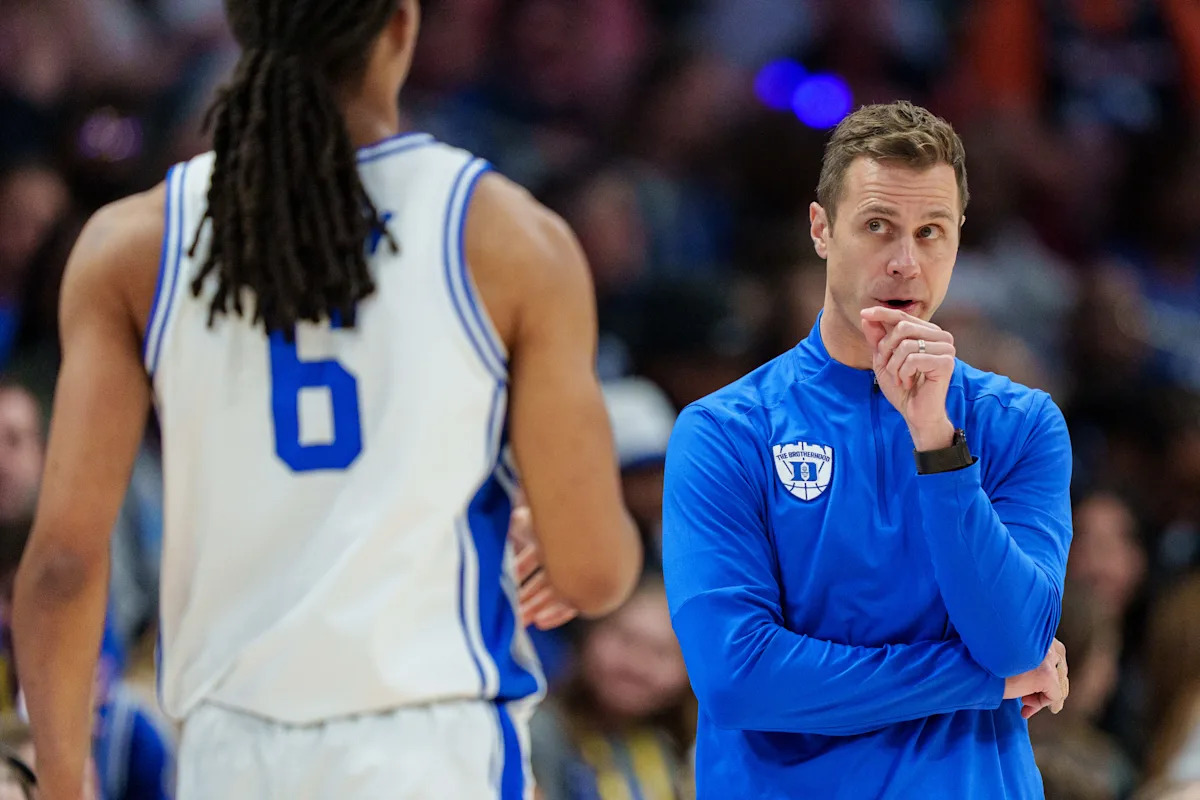
As if the quality of the teams isn’t proof alone that the East is the toughest region, consider the pedigree of the coaches. Jon Scheyer will match wits against former national champions Dan Hurley, Tom Izzo, Rick Pitino and Bill Self.
That is a gauntlet.
If you caught him in an honest moment off-camera, how much do you want to bet that Scheyer would trade paths with Michigan or Arizona right now?
What the committee got right: The 68 most deserving teams made the field
Sorry, Bruce Pearl.
No matter how incessantly you stump for your son’s Auburn team, the committee was correct to leave the Tigers out.
Never before has an at-large bid been awarded to a team with 16 or more total losses or to a team that is just a single game over .500. Auburn didn’t accomplish enough to persuade this year’s committee to break with either precedent.
The case for Auburn was that the Tigers have played the nation’s second-toughest schedule and showed the ability to defeat elite teams. They boasted marquee wins over Florida, St. John’s, Arkansas and Kentucky, as well as victories over fellow bubble teams NC State and Texas.
The problem is that Auburn simply didn’t win enough games. The Tigers went 4-13 in Quadrant 1 games and 11-16 against the top three Quadrants. Yes, they played a lot of good teams, but they lost to most of them.
NC State, Texas, SMU and Miami (Ohio) were the committee’s lowest-ranked at-large teams in the field and will battle it out in the First Four to advance to the main draw. Oklahoma, Auburn, San Diego State and Indiana were the first four teams left out.
It’s hard to argue with any of that. Even NC State’s surprise demotion to the First Four was the proper call. Eleven Quadrant 1 and 2 wins was impressive, but the North Carolina win came without Caleb Wilson and Henri Veesaar, the Clemson and SMU wins depreciated in value and none of the others came against top-40 teams in the NET.
What the committee got wrong: Vanderbilt as a No. 5 seed
Vanderbilt has more reason to complain about its seeding than any other team in the NCAA tournament field.
How did the Commodores get stuck with a No. 5 seed when their resume appeared strong enough to give them an outside chance at the last No. 3?
Start with Vanderbilt’s team-sheet metrics. The Commodores ranked between 7th and ninth in the results-based metrics and between 10th and 14th in the predictive ones. In other words, not a single metric deemed Vanderbilt worse than a No. 4 seed and some had Mark Byington’s team higher than that.
Vanderbilt’s 17-8 record against the top two quadrants is also impressive. In non-league play, Vanderbilt announced itself as a team to watch by going undefeated and by taking down NCAA tournament-bound Saint Mary’s, UCF, VCU and SMU. The Commodores then finished tied for fourth in the SEC in the regular season and advanced to Sunday’s conference tournament title game, ousting Tennessee and Florida before falling to Arkansas.
Compare Vanderbilt’s resume to No. 4 seeds Alabama or Nebraska. Heck, the Commodores even have a case to bypass Virginia for the final No. 3 seed.
The only silver lining for Vanderbilt is that drawing 12th-seeded McNeese is manageable, as is a potential second-round matchup with fourth-seeded Nebraska The selection committee owed the Commodores that much.
Read the full article here