




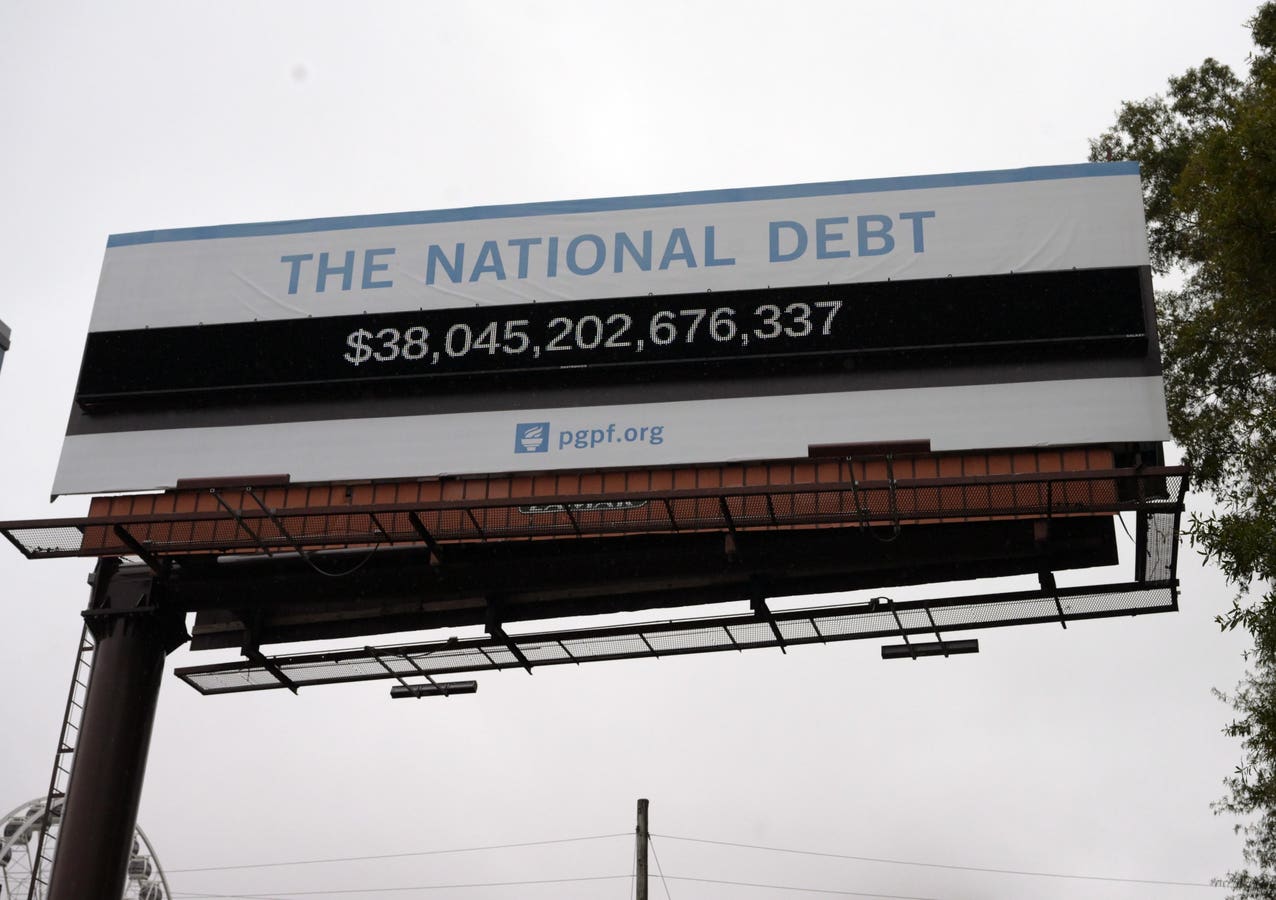
The national debt as of Jan. 26, 2025 was $38.5 trillion dollars, according to the U.S. Department of the Treasury. It’s hard to say exactly. By Jan. 27, 2025, who knows? It’s changing at a faster and faster rate, and all of the concern about the current level — it topped $37 trillion in Aug. 2025 — will soon enough seem like nothing.
By 2030, the national debt, at a 10-year annual growth average of $2,01 trillion, will be $48.9 trillion. Substitute the growth rate over the last five years, $2,5 trillion, and you can mark up the debt by another $2 trillion to $50.9 trillion.
To see some of the change, the graph below uses data from the Treasury, via the Federal Reserve Bank of St. Louis.
The numbers in the graph are in billions; you have to add six zeros to the end of each for the actual value.
The size of the debt is difficult to comprehend and also unnerving, even to many who are used to very large numbers. JPMorgan Chase Chief Executive Officer Jamie Dimon, in a discussion with massive global investment firm Carlyle cofounder David Rubenstein at the Chamber of Commerce, made his concern plain, calling the current $38.5 trillion “not sustainable.”
He called geopolitics and the national debt “tectonic plates,” which move like continents. “They may crash,” Dimon said. “We don’t know, and we don’t know when.”
The debt side is moving quickly, maybe faster than most people realize, with ultimate implications for citizens.
On Dec. 5, 2025, the Republicans of the congressional Joint Economic Committee wrote, “The increase in gross national debt over the past year amounts to $6,566.84 per person or $16,574.81 per household while total gross national debt amounts to $112,881 per person or $284,914 per household.”
The non-partisan nonprofit Committee for a Responsible Federal Budget last week released a report titled, What Would a Fiscal Crisis Look Like? They defined a fiscal crisis as “a sharp economic shock or downturn caused or sparked by high levels of current or expected public borrowing.”
As they wrote, “The U.S. national debt is approaching record levels as a share of Gross Domestic Product (GDP) and currently stands at 100% of GDP, while interest costs are surging to new records and budget deficits remain elevated at around 6% of GDP.”
The yield on the 10-year Treasury Note is a sign to watch. The higher the yield, the lower the price on the Notes because investors are worried about a variety of things, such as the amount of the debt, how well the U.S. is operating fiscally, and the potential for higher inflation. Below is a graph from the Federal Reserve Bank of St. Louis, based on data from the Board of Governors of the Federal Reserve System.
The yield had been generally falling since the early 1980s, which was a time of high inflation and concern about the U.S. economy. As is clear, with ups and down, the rate kept falling until the pandemic. Rates began to rise as the debt kept growing and there was more conflict within the government.
Next time we’ll dig into the Committee for a Responsible Federal Budget report to understand what could go wrong and how likely that might be.
Read the full article here