




OBSERVATIONS FROM THE FINTECH SNARK TANK
New York filed a pair of lawsuits Tuesday targeting Coinbase and Gemini, arguing the crypto companies violated state gambling laws by offering prediction markets, covering sports, entertainment, and politics. New York is seeking at least $2.2 billion from Coinbase and at least $1.2 billion from Gemini.
You don’t need a prediction market to see where this is going: New York Attorney General Letitia James isn’t going to stop with Coinbase and Gemini.
Prediction Markets: A $44 Billion Business
Prediction markets recorded over $44 billion in total trading volume in 2025—up 4x from 2025—and is on pace to exceed $325 billion in 2026. One analyst firm projects volumes could top $1.1 trillion by 2030.
The rapid rise traces back to October 2024, when a federal court ruled that Kalshi could legally offer election contracts. From there, the institutional money arrived: ICE—the parent company of the New York Stock Exchange—invested $2 billion in Polymarket at an $8–9 billion valuation, and Kalshi raised over $300 million at a $5 billion valuation, backed by Sequoia, a16z, and Paradigm.
Robinhood estimates event markets already generate $300 million in annual revenue, its fastest-growing business line. Super Bowl-related volumes on Robinhood’s prediction markets alone exceeded $1 billion. A single geopolitical contract on Polymarket—”Will the US strike Iran by Feb 28, 2026?”—attracted $73 million in volume, the largest geopolitical contract in the platform’s history.
The Prediction Markets Regulatory Turf War
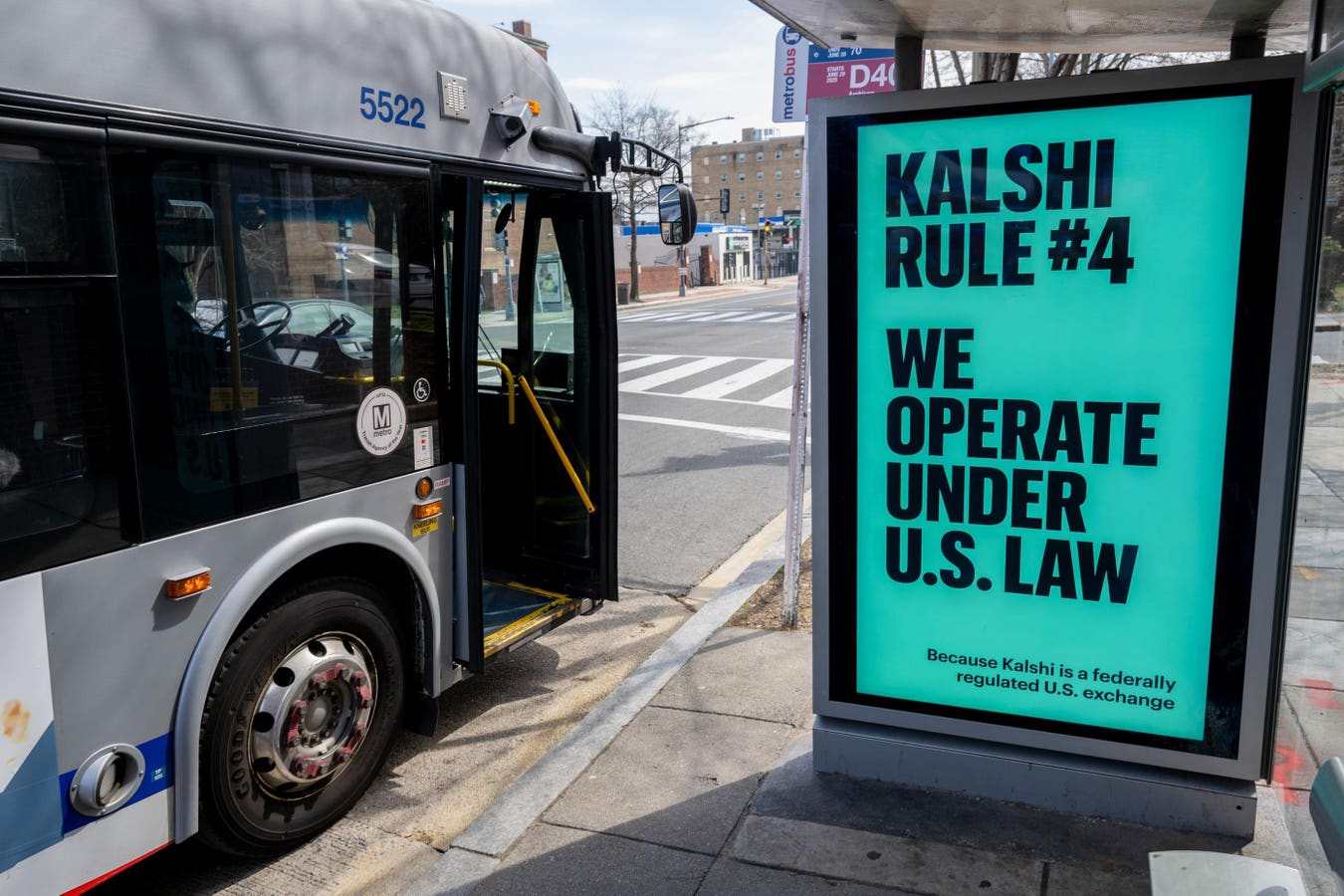
New York’s suit isn’t about whether prediction markets are useful or a genuine price-discovery mechanism for geopolitical events. It’s a jurisdictional brawl between state and federal regulators, and Coinbase and Gemini are the latest platforms to get caught in the middle.
On April 2, the CFTC sued Arizona, Connecticut, and Illinois to stop them from regulating prediction markets, citing its “exclusive regulatory authority” over commodity derivative markets.
Four days later, the federal appeals court in Philadelphia sided with Kalshi, finding the CFTC—not New Jersey gaming regulators—had exclusive oversight of its sports-related event contracts.
Despite the ruling, New York and other states have stepped into the fray. Nevada issued a temporary ban on Kalshi in March 2026, Arizona accused the platform of offering unlicensed gambling, and additional legal pressure has come from Tennessee, Illinois, Connecticut, and Massachusetts.
Prediction Markets: “Gambling by Another Name”
AG James’s core argument is simple: because event outcomes are outside bettors’ control or amount to games of chance, prediction market contracts fit New York’s legal definition of gambling—and Coinbase and Gemini failed to obtain New York State Gaming Commission licenses to operate.
Coinbase’s response was predictable. Chief Legal Officer Paul Grewal said the company “will continue to fight for the federal oversight of [prediction] markets that Congress intended.”
Technically, both sides are technically correct. That’s what makes this an actual legal dispute rather than a PR spat—and why it’s likely headed to the Supreme Court, whether the industry wants to admit it or not.
The Part the Prediction Market Industry Keeps Burying
Lost in the jurisdictional debate is a detail that prediction market advocates would prefer not to talk about: both Coinbase and Gemini allow users aged 18 to 20 to access their platforms, despite New York law setting 21 as the minimum age for mobile sports betting.
The AG’s office argues this exposes younger users to financial risk and potential harm—and cites research from the American Psychological Association that a significant share of individuals with gambling disorders report suicidal ideation.
Prediction market advocates often argue the value of the platforms is “price discovery for geopolitical risk.”
Just one problem there: Sports accounted for 85% of Kalshi’s notional volume in 2025. Polymarket’s volume was more evenly distributed, but sports, politics, and crypto together drove more than 90% of its activity.
The “price discovery for geopolitical risk” use case accounts for a small fraction of actual volume. The vast majority of the market is people betting on whether the Chiefs cover the spread.
That doesn’t make it illegal. But it does make the “sophisticated financial instrument” framing a lot harder to sustain in court.
Coinbase Asked For Prediction Market Trouble
Coinbase launched prediction markets in all 50 states—clearing through Kalshi. Robinhood did the same, contributing over half of Kalshi’s trading volume in 2025.
But then both Coinbase and Robinhood made a similar move simultaneously: Robinhood formed a joint venture with Susquehanna to acquire MIAXdx, and Coinbase acquired The Clearing Company, both to build their own CFTC-qualified exchange infrastructure.
In other words: Coinbase used Kalshi’s rails to learn the market, then started building its own exchange. Now it’s getting sued by New York, precisely because it went direct-to-consumer rather than riding a licensed intermediary. Coinbase’s ambition to own the full stack is partly what made it a target.
The Prediction Markets Forecast
Fintech newsletter writer Alex Johnson argues that clarifying what prediction markets are for can help us determine where they belong:
“If they’re tools for hedging risk, they belong in financial infrastructure. If they’re gambling, they should exist as standalone applications with clear boundaries and built-in protections. If they’re mechanisms for discovering truth, they should be integrated into information systems: news platforms, research tools, and real-world decision-making environments.”
News platforms as “mechanisms for discovering truth” seems a bit of a stretch, but Johnson’s overall point is well-taken.
Prediction markets are mainstream infrastructure now, not a crypto side project—Google Finance has already begun embedding live Polymarket and Kalshi odds.
The jurisdictional question will land in federal appellate courts, with the Supreme Court as the logical endpoint. Congress will eventually be forced to weigh in, though “eventually” in legislative time could mean 2029.
Until then, every prediction market platform operating in New York is playing regulatory hot potato, and the damages being sought—$2.2 billion from Coinbase and $1.2 billion from Gemini—are large enough that even a partial settlement would sting.
Here’s what I’d like to see on a prediction market: a contract on how many more state AGs will file suit before Congress clarifies the federal framework. Given the current trajectory, the over is a very safe bet.
Read the full article here