




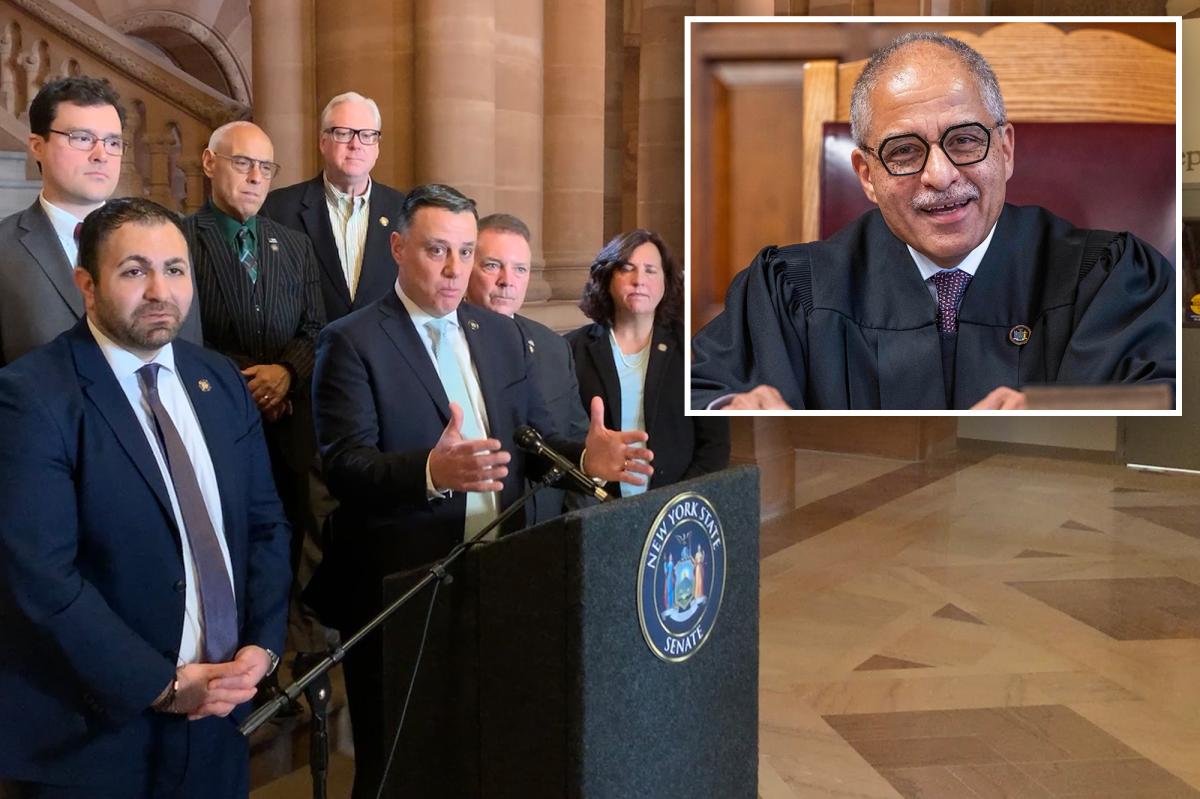
ALBANY – New York’s top judge has sparked outrage after suggesting that local jurists should consider going easy when sentencing criminals — and that voters should oust those who don’t.
State Republicans filed a complaint on Wednesday claiming Chief Judge Rowan Wilson ran afoul of ethics rules with his comments at a panel discussion hosted by the CUNY School of Law in Queens late last month.
Wilson, who has served as chief judge of the New York Court of Appeals since 2022, advocated for people to vote out judges who dole out lengthy prison terms — and called it “stupid” to oppose legislation that would give convicted criminals the right to a second sentencing hearing.
“It’s a very hard thing, I think, given the current sentencing framework, to get judges at the moment of sentencing, to think ‘oh I should think about this fact that there isn’t a re-sentencing available,” Wilson said, suggesting some judges need to apply more lenient punishments.
He also called it “very distressing” that a judge recently called a defendant an “animal” who “should be “locked up” for the rest of his life, before sentencing him.
“You can find out who those people are,” Rowan told the panel’s attendees.
“And when those judges come up to be elected, don’t vote for them and get other people not to vote for them. That’s something that you can do for me,” he said.
The CUNY forum was centered around the Second Look Act, a piece of legislation that has been floating around Albany for a few years and that would give convicted criminals the option to request another sentencing hearing after 10 years.
But Wilson’s comments, Republican lawmakers said, crossed the line of what judges are allowed to avow publicly, according to state judicial conduct rules.
“Your political opinion means nothing when you’re in that robe on the bench. Your politics should have nothing to do with the way you render a decision,” state Sen. Anthony Palumbo (R-Suffolk), ranking member of the chamber’s judiciary panel, wrote in a statement.
“We think it definitely warrants review. This is not us being dramatic or hysterical,” he said.
Palumbo’s counterpart, Assemblyman Michael Tannousis (R-Staten Island), accused Wilson of “trying to influence elections” with the remarks.
“The chief judge of New York State needs to stop pushing for and trying to influence elections, because he’s telling people to vote certain judges out and we would like him to stop influencing, trying to push legislation that is not directly linked to [the Office of Court Administration] in their operations,” he told reporters.
Al Baker, a spokesperson for OCA, brushed off the concerns that Wilson’s comments breached ethics policies.
“It is appropriate for the Chief Judge to express his views on pending legislation that affects the court system,” Baker wrote in a statement.
“It is also appropriate for him to speak publicly about proper judicial temperament and values, and to encourage New Yorkers to stay informed about the conduct of the judges serving their communities and to participate in the processes by which those judges are elected or appointed.”
Judges and candidates running for a spot on the bench are barred from a number of political activities, especially when it comes to fundraising or campaigning for others. They are also broadly discouraged from commenting on political issues that could come up in cases they oversee.
Wilson’s escalation to the top judicial post in the state was born out of Albany drama, after lefties in the state Senate killed newly-minted Democratic Gov. Kathy Hochul’s first pick for the seat, Hector LaSalle, a more moderate jurist.
Wilson’s court has gone on to deliver a number of eyebrow-raising rulings in recent years, including refusing to hear an appeal on a recent Democrat-led attempt to gerrymander a Republican Staten Island congressional district and tossing out disgraced movie mogul Harvey Weinstein’s sex crimes conviction.
The State Commission on Judicial Conduct has a number of remedies available, stretching from privately admonishing a judge to removing them from the bench.
The commission is an 11-member body with four members appointed by Hochul and two by the minority conferences in the state Legislature.
Read the full article here