




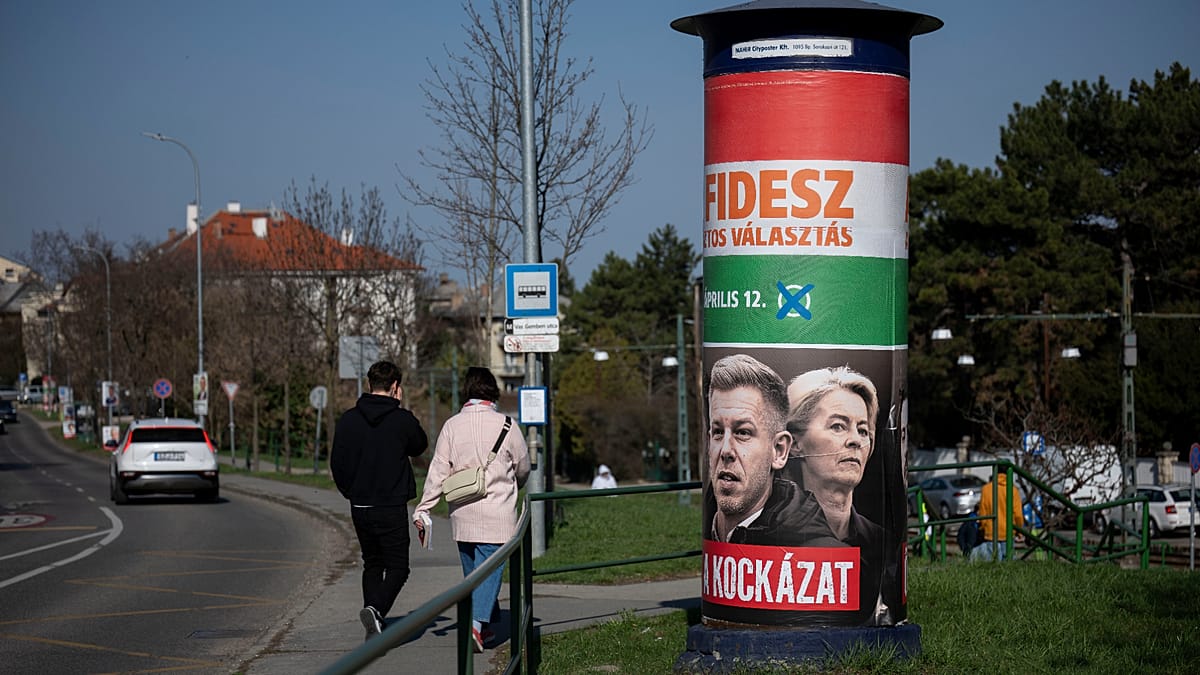
As Hungary heads to the polls on Sunday, European Union officials are quietly preparing for every possible outcome — from a continued stand-off with Viktor Orbán to a cautious reset under opposition leader Péter Magyar.
Orbán has long been a thorn in Brussels’ side, frequently using—or threatening to use— his veto power to a degree that now threatens the system from within. Most recently, in March, he blocked a previously agreed €90 billion loan for Ukraine over a dispute involving the Druzhba pipeline.
Magyar, who founded the Tisza Party two years ago, has pledged to restore Hungary’s broken ties with the EU and NATO — a promise welcomed in Brussels. Tisza currently leads in opinion polls ahead of Orbán’s Fidesz party. But Magyar is far from a pro-European liberal in the classical sense of the term.
“We are watching the campaign very closely, and we are optimistic,” one EU diplomat told Euronews on condition of anonymity, adding that a full assessment would follow once results were known on Monday.
Fidesz officials, however, are dismissive of the polling. “The two camps are similar in size, and the polls are very unreliable — about one in ten people answers the phone. Tisza supporters like to say their opinions out loud; ours are quieter. A lot will depend on mobilisation,” a source close to the party told Euronews.
Orbán has predicted he will win the majority of individual constituencies and secure a stable parliamentary majority of between 100 and 110 seats in the 199-seat legislature. Fidesz carried out an electoral system reform in 2011, which helped the party in government.
If Orbán wins: vetoes, radicalisation, and right-wing expansion
Should Orbán retain power, EU diplomats expect tensions with Brussels to deepen.
One diplomat, speaking on condition of anonymity, said a solution to the Ukraine loan would become virtually impossible, and the EU would likely need to proceed at the level of 25 member states, bypassing both Hungary and Slovakia. The diplomat said he believed Hungary would also continue to block the opening of EU accession negotiating chapters with Ukraine — a move that requires unanimity.
A Fidesz source confirmed that little would change. “Some things can be agreed upon, but there are red lines for Hungary that are not open to negotiation — Ukraine, and the question of unanimity. I don’t expect any major agreements.”
Still a second top-level diplomat from the EU told Euronews the reality after the election may be more nuanced and that the margin of victory will matter: a narrow win could leave Orbán politically weakened at home, producing what some describe as an “Orbán-light” — a less assertive version of himself on the European stage.
Dániel Hegedűs, deputy director of the Berlin-based Institute for European Politics, expressed scepticism about any such moderation.
“Since 2014, Prime Minister Orbán has been radicalised after every single electoral victory. Even if he wins, he will become even more dependent on strategic partnerships with Russia and the current Trump administration,” he said.
A Fidesz insider added that in the event of a victory, Orbán would step up efforts to expand the influence of the Patriots for Europe group in the European Parliament —an ambition he has framed with the slogan “occupy Brussels.”
“We are preparing for 2029 — for the European Parliament elections and for the French elections in 2027. The right must have an absolute majority in the Parliament,” the official said.
Electoral fraud could trigger a rupture
In Brussels, one of the main concerns is the election itself.
Dutch Green MEP Tineke Strik told Euronews she would urge Brussels to monitor the vote closely and respond swiftly if Orbán wins through fraud or vote-buying. Several MEPs have also written to European Commission President Ursula von der Leyen calling for enhanced oversight by the European Commission.
If there is fraud or vote-buying, the EU “should freeze all funding, because we can only expect further radicalisation from Orbán,” Strik said. She also called on the Council to step up its work on the Article 7 procedure against Hungary, a mechanism that was launched against Hungary in 2018 and would ultimately strip the country of its voting rights.
However, the procedure has stalled mainly because it requires unanimity, with little prospect of agreement among all 27 member states.
“I cannot see any scenario in which Bratislava, Prague, or Rome would support the suspension of Hungary’s voting rights,” expert Dániel Hegedűs said.
He also cautioned against hopes of bypassing Hungary through differentiated integration.
“You cannot do differentiated integration every day. There is no intergovernmental version of an EU budget or a multi-annual financial framework,” Hegedűs said, suggesting instead that a political solution would ultimately be required.
Diplomats widely see Orbán’s veto on the 90 billion loan to Ukraine as linked to his re-election campaign, in which opposition to Kyiv has become a central theme. Once the election is over, many of them say EU leaders are expected to take a tougher line with him if he maintains the blockade.
“Orbán understands that he is constantly testing the limits of what other member states are willing to tolerate,” one of the senior diplomats consulted by Euronews said.
A preview of that backlash came in mid-March, when EU leaders took turns to publicly rebuke the Hungarian prime minister at a heated summit, following his last-minute reversal on the Ukraine financing deal.
Most capitals regard the veto as a breach of the principle of sincere cooperation underpinning the bloc’s collective decision-making — a legal basis the European Commission could use to launch proceedings against Budapest after the election.
If Magyar wins: cautious optimism and a race to unlock EU funds
In Brussels, a victory for Péter Magyar would be greeted with cautious optimism.
The broad expectation is that Hungary would abandon its frequent use of the veto and adopt a more constructive approach to EU affairs — as Magyar himself indicated in a recent interview with the Associated Press.
Yet no one in Brussels expects a dramatic transformation. Magyar has already said he would oppose the EU migration pact — which was adopted in 2024 — and resist any fast-tracking of Ukraine’s accession bid.
Should he win, his immediate priority will be to unlock Hungary’s frozen EU funds. Of the €27 billion earmarked for Hungary, €17 billion remains blocked over rule-of-law concerns and corruption risks.
Diplomats say a significant portion could be released quickly if there is political will in Budapest and if the necessary legislative changes are made.
Under an optimistic scenario, a new government could be in place by May, potentially allowing legal changes in June and a gradual resumption of EU transfers over the summer.
One early step could be Hungary joining the European Public Prosecutors’ Office (EPPO).
“Joining the EPPO could give a new Hungarian government access to a large part of suspended cohesion funding without requiring major political deliberation — purely on merit,” Hegedűs said.
He also warned that Hungary risks losing €10 billion in August, when the deadline to withdraw cash from the EU’s Recovery Fund is set to expire, and called for diplomatic efforts to secure a 12- to 18-month extension.
One senior diplomat described Péter Magyar as “an opportunity to restart EU–Hungary relations,” with EU funds seen as a clear incentive—while also striking a note of caution.
“There is a lot of uncertainty about Péter Magyar’s personality. We have no idea what he really thinks or who he really is. We shall see whether he is an Orbán-light or not.”
Strik echoed that ambivalence, noting that Péter Magyar at times resembles Viktor Orbán, particularly on migration, where she does not expect significant change.
She suggested he could follow a trajectory similar to Polish Prime Minister Donald Tusk in Poland. “On Ukraine, he is less radical than Orbán,” Strik said, adding that he was also “silent on LGBTQ+ issues.”
Roughly €2 billion of Hungary’s blocked funds are tied to legislation targeting LGBTQ+ communities. Magyar has made no commitments on the issue and did not speak out when Orbán’s government banned Budapest Pride last year.
Strik warned that a ruling by the European Court of Justice possibly annulling Hungary’s so-called Child Protection Law — widely regarded as anti-gay — would put a Tisza government to the test.
“If the Court comes up with a ruling, he would have to withdraw the law. If he does not, he will have broken his own promises,” she said.
Read the full article here