




I’ve been steeling myself for a coming wave of AI-infused wearables that could be worn all over the place, based on reports on gadget plans at Meta, Google and Apple — a halo of connected tech with cameras onboard, streaming to AI services. Qualcomm’s latest chip, announced Monday at Mobile World Congress in Barcelona, is built for it, and the first devices using it are coming this summer. Samsung, Google and Motorola are already building hardware with it.
I sat down with John Kehrli, senior director of product management for Qualcomm, to discuss the newest wearable chip push, and it caught my attention on several levels. The reason you should care is that this is a clear preview of tech products to come: Qualcomm’s chips power almost all of the non-Apple watches, VR headsets and smart glasses out there.
While Qualcomm has had separate chip lines for smartwatches and for smart glasses and VR headsets, the new Snapdragon Wear Elite chip aims to bridge across categories. It’s a higher-powered watch chip filled with different wireless connection capabilities, but it is also made to support video input and streaming for AI, even 1080p video output to displays. That could include AI-infused smart glasses.
“It’s not just the watch: for sure that’s a focus for us, but the portfolio [of devices] has expanded dramatically,” Kehrli says.
Here’s the news about Snapdragon Wear Elite that stood out for me.
Qualcomm’s new chip design is meant to be flexible in form. It could end up many places.
A lot more onboard processing for offline AI
A big part of Qualcomm’s push on these chips is to do more generative AI and LLM work on device, a trend I expect to grow. The Snapdragon Wear Elite looks a lot more powerful than previous Qualcomm watch chips. Some of the offline, on-device functions could be voice-based AI, for fitness or, according to Qualcomm, for “life logging.”
I’m not sure I need life logging, but I’d be interested in having more AI-based controls for wearables. The extra power looks to also drive video on displays and run onboard cameras, including video streaming. The whole idea behind next-wave multimodal AI is to have AI services be aware of what you’re doing — that’ll mostly happen via camera access.
Kehrli says the processing cores for the neural processing unit on the Snapdragon Wear Elite could support AI models of up to 2 billion parameters on device, at about 10 tokens per second to process. He sees that being good enough for a lot of offline needs, with cloud-connected AI kicking in when needed otherwise.
Kehrli sees a lot of local AI needs for the extra sensors, including cameras, that are going to be on these wearables. “There’s so many exciting inputs coming in [to the devices]. Location, sound, voice, text, all the sensors — we’re really seeing a lot of medical-grade sensors come into the retail space. What do I do with that data?”
Qualcomm’s concept for a wearable pendant is like a smartwatch, but with outward-facing camera.
Cameras everywhere?
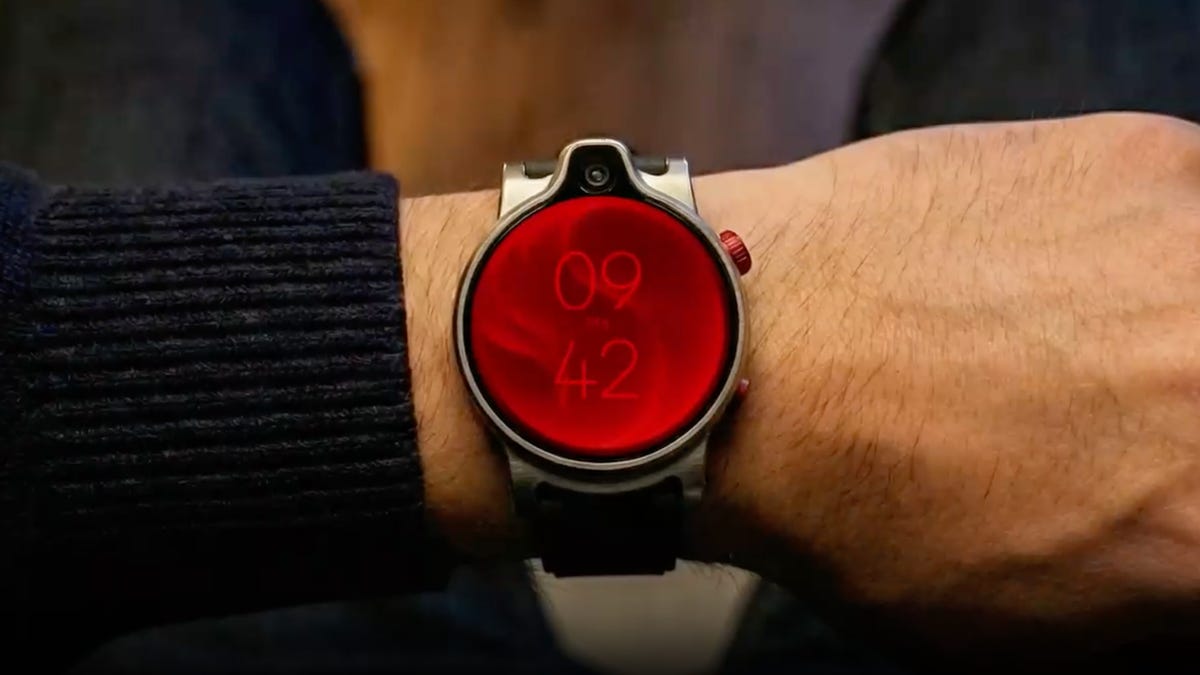
In Qualcomm’s sizzle video for the new chip, we can see a glimpse of a watch with a camera on its top edge. Most smartwatches don’t have cameras right now, but that could be changing soon. While it’s not necessarily a great way to take photos, the onboard cameras are likely more an additional way to tap into AI, like for face recognition biometrics for tap-to-pay, using a watch like a smart key for cars or other connected things, or maybe to use for other AI-based controls.
Another concept shot of a pendant, which looks basically like a neck-worn smartwatch, has its camera facing out. All the AI pins and pendants that have been trickling in these last few months are showing similar ideas. Like smart glasses, the outer-facing cameras could be another way to see things without putting something on your face. But you’d have to wear some pin or pendant.
Qualcomm’s talking points for the new chipset.
Better battery life, faster charging, lower-power Wi-Fi connections
It also sounds like devices with these new chips will last longer on a charge. Qualcomm’s promising 30% better battery life than with its previous watch chip — potentially “days” of use. I’d still expect more or less a full day, considering these chips might also be supercharging more camera-based and AI features.
The faster charging sounds promising, though. The chips could charge devices up to 50% on 10 minutes of charging. That’s key because a lot of these wearables are being designed to be worn all the time, and some while you’re sleeping. It’s like companies are trying to find ways to do a quick recharge pit stop without spending too much time off your body.
The most interesting part could be the boosted wireless features. Qualcomm’s got six different protocols on-chip: support for Redcap 5G (a protocol to support high-speed and low-power connected tech), Bluetooth 6.0, ultra wideband, GPS, satellite-connected NB-NTN for messaging, and micropower Wi-Fi 802.11ax.
The micropower Wi-Fi support could allow these new wearables to stay Wi-Fi connected continuously, says Kehrli, letting them work in the background longer. On Meta’s Ray-Ban glasses, for instance, right now, they’re mainly Bluetooth-connected and don’t stream video by default; switching to that mode kills battery life fast. Streaming always-on AI modes could last longer on Elite-powered devices.
Qualcomm’s plans for this chip extends to nearly every wearable territory.
Where they could show up: Watches, glasses, headphones, pendants, more
Qualcomm’s aiming to put its new chip across a wide range of wearables, from camera-enabled headphones and earbuds like Razer’s Motoko concept (which I tried at CES in January) to next-gen smartwatches and AI pendants, to smart glasses, and even sensor-connected bands. Devices like Meta’s neural band, which uses EMG (electromyography, using skin contact sensors) for hand gestures that control its smart glasses, could see upgrades with this chip. Maybe that’s exactly the sort of territory Meta could be exploring with its reported smartwatch debut this year.
It’s also clear that everyone, Qualcomm included, isn’t entirely sure where people prefer to wear these future AI gadgets. Is it glasses? Pendant? Watch? Headphones? All of the above? Kehrli feels people will have different preferences and will choose what works. Will that sort of redundancy make sense or settle itself down into clearer categories in another year or two?
Glasses, Kehrli adds, could be a landing spot for this chip because of the cellular-connecting possibilities, saying he expects adoption of wearables with their own data connections will keep rising, especially with AI services. “We’re seeing, on-wrist, up to 50% of customers taking connected [wearables] with a service plan. We’re seeing that dramatically increase, especially with this AI on device/off device type of experience in the cloud.”
It’s clear that halos of wearables are on deck from several big companies. How it all shakes out and works, though, is still unclear. And while these new wearables should be a lot more powerful, the focus right now isn’t on improving how they could stay connected and communicate with each other, something I got a glimpse of in a demo of a personal mesh network made by startup Ixana at CES. Maybe that’s next on deck.
For now, wearables are trying to be better extensions of your phone, first, and act better as standalone devices too.
Read the full article here