




Listen to this article
Estimated 4 minutes
The audio version of this article is generated by AI-based technology. Mispronunciations can occur. We are working with our partners to continually review and improve the results.
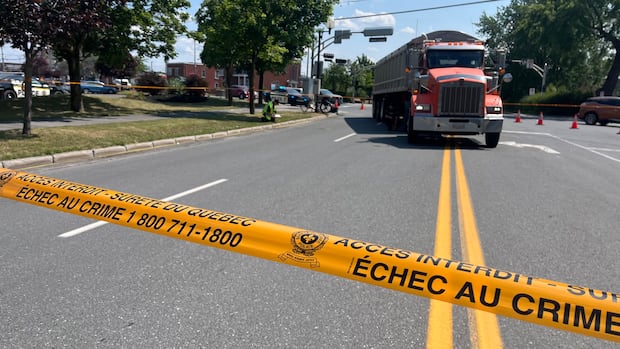
Following several collisions involving heavy vehicles, Quebec has announced new measures aimed at addressing the issue of inexperienced drivers from Ontario.
Under the changes announced Thursday, truck drivers in Ontario with less than two years of experience who wish to work in Quebec and exchange their Class 1 heavy vehicle driver’s licence will be required to take practical exams.
This requirement applies to all drivers with less than two years of Class 1 driving experience. If these drivers fail the practical tests twice, they will be required to complete mandatory training.
Simon-Pierre Poulin, spokesperson for the Société de l’assurance automobile du Québec (SAAQ), said they’ve been seeing more accidents involving new and unexperienced drivers.
In a news release, the province’s automobile insurance board said this measure follows a May report by Ontario’s auditor general about commercial driver’s licences, which highlighted the need to strengthen the oversight of training and licencing programs.
Until now, for heavy-duty truck drivers moving to Quebec, the transfer of their licences was automatic, with no additional questions asked about the quality of the training they received, Quebec Transport Minister Benoit Charette said.
The SAAQ also said a working group was established to “develop a co-ordinated approach to strengthening road safety requirements regarding the operation of vehicles by temporary foreign workers.”
According to the SAAQ, the goal of the working group is to propose regulatory changes to better address road safety issues and increase the number of workers who adopt safe driving practices.
Poulin said the group will have six months to give the board recommendations that may lead to regulatory changes.
Last October, Quebec’s chief coroner ordered a public inquiry into deaths caused by freight trucks.
A temporary measure
On Radio-Canada’s Tout un matin, Charette said the changes are temporary.
He said he was implementing this measure while waiting for Ontario to take action in response to its auditor general’s report.
Marc Cadieux, CEO of the Quebec Trucking Association, said the new measures are a “step in the right direction.”
However, Cadieux pointed out that this will not fully solve the problem.
“In some cases, this kind of initiative also requires legislative changes by the government,” he said.
“The issue also involves all the others who hold licences from other provinces … whose licences are often considered questionable in terms of driving experience.”

‘We want this to stop’
The national voice of Canada’s trucking industry, the Canadian Trucking Alliance, has coined the term “Driver Inc.” to describe the practice of companies incorrectly classifying drivers as independent contractors rather than employees in order to save money on payroll taxes.
Marc-André Gauthier, director of communications for transport union Teamsters Canada, also believes the Quebec government’s new measures are a step in the right direction, but notes that they won’t “magically solve everything.”
According to Gauthier, it is the Driver Inc. companies that are the “real culprits,” not the drivers they hire.
“It’s the companies who have put in place that stratagem to avoid paying taxes and social charges,” Gauthier told CBC.
He said since the drivers hired by these companies are not real employees, they are not obliged to follow trainings.
“So, at the end of the day, some of those Driver Inc. have had less training than they should have,” he said.
Gauthier added that “real” trucking companies — those that follow the rules — are struggling to compete with these Driver Inc. companies, which is causing many truck drivers to lose their jobs. He wants governments across the country, particularly the federal government, to crack down.

Shelley Walker, CEO of the Women’s Trucking Federation of Canada, based in Ontario, said she had no objection to Quebec imposing measures on Ontario drivers, although she believes Quebec should require the same of all provinces.
Walker said members of the federation she represents wish to see “some practical fixes, verified training, transparent records, enforcement that targets the bad actors within our sector.”
According to her, the country needs national consistency.
“Make verification public, simple and mandatory. We don’t need more studies. We need action now,” she said.
“Drivers now fear for their own safety out on the roads. We all have families that are out travelling on those roads. We want this to stop.”
Read the full article here