



E-waste is a pretty serious problem, and researchers have been studying how to reduce, reuse and recycle old tech as long as there has been old tech to recycle. Google Research and the University of California San Diego came up with a pretty cool way to deal with at least some of it.
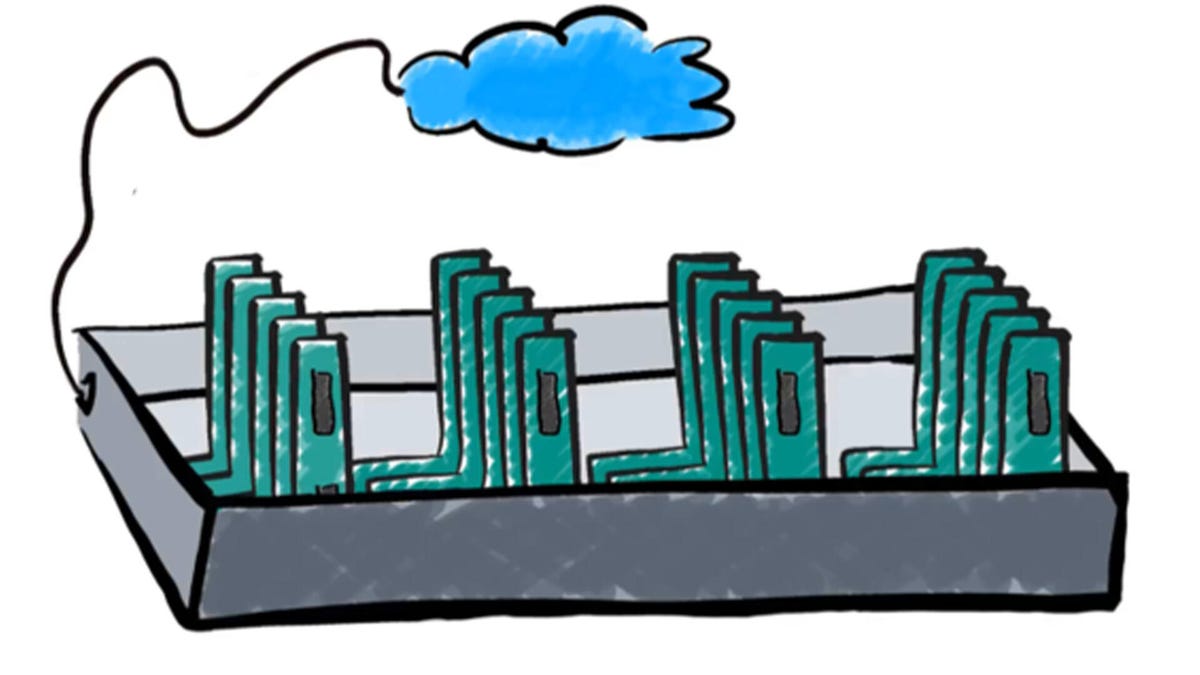
Researchers used 2,000 discarded Google Pixel phones to create a mini computing platform. Unlike the famous Taiwanese grandfather who played Pokemon Go on 64 phones, the old Pixels underwent extensive modifications before being placed in their new home. The motherboards were removed and placed in self-governing clusters comprising 25 to 50 devices, according to the study.
The motherboards had their Android operating systems removed and replaced with Linux, which removed many consumer-facing protections, such as a low-memory killer function that helps phones run more smoothly, but would be counterintuitive in a server context. Everything that was unnecessary, like displays, camera arrays and batteries, was removed, leaving just the motherboards to do their thing.
The Pixel phone server (the blue bars) did surprisingly well on benchmarks compared with an Asus server rack.
“Each smartphone ‘server’ fits in a standard datacenter tray,” Ryan Kastner, professor of computer science and engineering at UCSD, told CNET in an email. “We’re still determining the exact density, but we plan to fit dozens of phones per tray. Since we are removing the battery, chassis, and display, each device is significantly smaller than an unmodified phone.”
This setup was pretty successful. According to Google, the Pixels performed better or at least on par with professional server racks like the Asus RS720A, a popular choice for enterprise data centers. This made them viable for UC San Diego’s needs, including a small-scale cloud computing platform that could run applications for classes.
UC San Diego says that 20 Pixels were enough to support a class with over 75 students, and with 2,000 Pixels, they could support 100 classes at once. Computer science and engineering will be the first classes to test the tech.
“Longer term, we envision that other departments could move some of their compute requirements onto these systems as well,” Kastner said. “To enable this, we are working to integrate the smartphone clusters into the UCSD Data Science and Machine Learning Platform, which serves as a centralized compute resource for education and research across campus.”
The big win for UC San Diego was cost. The price of the Pixel phones and the time it took to set them up was “a fraction of the usual cost” of a comparable amount of server computing power. UC San Diego intends to study how long consumer-grade electronics can last in a more intense server environment and plans to launch the system in the fall 2026 semester.
Not a simple process
The experiment is undeniably ambitious and, if the UC San Diego team succeeds, could represent a significant achievement. But it hasn’t been easy. Beyond challenges such as removing batteries to mitigate fire risks, researchers have had to navigate a range of additional technical and logistical obstacles.
“These devices were never meant to run a data center,” Kastner said. “That means we have a lot of exciting unknowns to answer, as well as some trouble getting the hardware to fit into a hole it doesn’t fit.”
One issue concerns the wireless communication systems that come with every smartphone, including Bluetooth, Wi-Fi, and cellular signals. Kastner said that these would cause significant “self-interference” if left on, affecting a wide range of functions. All those avenues for connecting also pose a security risk, as even a single hacked phone could leak confidential information. To prevent such issues, the team ensured that all radios were permanently disabled.
Another hurdle was temperature. The team is using standard data center cooling measures, such as fans and heatsinks, to dissipate heat. Smartphones have many consumer protections in place to prevent them from overheating. These protections aren’t necessary in a datacenter environment, so the team spent quite a bit of time finding and disabling these protections, an act that Kastner refers to as a “needle in a haystack situation.”
Part of the experiment is to see whether these higher temperatures affect long-term reliability.
“Giving these smartphones new lives is no small feat,” said Kastner. “Repurposing the smartphone to operate as a general-purpose compute processor that can handle diverse cloud workloads was, and remains, a significant challenge and requires undoing a lot of sophisticated techniques that are required for it to operate as a smartphone.”
A small solution to a big problem
While small in scale, the experiment could pave the way for further academic research. Google says that the vast majority of school usage, including teaching, grading and even research, is “within the capabilities of a single smartphone to host.” Should UC San Diego’s experiment prove successful, colleges all over the world could use old, discarded smartphones in similar server setups to help reduce costs.
However, this approach isn’t the next big thing in data center or server construction. Data centers can process hundreds of gigabytes per second on the low end. Data centers for AI and other enterprise applications require much larger, stronger and more robust solutions, which bring with them an entirely different set of environmental concerns, such as the enormous amount of water they require to stay cool and the fact that some data centers use enough electricity to power tens of thousands of homes.
There is no chance that a gaggle of old smartphone motherboards will make an impact on the broader data center industry, but it is nice to see it work on smaller scales, where businesses and researchers alike often overpay for cloud computing power when they really don’t need that much.
A drop in the bucket for e-waste
It’s commendable that researchers and companies are seeking ways to use e-waste, but they still have a long way to go. The 2,000-smartphone server farm built by UCSD removed a tiny fraction of the estimated 62 million tons of e-waste entering the garbage stream each year, with only 22.3% of it properly recycled. CNET readers do better than average, recycling old tech 39% of the time, but that’s still a concern.
An estimated 5.3 billion mobile phones are discarded each year. That means UCSD would need to build another 2.65 million such server farms per year, in perpetuity, to clean it all up. There’s no expectation that any one university do so, but it shows just how big the e-waste problem really is. Those numbers also don’t account for the large number of adults who keep old tech in a closet, collecting dust.
Other initiatives are helping with this. Right-to-repair laws in the US are slowly making it easier and more affordable to repair tech instead of just throwing it away. Governments and companies are working to raise awareness of proper e-waste recycling so that these metals and chemicals can be reused rather than left to rot in a dump somewhere.
Should UC San Diego’s experiment prove successful, it may be another in a long line of small initiatives to help clean up a problem that was once considered out of control.
Read the full article here