




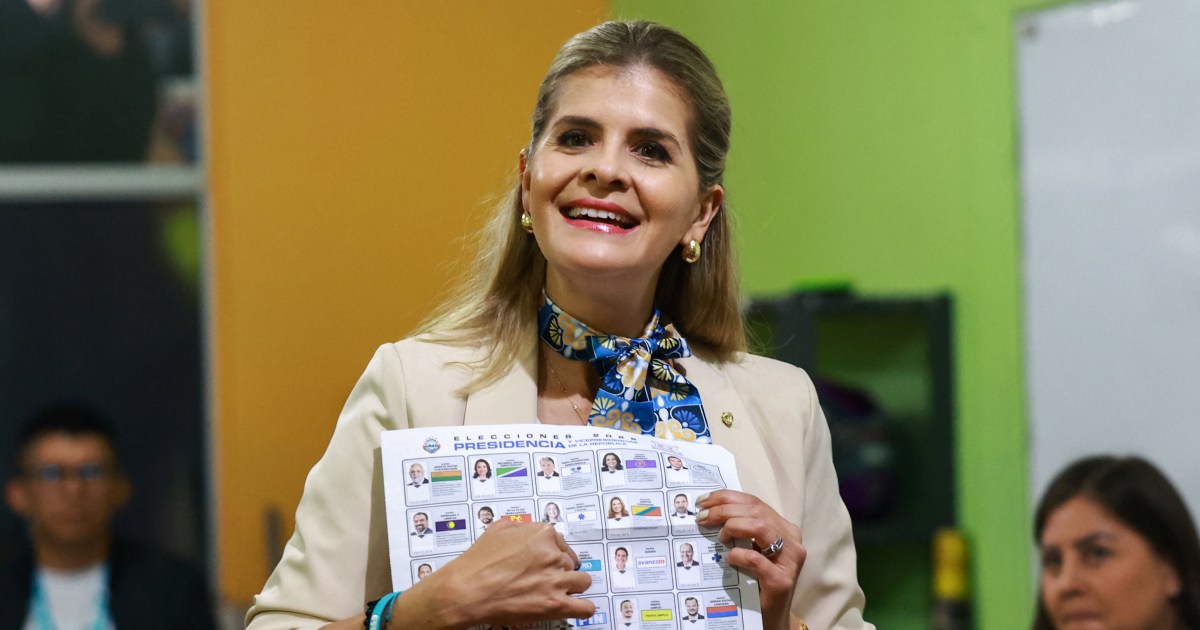
Right-wing candidate’s closest challenger concedes defeat as partial results showed her on verge of winning the presidency.
Right-wing candidate Laura Fernandez has declared victory in Costa Rica’s presidential election after preliminary results gave her a commanding lead and her closest challenger conceded defeat.
The move early on Monday came after Supreme Electoral Tribunal said that votes tallied from 81 percent of polling stations showed the candidate of the Sovereign People’s Party winning 48.9 percent of the vote.
In her victory speech, Fernandez promised “deep and irreversible change” and announced that Costa Rica was entering a new political era.
The Central American nation’s second republic, which began after the 1948 civil war, “is a thing of the past,” she said.
“It’s up to us to build the third republic,” Fernandez told flag-waving supporters.
The 39-year-old politician also pledged to lead a nation that is “respectful and firm on the rule of law”.
“Any law that is ineffective, that has become obsolete, that has become a hindrance to development, will be modified or repealed,” she added.
Fernandez’s closest challenger was economist Alvaro Ramos of the National Liberation Party, who obtained 33 percent.
At third was Claudia Dobles, a progressive architect and former first lady, who was just shy of 5 percent of the vote.
Ramos conceded on Sunday night and pledged to lead a “constructive opposition,” but one that would not let those in power get away with anything.
“In democracy dissent is allowed, criticizing is allowed,” he said.
Fernandez needed at least 40 percent to win the election outright and avoid a run-off on April 5. The politician is the handpicked successor of incumbent President Rodrigo Chaves, and campaigned on continuing his tough security policies.
She has pledged to complete a maximum-security mega-prison that Chaves started to build in August, saying that it would “isolate leaders of organised crime”, cutting them off from the outside world.
She has also advocated for mandatory prison labour and stricter criminal sentencing.
Al Jazeera’s Julia Galiano, reporting from capital San Jose, said that the main issue during the campaign was security, with homicides reaching an all-time high in 2023.
“Without a doubt, the increasing insecurity was the main issue for everyone that we spoke to here. Costa Rica has long been considered as the Switzerland of Central America. It’s a nation known for its long history of a stable democracy,” she said.
Fernandez’s tough line on security has prompted worry among the opposition, Galiano said.
“They fear the changes that her government will do will ultimately erode the democratic nature of this country. But in her victory speech, she did say that above all, she would remain democratic and that her government would never turn authoritarian,” our correspondent added.
Costa Ricans also voted for the 57-seat National Assembly on Sunday.
Fernandez’s party is projected to win a majority of 30 seats in the 57-seat Congress, up from its current eight seats, but short of a “supermajority” that would give it greater powers.
Some 3.7 million Costa Ricans were eligible to vote in Sunday’s elections.
Read the full article here