




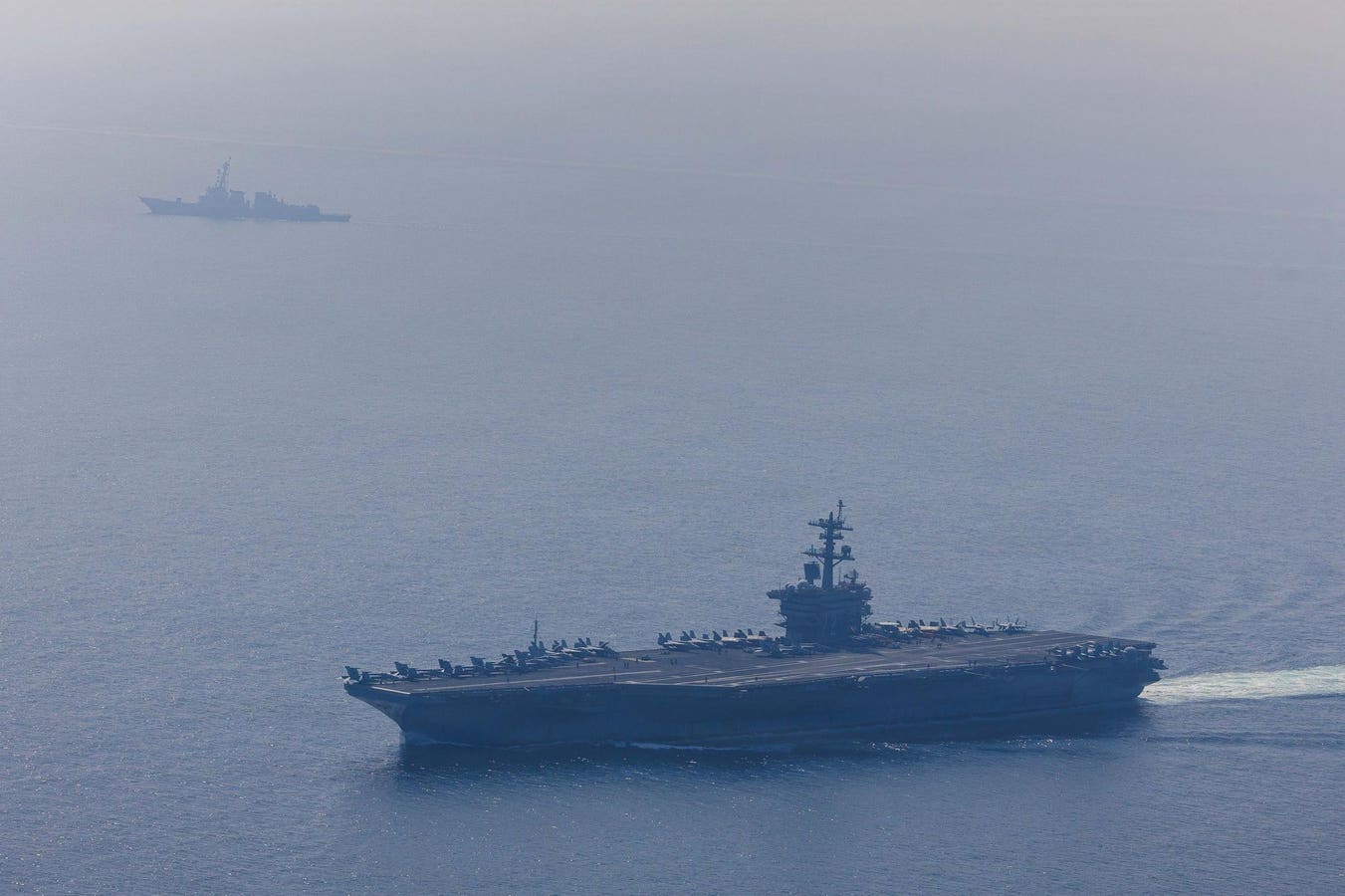
In March, the United States Navy’s oldest active nuclear-powered supercarrier, the USS Nimitz (CVN-68), began a homeport shift from Naval Base Kitsap in Bremerton, Wash., to Naval Station Norfolk, Va., in advance of the warship’s decommissioning next March. Current plans call for a Gerald R. Ford-class supercarrier, the future USS John F. Kennedy (CVN-79), to be homeported in Bremerton, but this week the Chief of Naval Operations suggested another U.S. Navy flattop could be based at the facility in the Pacific Northwest to better align with the increased focus on the Indo-Pacific as part of great power competition with China.
The USS Abraham Lincoln (CVN-72), which is currently operating in the Arabian Sea in support of U.S. military operations in the Middle East, is based at Naval Air Station North Island in San Diego, could be homeported in Bremerton, Admiral Daryl Caudle said during a visit to the Naval Base Kitsap on Wednesday.
“Reagan is going to stay here, and I believe that Abraham Lincoln will probably, you know, change homeport to here as well,” Caudle told the Kitsap Sun during an interview. “Kennedy will be the first Ford-class aircraft carrier to be permanently stationed in this area, too.”
The USS Ronald Reagan (CVN-76) is already homeported at Naval Base Kitsap in Bremerton, having arrived at the facility in August 2024 to undergo routine maintenance after spending nearly a decade as the U.S. Navy’s only forward-deployed carrier in Yokosuka, Japan.
Currently, the USS Carl Vinson (CVN-70) and the USS Theodore Roosevelt (CVN-71) are both homeported in San Diego.
Increasing The Strategic Balance In the Pacific
Adm. Caulde has called for a greater division of the West Coast-based carriers, which could provide a broader, more rapid deployment across the Pacific and to global theaters.
Naval Base Kitsap is the U.S. Navy’s third largest fleet concentration area in the United States, and according to the service, it is the most complex. It is home to more than 70 tenant commands, including Commander, Navy Region Northwest; Commander, Submarine Group 9; Commander, Carrier Strike Group 3; Naval Facilities Engineering Command Northwest; Naval Undersea Warfare Center Keyport; and Puget Sound Naval Shipyard and Intermediate Maintenance Facility.
“Spanning more than 12,000 acres across the Kitsap Peninsula, they support a diverse range of strategic missions, including all types of submarines, Nimitz-class aircraft carriers, Puget Sound Naval Shipyard and Manchester Fuel Depot. NBK is also the home of several Research, Development, Testing & Evaluation commands that ensure the Navy’s technological advantage,” the Navy explained.
It is one of the few global facilities that can handle the 100,000-ton displacement and 12.5-meter navigational draft for the U.S. Navy’s nuclear-powered aircraft carriers.
In addition to CVN-68 and CVN-76, the USS Carl Vinson (CVN-70) was also stationed at Bremerton for several years before changing its homeport to San Diego. Naval Base Kitsap also served as a “mothball” facility for several decommissioned conventionally-powered aircraft carriers including the USS Kitty Hawk (CV-63), the USS Independence (CV-62), the USS Constellation (CV-64) and the USS Ranger (CV-61).
New Home For USS Abraham Lincoln
The fifth Nimitz-class nuclear-powered aircraft carrier has never been permanently homeported in Bremerton; from 1997 to 2011, USS Abraham Lincoln was based at Naval Station Everett, across the Puget Sound north of Seattle. The basing was part of the Reagan-era Strategic Homeporting Initiative, a 1980s program aimed to disperse the U.S. fleet geographically, stimulate local economies, and improve operational flexibility rather than clustering all major warships at existing hubs such as Kitsap.
In addition, CVN-72 has spent several extended periods undergoing major overhauls, dry-dockings, and repairs at the Puget Sound Naval Shipyard and Intermediate Maintenance Facility located within Naval Base Kitsap.
The warship, which first entered service in November 1989, spent a year from 1995 to 1996 at the shipyard for an extensive, $200-million overhaul. In 2006, USS Abraham Lincoln underwent a six-month planned incremental availability period, a scheduled block of extensive maintenance, modernization and repairs aimed at maximizing the carrier’s lifespan and mission readiness, at the PSNS-IMF. Another nine months were spent at Bremerton in 2009 to 2010, where CVN-72 underwent a $250 million overhaul that included resurfacing the carrier’s flight deck and replacing its propellers.
The PSNS-IMF continues to serve as the primary West Coast facility for major repairs to the U.S. Navy supercarriers and other vessels. As the primary and largest maintenance facility, it is also the only public shipyard on the West Coast equipped with dry docks large enough to accommodate nuclear-powered carriers.
The USS Abraham Lincoln, which began her current deployment in November 2025, is currently homeported at NAS North Island, San Diego. From 2012 to 2017, the carrier was relocated to Naval Station Norfolk to undergo the 42.5-month refueling and complex overhaul at the nearby Newport News Shipbuilding facility.
The supercarrier’s first homeport after commissioning was at the former Alameda Naval Air Station, California, which officially ceased operations in April 1997.
Ford-class Flattop Delayed
Even if USS Abraham Lincoln is homeported in Bremerton, joining USS Ronald Reagan, it could be a while before a third carrier is based there.
The second Gerald R. Ford-class flattop was supposed to be handed over to the U.S. Navy last summer, but the delivery was delayed to certify complex systems, notably the Advanced Arresting Gear and Advanced Weapons Elevators, and to shift major baseline construction work, which will allow the carrier to operate with the fifth-generation Lockheed Martin F-35C Lightning II.
Both the AAG and AWE were the cause of problems with the USS Gerald R. Ford (CVN-78), and the U.S. Navy is seeking to resolve any issues during the building phase. Moreover, CVN-78 still requires modifications to operate with the carrier-based variant of the Joint Strike Fighter.
The U.S. Navy had previously planned a “dual-phase” delivery for CVN-79, where certain combat capabilities would be added later, but Congressional mandates called for the systems to be operational when she was handed over to the U.S. Navy.
The future USS John F. Kennedy is still slated to be homeported at Bremerton, yet, given that sea trials and shakedown cruise that will need to be completed next year, the carrier will arrive in the Pacific Northwest no earlier than fiscal year 2029.
However, the U.S. Navy still needs to complete its ongoing $145 million electrical infrastructure upgrade at Naval Base Kitsap to accommodate the supercarrier. Work commenced in May 2025 and is now scheduled to be completed sometime in 2028.
Read the full article here