




Scientists may fin-ally understand more about hurricanes.
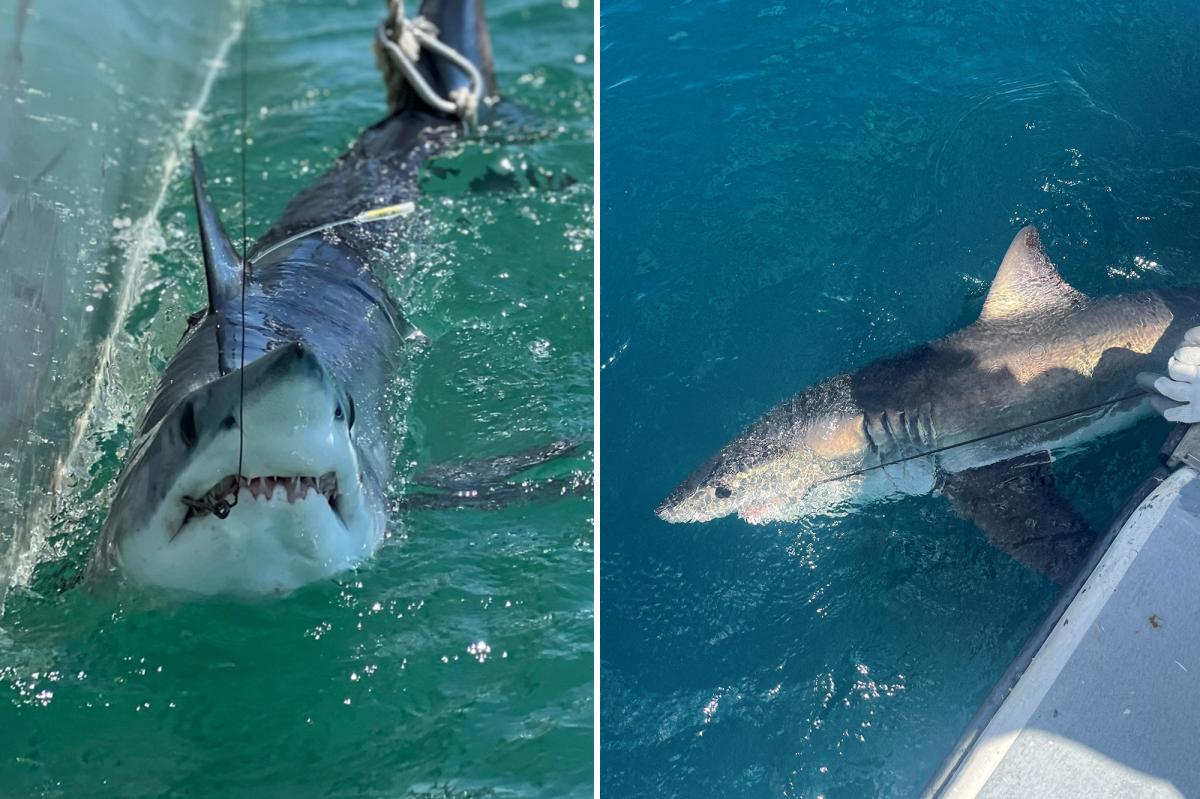
This summer, researchers at the University of Delaware are experimenting with using sharks to predict the intensity of hurricanes as they approach the East Coast.
They are attaching electronic tags to the fish, which collect data such as ocean temperature and salinity measurements from the Atlantic Ocean that otherwise prove challenging and pricey to monitor.
This could lead them to gain more knowledge on the Mid-Atlantic’s “cold pool,” a layer of bottom water under 50 degrees Fahrenheit that forms in spring and disappears in fall — which can determine how fast hurricanes intensify.
“Animal-borne sensors have been used successfully by oceanographers for years, particularly on elephant seals in polar regions where scientific observations are scarce,” said UD marine scientist Aaron Carlisle, who is leading the research.
His team has been out in the Mid-Atlantic on the R/V Daiber, a research vessel owned by the university’s College of Earth, Ocean and Environment, to test out the shark tagging, which before now, was mainly used to track their route and habitat.
The group heads 30 to 40 miles offshore, sets up baited lines and then waits in anticipation — sometimes for as long as three hours — for a shark to take the bait.
The scientists, who began tagging the creatures in May, when sharks move closer to the coast after leaving their winter habitats, have found that shortfin mako sharks, blue sharks, smooth hammerheads and juvenile great white sharks are best fit for the experiment.
That is because those species tend to come to the surface most frequently, allowing their tags to transmit their findings to satellites.
“The tags are attached to the dorsal fin. Then every time the shark fins (swims) at the surface, the tag can communicate and transmit data to the orbiting network of satellite receivers,” Carlisle said.
The tagging is done in a manner that does not harm the sharks.
First, each candidate undergoes a health exam to ensure they are not stressed or harmed, which would compromise the data, and the tags themselves are made of materials that eventually corrode and fall off.
Carlisle, who holds a PhD in biological sciences from Stanford University, explained why the heat at the top layer of the ocean is most important for their research.
“This is the part of the water column that really drives hurricane intensity — warmer mixed layer equals stronger hurricane — as it holds the heat that feeds hurricanes,” he said.
Carlisle hopes his team’s research will enable residents from North Carolina to Massachusetts to better prepare for hurricanes before they hit.
He also wants the project to dispel the stereotype that sharks are merely scary creatures that should be feared.
“They are amazing animals perfectly adapted to the ocean, and we can learn a huge amount from them,” he said.
“If we can show that sharks can help people, it’s a win-win situation.”
With Wires
Read the full article here