




A new restaurant blending two beloved cuisines is open for dinner in the East Village.
Sono, a new Korean-Italian restaurant at 176 First Ave., offers handmade pasta with Korean flavors, including fermented sauces, pickled vegetables, and Korean pantry ingredients.
“Sono is really a reflection of my life. It’s 30 percent Korean, 70 percent Italian, which is honestly just who I am,” says chef Chef Sechul Yang, an alum of Gramercy Tavern and Oiji Mi. Yang grew up in Korea, and spent most of his career cooking in Italian kitchens. “At some point, I stopped seeing those two parts of myself as separate. This isn’t fusion for the sake of it. I’m not trying to mimic Italian culture, and I’m not trying to follow Korean culture. This is about putting out a concept that represents who I am and what I have learned over the years,” he says.
Dining at Sono
Sono was created as a trattoria, an informal, comfortable restaurant to linger in. The menu follows traditional Italian framework: antipasti, primi, secondi, contorni, plus dessert, of course.
“The two cuisines are more connected than people expect. Both come from peninsula cultures with coastlines that shaped their cooking, so seafood runs deep in both traditions,” says Yang. “Both are built around handmade noodles, fermented flavors, alliums, and the ritual of sharing many dishes at once around a table. Banchan and antipasti are not so different in spirit. Kimchi and Italian pickled vegetables are cousins. The umami of doenjang and aged Parmigiano come from the same instinct, patience, fermentation, and depth.”
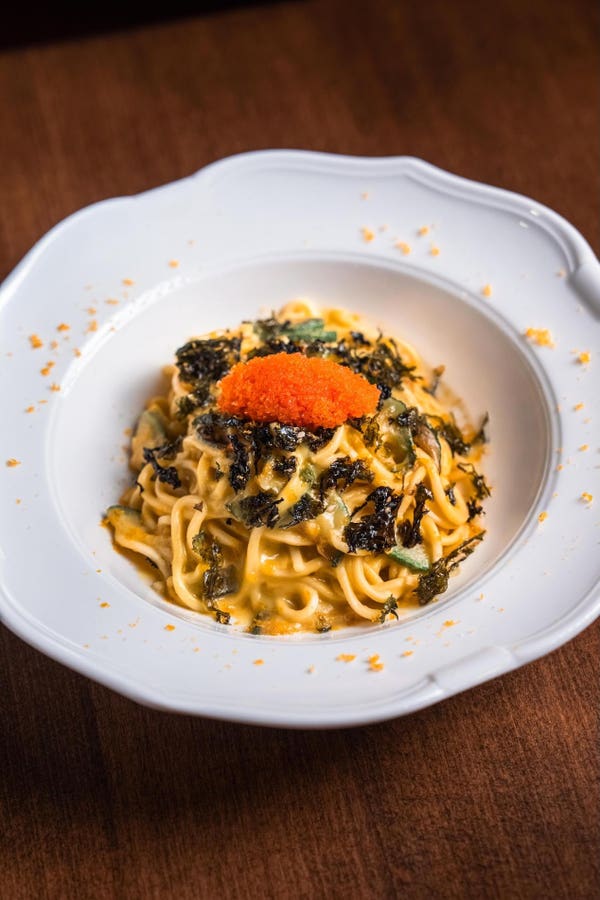
On the menu, Yang points to spaghetti alla chitarra as one of the dishes that exemplifies his concept. “I realized that Italian bottarga pasta has a mirror in Korean cooking: al-bap, which is rice with nori and different fish roes, and a sautéed zucchini side with cured shrimp,” he says. Yang’s pasta dish is made with saffron and yellow zucchini purée, finished with Korean zucchini, myeongran (pollock roe), nori, and bottarga. “You get that cured, umami depth without it being too fishy, and the roe adds this little pop of texture and sweetness. It just works.”
For meat eaters, the oxtail fettuccine merges cacio e pepe with Korean oxbone soup, and the vongole is a take on Italian clam linguine pushed through the lens of Korean kal guksu, an anchovy-potato-onion broth.
For dessert, the black sesame tiramisu adds a new element to a familiar dish. “Strange but satisfying, which is kind of the whole point,” Yang says. A chef’s tasting menu for $150 serves two and leaves guests in Yang’s hands. Ala carte ordering is also available.
“I want people to come in curious. I want them to think, I’ve never had Korean-Italian cuisine before, what does this even look like? And then I want the food to answer that question in a way that feels familiar and surprising at the same time,” says Yang.
Pricing is also really important for him. “Eating out has gotten so expensive, and that’s not good for anyone, not for diners, not for restaurants,” he says. “I kept the menu under $50 for mains because I genuinely want Sono to be a place people can come back to, not just a special occasion. Hospitality has to mean something. I learned that from Danny Meyer, from my years at Gramercy Tavern — it’s about taking care of people.”
Read the full article here