




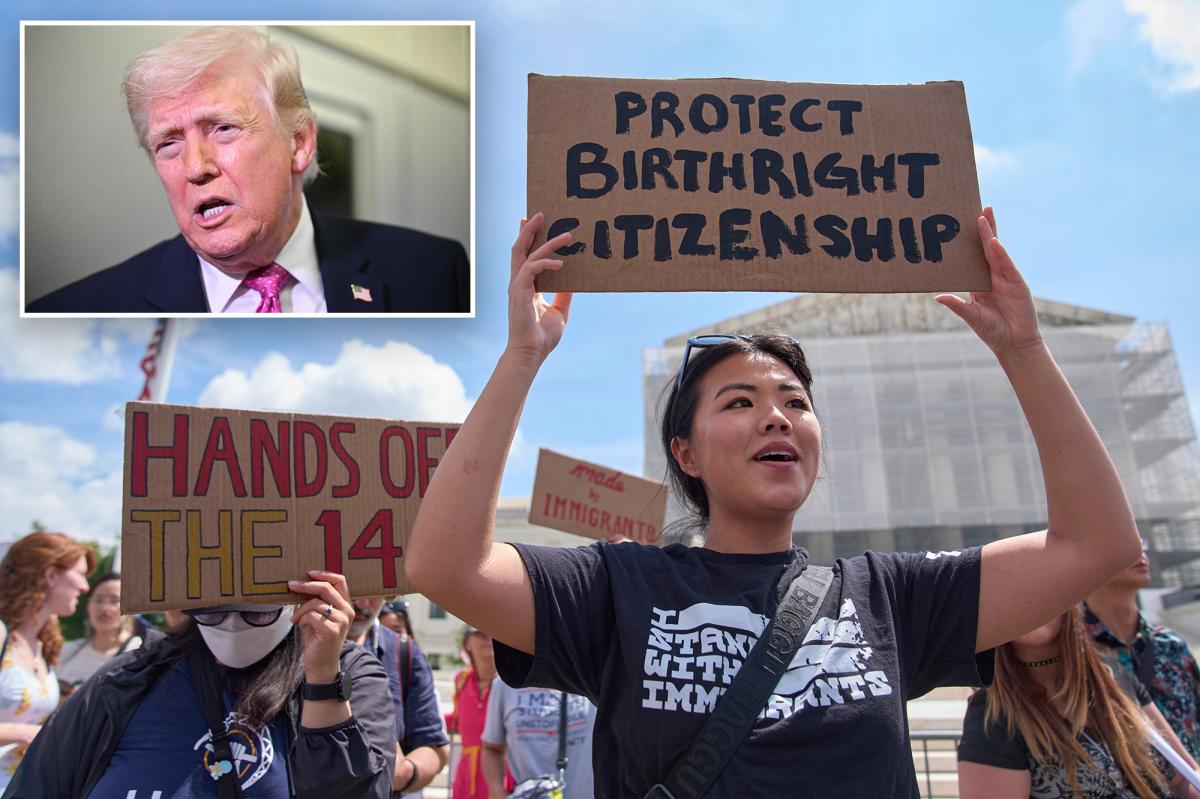
WASHINGTON — One of President Trump’s most ambitious policy endeavors — his effort to end birthright citizenship — is set to face its moment of truth before the Supreme Court on Wednesday, just over a month after it axed the centerpiece of his tariff agenda.
The Supreme Court will decide whether Trump’s attempt to block the kin of illegal immigrants born on US soil from automatically becoming citizens is within his power, something that is widely seen as the most consequential case left on its docket.
“This is a glaring red line for the Supreme Court justices that they don’t get to give away citizenship. They don’t have that power,” Mike Davis, a staunch Trump ally and founder of judicial advocacy group Article III Project, told The Post. “We the people never agreed to give this away.”
“These justices need to follow the law or they’re going to lose their legitimacy,” he added. “There’s no more important of a case before the Supreme Court.”
Before the high court is a question of the legality of Trump’s executive order to end so-called birthright citizenship that he signed during his very first day back in office last year.
Trump had toyed with the idea of tackling birthright citizenship during his first administration, but ultimately, that never came to fruition. At the time, even many conservative legal scholars were deeply skeptical that he could end birthright citizenship for illegal immigrants with the swipe of a pen.
“It really used to be more of a fringe view that language could be reinterpreted in this way,” Ming Hsu Chen, a law professor and director of the Race, Immigration, Citizenship, and Equality Program, University of California-San Francisco, said.
“I’m a little surprised that the Supreme Court would take up this case on the merits, because on the merits, it seems like the decision is pretty clear,” she added, referring to the textualist and precedential arguments against Trump’s order.
Birthright citizenship stems from the 14th Amendment, which stipulates that “all persons born or naturalized in the United States, and subject to the jurisdiction thereof, are citizens of the United States and of the State wherein they reside.”
Trump’s team has latched onto the word “jurisdiction” and argued that illegal immigrants aren’t exactly subject to the jurisdiction of the US. They’ve also pointed to the Supreme Court’s ruling in the 1884 case Elk v. Wilkins, which states that the children of Native Americans aren’t guaranteed birthright citizenship.
“Children of temporarily present aliens or illegal aliens are not ‘subject to’ the United States’ ‘jurisdiction,’ as the historical evidence—especially from the critical juncture immediately surrounding ratification—firmly shows,” Trump’s team wrote in its brief on the case.
Congress later passed the Nationality Act of 1940 to guarantee the children of Native Americans citizenship.
“The purpose of the Nationality Act was to gather all the rules about nationality to put them all in one place for comprehensiveness and clarity,” Gerald Neuman, a professor at Harvard Law School, who specializes in immigration and constitutional law, said.
Backers of the executive order argue that the Nationality Act of 1940 helps their case that there is more of a gray area in the 14th Amendment, while opponents contend that Trump is violating both the Constitution and statutory law.
The Supreme Court is evaluating whether Trump’s order complies with both that statute and the 14th Amendment.
So far, every lower court that has looked at the executive order has deemed it illegal. The Supreme Court also dealt with a birthright citizenship question in the 1898 US v. Wong Kim Ark case, which revolved around the status of a man born to Chinese immigrants.
The high court ruled in that man’s favor and determined that almost all native born children automatically become citizens, with a few exceptions, such as foreign rulers, diplomats, and hostile foreign invaders.
“It is incorrect to say that the … Wong Kim Ark decision has settled this question, because Wong Kim Ark involved lawful domiciled parents, and the case before the Supreme Court today involved temporary visitors or unlawfully present aliens,” Ilhan Wurman, Professor of Law at the University of Minnesota, said.
“The court has never actually addressed the meaning of the 14th Amendment as applied to the two categories of persons at issue in the Trump executive order,” he added, referring to the children of illegal immigrants and temporary visitors.
Some legal scholars believe that a major complication for Trump’s effort to nix birthright citizenship for illegal immigrants is the fact that he used an executive order to end it.
“There had been a theory that had been pushed as to how Congress could change the rule without amending the Constitution, but nobody had really been talking about the president having the authority to do this by executive order,” Neuman said.
“It’s extremely solid,” he added about the legal case against Trump’s executive order. “First of all, the precedent is very strong. And second of all, if you talk about it as a textualist, the key term in the Constitution is the arguments that are being put forward try to give jurisdiction a twisted meaning that it doesn’t normally have.”
Wurman countered that presidents often have to “interpret the statutes for purposes of executing the law” and that other presidents have had similarly controversial interpretations that the courts would later adjudicate.
Critics of the existing birthright citizenship policy argue that it has made the US a magnet for illegal immigrants and has helped fuel the border crises America has weathered over the years.
“There is no chance in hell that that was ever intended by the plain text or the original public meaning of the 14th Amendment to allow illegal aliens to have birthright citizenship,” Davis contended.
“Invading armies don’t get birthright citizenship. Foreign ambassadors’ kids don’t get birthright citizenship. Why the hell would Chinese birth tourists get birthright citizenship?”
Very few countries outside the Americas offer birthright citizenship as universal as the US does, to the point where illegal immigrants automatically become naturalized. Most of the ones that do aren’t fully developed countries.
“We have other important Supreme Court cases that have consistently held that the rights of children of undocumented immigrants are distinct from the rights of their parents,” Ming countered.
“I think it falls outside the scope of what the law has allowed to be up for policy debate in terms of blaming the children or saddling the children with the consequences of their parents’ actions.”
Trump has signaled some nervousness that the Supreme Court could rule against him on the birthright citizenship case in light of the massive blow it dealt him on tariffs last month.
“Birthright Citizenship is not about rich people from China, and the rest of the World, who want their children, and hundreds of thousands more, FOR PAY, to ridiculously become citizens of the United States of America,” Trump declared on Truth Social Monday. “It is about the BABIES OF SLAVES!”
“We are the only Country in the World that dignifies this subject with even discussion,” the president went on. “The World is getting rich selling citizenships to our Country, while at the same time laughing at how STUPID our U.S. Court System has become (TARIFFS!)”
During its last term, the Supreme Court dealt with a peripheral issue in the birthright citizenship case about whether the lower courts could impose universal injunctions to block presidential actions, specifically Trump’s order on birthright citizenship.
Ultimately, the high court ruled in Trump’s favor to nix universal injunctions, but the lower courts blocked his executive order when a challenge against it was refiled as a class action lawsuit.
Justices did little to tip their hand about their thoughts on the merits of the case.
Read the full article here