

The numbers are in, and they are, as Miranda Priestly herself might say, groundbreaking. The Devil Wears Prada 2 opened to an estimated $233.6 million worldwide in its opening weekend, including $77 million domestically and $156.6 million internationally — one of the strongest theatrical debuts of 2026. It is the first female-driven movie in modern history to kick off the summer box office, a title that has almost always gone to a Marvel superhero film. For an industry that has spent years debating whether legacy IP can carry a sequel, and whether female-skewing films can lead the summer, The Devil Wears Prada 2 just answered both questions with a resounding and very chic yes.
But here is the question worth asking: how much of this belongs to nostalgia, and how much belongs to an exceptional marketing campaign that refused to let nostalgia do the work alone?
The answer is both — and that is exactly what makes this rollout worth studying.
The Nostalgia Is Real, and It Was Not Left to Chance
Let’s give the obvious its due. The original Devil Wears Prada is one of those rare films that never left the cultural conversation. With endlessly quotable lines and a starry cast that has only ascended on the A-list, the 2006 film has remained a generation-spanning cultural touchstone. Twenty years later, the built-in audience was enormous, passionate, and hungry. According to Nielsen, streaming viewership for The Devil Wears Prada surged 428% from March 2026 to April 2026 — a number that tells you everything about who was getting ready for opening weekend and how intentional the campaign was about warming that audience up ahead of release.
But nostalgia is passive. It lives in the hearts of people who already love something. What this marketing team understood — and executed masterfully — is that nostalgia alone fills a theater once. Strategy is what fills it opening weekend, beats projections, and breaks records globally. This campaign did not assume the audience would show up. It gave them every possible reason to.
The Trailer Rollout
Every great rollout needs a moment that cracks the internet open. For The Devil Wears Prada 2, that moment came in December when the teaser trailer dropped. The teaser generated 185 million views in the first 24 hours, making it the most-viewed 20th Century Studios trailer ever, the second most-viewed trailer of 2025, and the most-viewed trailer on Instagram that year.
That is not a nostalgia number. That is a marketing number.
The first full trailer, released on February 1, 2026, recorded 222 million views within its first 24 hours, which 20th Century Studios described as the most-viewed trailer in the studio’s history. The studio did not stop there. The second trailer garnered 222 million views in 24 hours and the final trailer amassed 67 million views in the first 24 hours, placing both above all comparable films.
Each trailer drop was an event in itself, not just a preview. The final trailer made sure of that by debuting the film’s original song. Lady Gaga and Doechii joined forces for “Runway,” the first new music from The Devil Wears Prada 2, soundtracking the final trailer for the sequel. The song was written alongside Bruno Mars and a roster of hitmakers, and its release created a second wave of cultural conversation entirely independent of the film itself — giving the campaign a music moment, a streaming moment, and a fashion moment all at once.
The Inescapable Press Tour
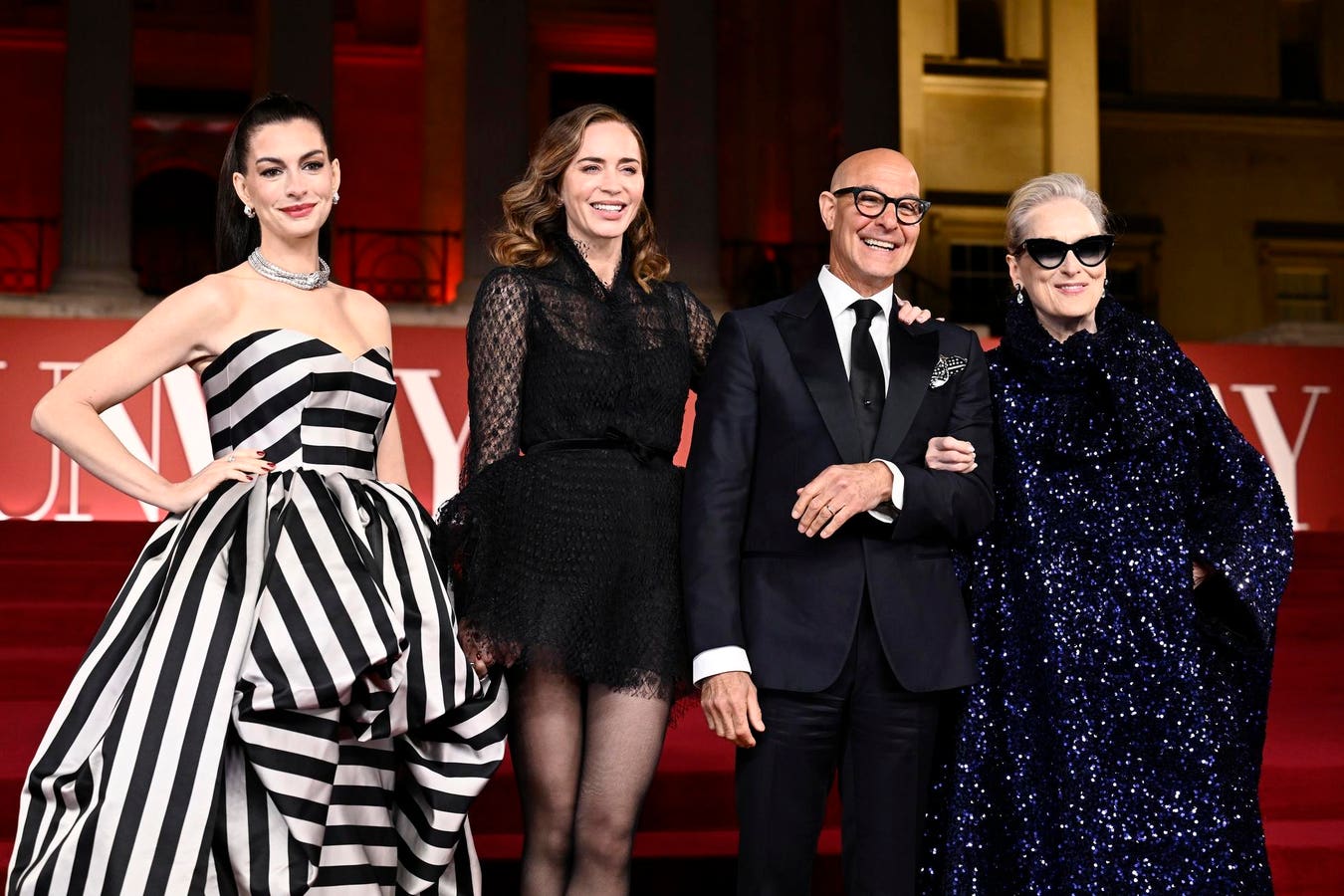
The global press tour for The Devil Wears Prada 2 was not a press tour. It was a spectacle. The global tour kicked off in Mexico City with Hathaway and Streep before continuing to Tokyo, Seoul, and Shanghai. The entire cast reunited in New York, where a full Runway Magazine office was created for two global press days and the world premiere, before flying across the pond to London for the U.K. premiere.
Streep and Hathaway traveled to South Korea to promote the film and participated in an interview with singer Jang Won-young. Anne Hathaway’s viral “inshallah” moment during her press tour made international headlines, with her casual utterance of the word during an interview amplifying her popularity among Muslim audiences, with one fan even gifting her a Quran at the London premiere. These were not manufactured moments. They were the organic result of a press tour that was expansive enough, human enough, and culturally curious enough to generate them.
Simone Ashley, who plays Amari Mari — Miranda Priestly’s sharp, self-assured new first assistant — was one of the breakout stars of the press circuit. Her on-stage interview in New York City as part of the film’s fan event, dubbed the La Watch Party, gave audiences a direct and intimate window into both her and the film ahead of opening weekend.
The Controversial Anna Wintour Play
Perhaps the single most audacious move of the entire rollout was what happened with Anna Wintour. In 2006, the fashion industry was so afraid of her that when the original film was being made, the entire fashion industry feared Vogue’s reaction, making it nearly impossible to source clothing for the production. Twenty years later, the calculus has completely flipped.
On April 7, Vogue dropped their May cover featuring Meryl Streep alongside Wintour — the first time in almost 40 years at the helm that Wintour had appeared on the magazine’s cover. The shoot was lensed by Annie Leibovitz, styled by Grace Coddington, and the cover story was written by Wintour’s successor Chloe Malle and moderated by Greta Gerwig. The tagline: “When Miranda Met Anna.”
Both women wore Prada, of course, as a nod to the forthcoming film. It was a perfectly orchestrated wink — the inspiration appearing alongside the portrayal, dressed in the brand that names the film, on the cover of the magazine that started it all. The cultural symbolism was almost too clean to be real. And it drove a full news cycle on its own.
Earlier, Wintour had appeared alongside Anne Hathaway at the 98th Academy Awards to present the award for Best Costume Design. The two walked out to an acoustic version of “Vogue” by Madonna — the same song that plays during Andy Sachs’ iconic makeover scene. The crowd’s reaction was immediate. The internet’s reaction was immediate. The Oscars stage became a promotional vehicle weeks before the film’s release.
The Runway Ready Merch Bundle
On the product side, Disney and the studio understood that this audience does not just want to watch the film — they want to experience it. The Devil Wears Prada 2 popcorn purse became one of the most talked-about theatrical merchandise items in recent memory, accessorized with a keychain charm featuring a pitchfork heeled stiletto. It was not just a novelty. It was a fashion object. It was shareable. It was the kind of thing you post.
Fandango offered the Runway Ready Bundle — a $50 package that included one movie ticket, the popcorn purse, and a limited-edition promotional Runway Magazine — creating a premium ticketing tier that turned the opening weekend experience into a collectible event. Initial stock sold out quickly, with pre-orders extended through May 13, 2026. Selling out merchandise before a film opens is not nostalgia. That is desire manufacturing at its finest.
The Lady Gaga Factor
No breakdown of this rollout is complete without talking about how the Lady Gaga involvement was handled. Gaga’s cameo in the film was kept tightly under wraps during production, her presence in Milan during filming noted by fans but never officially confirmed. It was Meryl Streep herself who personally called Gaga after the two met at SNL 50, and Gaga said yes on the spot — mid-world-tour — and flew to Milan to film.
Gaga ultimately wrote three original songs for the film: “Runway,” the duet with Doechii, along with “Shape of a Woman” and “Glamorous Life.” The decision to use “Runway” in the final trailer gave the campaign a pop culture drop that generated its own press cycle — a Gaga music moment embedded inside a film marketing moment, designed to travel far beyond the core audience of the original film.
At the New York premiere at Lincoln Center, Gaga’s surprise appearance on the red carpet confirmed her cameo publicly for the first time, shutting down the step-and-repeat in a vintage Saint Laurent gown. Her appearance was the last major marketing surprise of the campaign, and it landed exactly as intended — a final jolt of cultural electricity right before opening weekend.
So: Marketing or Nostalgia?
The answer is that this film’s opening weekend success is the product of a team that understood nostalgia is a starting point, not a strategy. The love for the original was the room. The marketing campaign was what filled it. Female moviegoers were waiting for this movie for 20 years — but they were given trailers that broke records, merchandise they actually wanted, a press tour that became content, talent they were excited to discover, and a cultural spectacle that felt worthy of the original’s legacy.
The Devil Wears Prada 2 did not just capitalize on what people remembered. It gave them something new to feel. That is the difference between a nostalgia play and a genuine rollout. And for anyone studying what a studio-backed campaign looks like when it truly fires on all cylinders, this is the case study worth dissecting.
That’s all.
Read the full article here