


What The Official Readouts, The American CEO Banquet, And A Flood Of Social-Media Memes Say About Doing Business In China Today
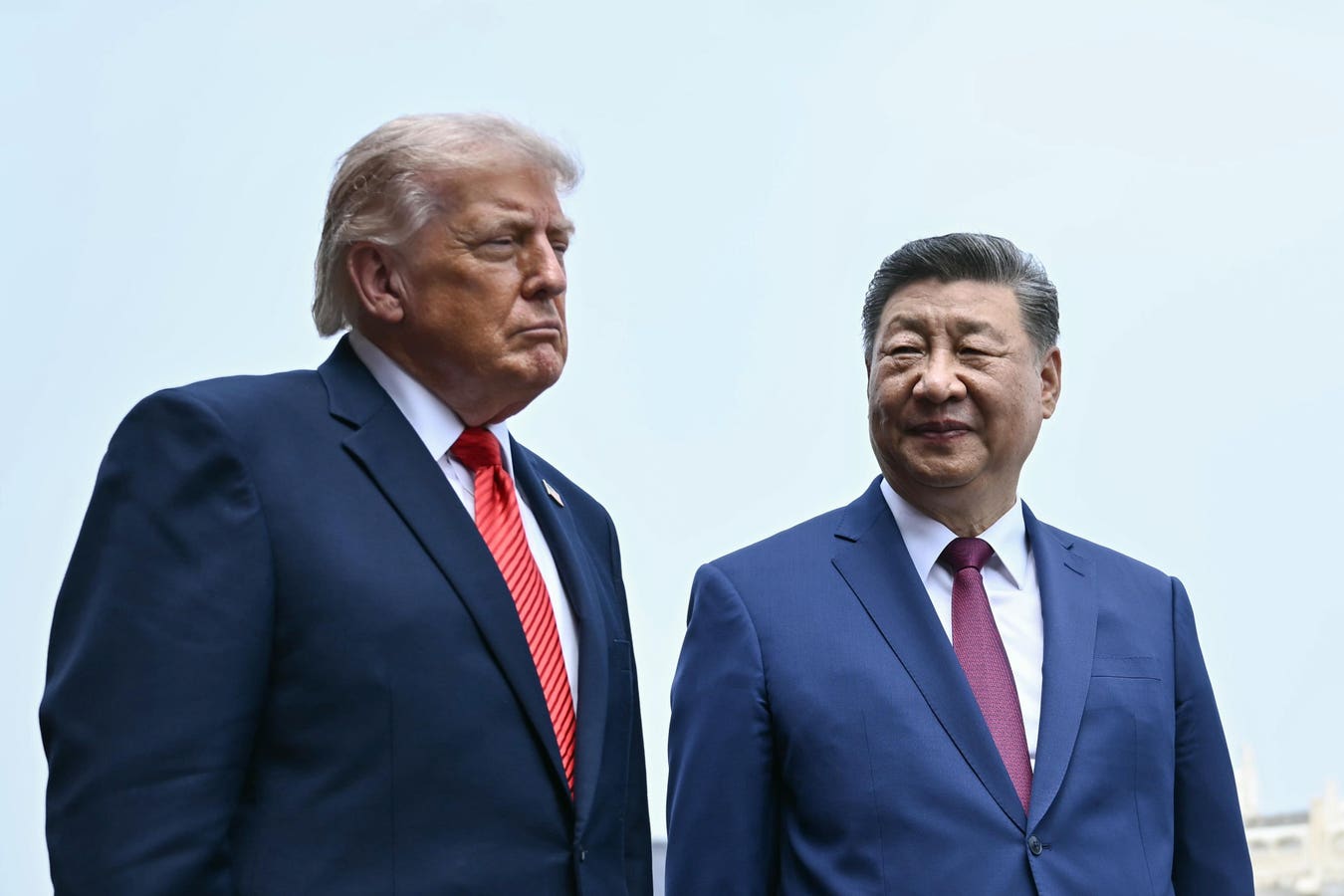
When Donald Trump’s motorcade rolled into Tiananmen Square on May 14, Chinese state television lingered on a single tableau: the U.S. president standing on the red carpet outside the Great Hall of the People, flanked by Apple’s Tim Cook, Tesla’s Elon Musk, Nvidia’s Jensen Huang, Blackstone’s Steve Schwarzman, and a dozen other American CEOs. Twenty-one cannons fired in salute. A military band played both national anthems. By Beijing’s count, this was the first U.S. presidential state visit in nine years, and only the third visit by any foreign leader in recent memory to merit the full ceremonial package — Vladimir Putin in 2024 and Trump himself in 2017 being the others.
Most American coverage of this week’s Trump-Xi summit has parsed what the two leaders said and which trade deals — soybeans, Boeing jets, GE engines — were announced on Fox News afterward. The more revealing material lies on the Chinese side: in the language of the official readouts, in Premier Li Qiang’s parallel meeting with the American CEOs, and in how Chinese social media absorbed the spectacle. The pageantry, with the American president and a collection of the world’s wealthiest men in a sea of Chinese flags, was the essential message.
Avoiding the Thucydides Trap
Xi’s opening remarks, carried verbatim by Xinhua and the Foreign Ministry, framed the meeting around a single rhetorical question: Can China and the United States “cross the Thucydides Trap and open a new paradigm for great-power relations?”
This was a direct reference to the theory that the tensions provoked by a rising power and the fear it invokes in the established power nearly inevitably lead to war. Harvard political scientist Graham Allison found that beginning with Sparta’s war with a rising Athens, conflicts have broken out in 12 out of the 16 historical cases. Xi’s remarks held out the potential that the U.S. and China can beat the odds if the relationship transitions from confrontation to “constructive strategic stability” over the next three years.
Renmin University’s Jin Canrong, a prominent foreign-policy commentator with a regular state-media platform, summarized the Chinese mood plainly: “China earned equality through strength.”
The Trillion-Dollar Delegation
Trump brought a delegation worth, in personal net worth, close to a trillion dollars: Tim Cook, Elon Musk, Jensen Huang, Steve Schwarzman, BlackRock’s Larry Fink, Citigroup’s Jane Fraser, Goldman’s David Solomon, and a dozen others.
The formal business event was a parallel meeting hosted by Premier Li Qiang on the afternoon of May 14. The Foreign Ministry’s official readout names every American firm represented — Apple, Nvidia, Meta, Cargill, Tesla, Boeing, Citi, Goldman Sachs, GE Aerospace, Qualcomm, Visa, Micron, Mastercard, BlackRock, Blackstone, Coherent, Illumina, and the New York Stock Exchange.
Li hosted the Americans as head of government, speaking to visiting executives, not as one side in an industry-to-industry dialogue. There was no parallel parade of Chinese tech and industrial champions in the room — no Pony Ma from Tencent, no Robin Zeng from CATL, no Wang Chuanfu from BYD. That asymmetry was deliberate. After the regulatory campaigns that restructured a generation of platform founders, Beijing’s playbook is now to let officials lead and to keep private-sector champions in supporting roles. The message to American executives was that in this market, industrial policy and market access are determined by the Party and aligned with national security and development goals, not lobbying muscle.
Chinese executives did surface — but at the state banquet that evening, in carefully chosen supporting cameos. Xiaomi’s Lei Jun, Lenovo’s Yang Yuanqing, and ByteDance’s Liang Rubo all attended. The viral moment of the banquet, captured on video and rebroadcast endlessly across Weibo, was Lei Jun walking up to a seated Musk, tapping him on the shoulder, and crouching half-down to take a selfie with him on a Xiaomi 17 Pro. Musk obliged with a wink to the camera. Chinese commentators read this as one of the Chinese auto industry’s most aggressive Tesla competitors pulling rank as the comfortable host, with Musk in the role of distinguished foreign guest.
Chinese Netizens Swoon for American “CEO Tourists”
Chinese social media’s reaction to the American CEO delegation was, by the standards of state-managed platforms, remarkably relaxed and affectionate. In Chinese cyberspace, where sensitive comment threads get scrubbed within minutes, what the censors permit to circulate is itself a signal. This week, they permitted a great deal.
The image of the week was Musk standing in the plaza outside the Great Hall of the People, phone aloft, spinning a full 360 degrees to capture a panoramic video of his surroundings while Cook, Huang, and the other CEOs stood respectfully still. Chinese netizens went after it with affection rather than mockery. One widely circulated comment compared Musk to “someone on a company-expensed vacation, snapping pictures for WeChat Moments”. Another joked, “If you don’t post it to your Moments feed, you didn’t really come.” A third: “Brothers, this is China — the energy here is just different.” The richest man in the world, $688 billion in personal wealth, behaving like a tourist who couldn’t believe he was actually at the center of Chinese imperial power.
The other breakout star of Chinese social media this week was Musk’s six-year-old son, X Æ A-12. Musk brought him to a working session at the Great Hall, where X showed up wearing a traditional Chinese embroidered vest, a tiger-head hat, and carrying a tiger-head shoulder bag. Musk posted in Chinese on his X account that evening: “我的儿子正在学习普通话” — “My son is learning Mandarin.” Within hours, a Guangxi e-commerce shop selling traditional tiger-head bags was renaming the product “Musk’s son’s bag” and seeing sales jump from two units to over 200 in less than half an hour. By midnight, the listing was sold out.
Even Jensen Huang, who was added to the delegation at the last minute after public criticism of his initial exclusion, became a Chinese internet character. Videos of him eating street noodles, buying milk-skin yogurt at a Beijing hutong stall, and grabbing bubble tea from Mixue Bingcheng circulated alongside footage of him in a suit, in place of his trademark leather jacket, telling reporters the summit was “great.”
The implicit message in Chinese feeds was that even the CEO of the world’s most valuable company — whose Nvidia chips have been restricted from sale in China by Washington — was making an obvious pitch for the Chinese market. Whether Huang gets the H200 sales approval he is hoping for on a market he has publicly valued at $50 billion will be the most-watched China-policy outcome of the next 90 days in Chinese tech circles.
Hospitality With Conditions
Beijing’s warmth to the CEO class this week was real, calibrated, and entirely conditional.
Real, because China genuinely needs U.S. technology partnerships and access to the U.S. consumer market to hit the growth targets in the 15th Five-Year Plan that the National People’s Congress approved on March 12, which holds 2026-2030 GDP growth in the 4.5-5% range and ratifies the Central Committee’s industrial-policy push toward advanced manufacturing, AI, robotics, and biomanufacturing.
Calibrated, because Chinese policymakers have learned they extract better terms from individual American firms — especially those publicly identified as champions of engagement — than from the U.S. government.
Conditional, because the moment Washington moves on chips, on Taiwan arms sales, or on any of half a dozen other red lines, the temperature in Chinese policy meetings will drop within hours.
Trump returned home with a few announceable wins: 200 Boeing 737s (with a “promise” of up to 750 if China is satisfied), 400-450 GE Aerospace engines, and roughly $10 billion in agricultural purchases per U.S. Trade Representative Jamieson Greer. But the cautionary tale here is Trump’s 2017 Beijing visit, which produced a $250 billion deal sheet that ultimately delivered very little of substance. Chinese purchase commitments tend to be inversely correlated with how loudly they are announced.
What the American CEOs in Beijing came for is harder to count. Huang needs regulatory clarity on AI chip exports. Cook needs Apple’s complicated dance with Chinese suppliers, regulators, and consumers to keep working. Cristiano Amon at Qualcomm and Sanjay Mehrotra at Micron face the same set of questions about export controls and Chinese demand. Visa, Mastercard, and Citi are inching toward genuinely open positions in Chinese payments and banking. Almost every one of these executives runs a business that still benefits enormously from the global open trading system. They came to Beijing partly to tell Trump, in the politest way possible, that they would like it preserved.
Read the full article here