




Pros
- Very good sound with surprising amount of bass for a compact Bluetooth speaker
- Waterproof and dust-proof rugged design with built-in handle and tie-down anchor
- Strong magnets allow you to stick the speaker to anything metal
- Good battery life (up to 25 hours)
Cons
- No companion app
- No sound modes or equalizer option to tweak the sound
Turtlebox made a name for itself with its self-titled ruggedized lunchbox-style Bluetooth speaker, known for playing loud and being a good option for boaters in search of a mountable “marine-grade” portable speaker. That original speaker is now in its 3rd generation.
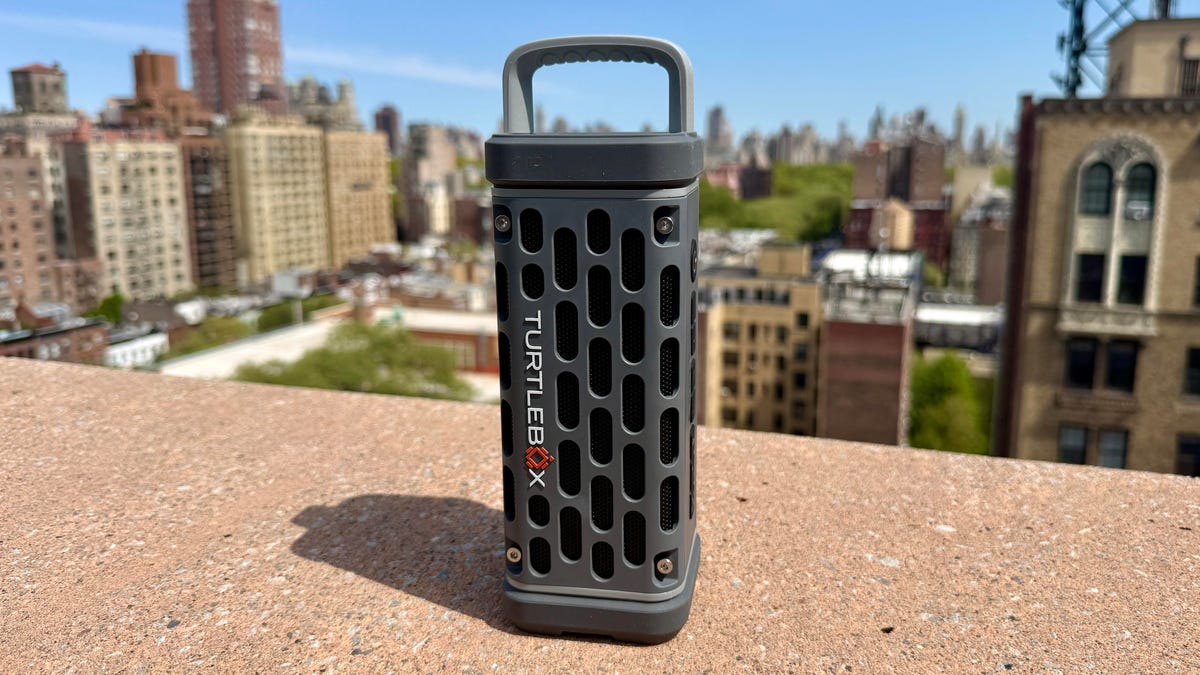
More recently, Turtlebox released the larger Turtlebox Grande ($730) and the Turtlebox Ranger. The Ranger, with an integrated handle and a pair of strong magnets for quick mounting to metal surfaces, delivers surprisingly solid audio for its compact, durable design. While pretty pricey at $250, it’s one of the top mini Bluetooth speakers out there right now.
Read more: Best Bluetooth speakers right now
Enlarge Image
The speaker comes in a few different color options. The special-edition yellow version (left) is currently sold out.
Turtlebox Ranger design
Weighing 2.4 pounds and measuring 8.1 by 3.2 by 3.2 inches, the Ranger is slightly heavier than the 2.2-pound JBL Charge 6. While it’s ostensibly a vertically oriented speaker, you can lay it on its side or mount it on a metal surface to give it a horizontal orientation. Like many Bluetooth speakers these days, it has an IP67 rating, which means it’s waterproof and dustproof, though it doesn’t float. A rubber gasket covers its USB-C charging port.
The speaker has a pair of magnets on one side.
Turtlebox also says it’s shockproof, and both its base and sides have fairly thick rubber shock absorbers. The only issue is that the rubberized finish (it’s on the handle as well) can attract dust, dirt and hair, though it’s easy enough to wash off, especially since the speaker is waterproof and can be submerged in water up to 3 feet deep for 30 minutes.
Beyond the magnets, which are quite strong, is a built-in anchor (a small metal bar) hidden in the base of the speaker that allows you to tie it down to keep it from going anywhere.
The tie-down anchor in the base.
Turtlebox Ranger’s limited feature set
Equipped with Bluetooth 5.4, the Ranger doesn’t have many features beyond the ability to pair with other Turtlebox speakers to expand the sound or create a stereo pair with another Ranger. There’s no Turtlebox app to tweak the sound with an equalizer or adjust lighting, though its buttons are backlit in blue when the speaker is on (which is helpful for nighttime use). Nor does it have a sound mode button to boost bass or speakerphone performance.
The speaker is equipped with physical buttons to adjust volume and advance tracks forward and back. One button lets you create a stereo pair, while another lets you daisy-chain multiple Turtlebox speakers.
Bluetooth speakers typically have pretty limited feature sets, though it’s rare these days for them not to have a companion app that, at a minimum, allows for firmware updates.
The speaker shown stuck to a piece of metal.
Turtlebox Ranger sound quality and battery life
I spent some time comparing the Ranger to the Bose SoundLink Plus, which retails for $279 and earned a CNET Editors’ Choice Award, as well as the JBL Charge 6 ($200). Of the three, the Bose Soundlink Plus arguably comes out on top for sound by a slight margin (it just sounds a little smoother and well-balanced overall). But it’s a close contest, and the Ranger and Charge 6 also sound impressive for their size.
The midrange and vocals on the Charge 6 are a little more recessed compared to the Ranger, but JBL’s bass is a little more energetic and goes a little deeper. That said, the Ranger delivers a pretty powerful, punchy bass for a speaker this size and has good tonal balance overall.
Enlarge Image
I compared the Turtlebox Ranger to the JBL Charge 6 and and Bose SoundLink Plus.
While more often than not the Bose came out on top when I ran through my test tracks, I did experience some variation from track to track, and sometimes the Charge 6 or the Ranger delivered superior sound.
You can get a bit of distortion at higher volumes from all these speakers, and when you’re listening to more complicated tracks with a lot of instruments layered, I did hear some clipping in certain frequencies as the speakers’ respective DSPs (digital signal processors) did their best to resolve the sound and keep it from distorting. In other words, when it comes to sound quality, none of these speakers is perfect, and you can expect some moments where you think they sound great and other moments where they fall a bit short.
While I did most of my critical listening indoors, all these speakers are designed for outdoor use and do well in producing fairly loud, expansive sound, given their compact size. As expected, the Ranger sounds significantly better when you pair two of them wirelessly and create a stereo pair that delivers real stereo separation.
As for battery life, the Turtlebox Ranger is rated for up to 25 hours of playtime at moderate volume. I tested it over the course of a week and didn’t need to charge it.
Turtlebox Ranger final thoughts
The Turtlebox Ranger went a little under the radar after its release last year — at least with tech reviewers like myself. I’m already seeing some more affordable knocks-offs appearing on Amazon (see the Krocx Travor), which is what tends to happen when a Bluetooth speaker becomes popular. For example, the Bose SoundLink Flex has inspired a few copycats over the years.
While the Ranger features very good sound for its size and puts up an admirable fight against other premium Bluetooth speakers like the Bose SoundLink Plus and JBL Charge 6, what really sets it apart is its design, especially its built-in magnets. I’ve tried a few other speakers with integrated magnets aimed at golfers and boaters, including the Rokform G-Rok ($100), but the Ranger plays louder and sounds better. Although it’s somewhat pricey, it’s easy to recommend.
Read the full article here