




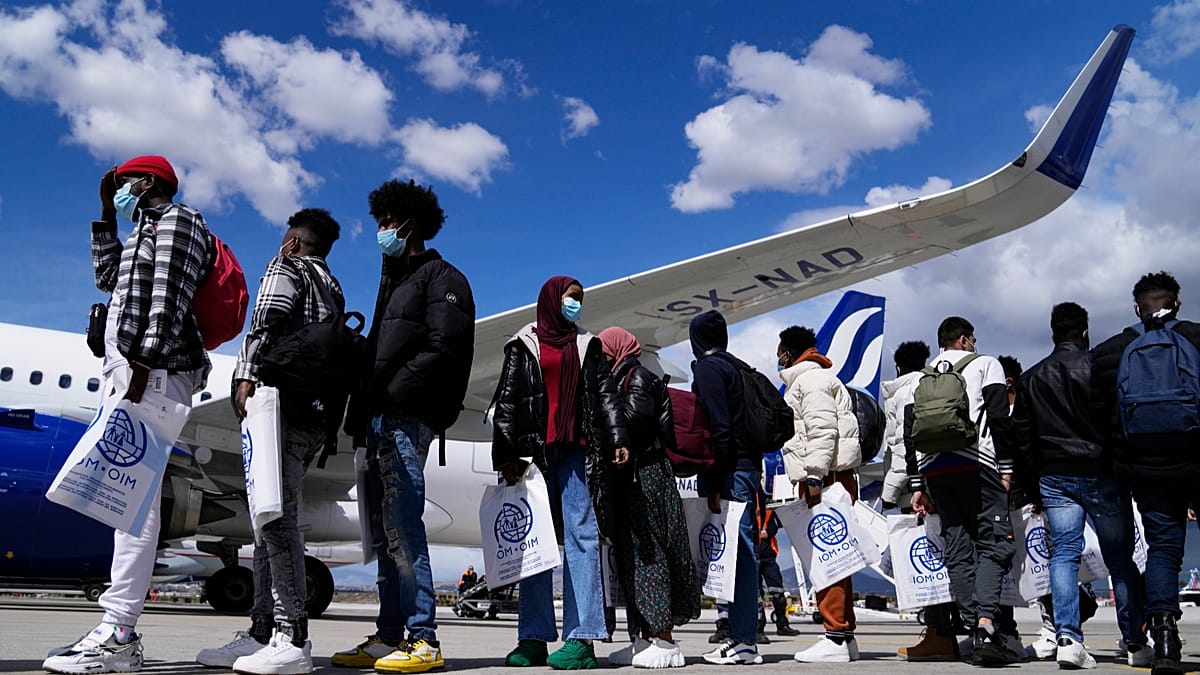
Europe is simultaneously in desperate need of workers and determined to keep more people out, with its Migration and Asylum Pact taking full effect on June 12. That contradiction sits at the heart of one of the continent’s most politically charged debates, and it is becoming harder to ignore.
With unemployment at historic lows and employment rates at record highs, EU labour markets are running on empty. Structural shortages plague healthcare, construction, agriculture, transport and tech sectors. And the cause is no mystery: Europe is ageing rapidly. In 2022, roughly 22 per cent of the EU’s population was aged 65 or older. The working-age population is shrinking, particularly in Germany, Italy and Central and Eastern Europe.
On 1 June, EU co-legislators agreed on new “return hubs” outside EU borders to detain migrants without the right to remain. Days later, on 12 June, the full Migration and Asylum Pact enters into force. It is the most extensive overhaul of European migration law in decades, built around tougher screenings, faster deportations, and stricter border controls.
The numbers that don’t add up
Since 2019, non-EU nationals have filled over half of the net job growth in the EU. In Italy, migrants support an estimated 600,000 pensions through social security contributions, paying approximately €8 billion annually into the welfare system while receiving about €3 billion in benefits. In Germany, each employed migrant contributes to current retirees at the same statutory rate as nationals.
The European Commission, the ECB, and multiple research institutions agree that immigration is one of the few viable options to maintain economic growth and support welfare systems.
Nicolas Schmit, former European Commissioner for Jobs and Social Rights and now an MEP with the S&D group, and president of FEPS, puts it bluntly. “Those who tell you the contrary don’t tell you the truth,” he says. “If Europe goes for zero migration, we will end up in a dead continent.”
Yet public debate rarely reflects these numbers. Instead, it is dominated by scenes of overcrowded reception centres like those in Lampedusa and Moria and by rising political pressure from far-right and centre-right parties demanding visible action at the borders.
A tale of two tracks
What has emerged is a “dual track” approach, as researchers call it. Governments tighten asylum rules and border enforcement for public consumption, while quietly expanding targeted labour migration schemes for sectors they cannot afford to leave understaffed.
Italy’s government, for instance, has promoted an anti-immigration agenda while approving “flows decrees” that admit tens of thousands of non-EU workers annually. Germany has reformed its Skilled Immigration Act to create new pathways for workers without university degrees.
Schmit, who co-launched the EU’s Talent Partnership and Talent Pool initiatives with then-Migration Commissioner Ylva Johansson, says this gap between rhetoric and reality is not sustainable. “We have to transform this toxic discussion on migration into a real one, a debate which is based on facts,” he argues. “But I know, in our time, facts are not always at the centre.”
Tesseltje de Lange, Professor and Director of the Centre for Migration Law at Radboud University Nijmegen, agrees that the political framing is misleading. “The rhetoric of less migration is a false narrative,” she says. “European businesses and households cannot do without migrant labour.”
When the system blocks itself
Even where legal pathways exist, the system is broken. De Lange’s research maps everyday obstacles preventing employers from filling vacancies with foreign workers: qualification recognition that can take up to a year and remains unharmonised across member states, visa appointment slots monopolised by brokers, and labour market tests that slow applications to a crawl.
“It sometimes takes some nine months just to get an appointment at an embassy,” de Lange notes, “because brokers have booked all available timeslots.”
The EU’s flagship tool for attracting skilled workers, the Blue Card, has been reformed through a 2023–2025 recast with lower salary thresholds, broader qualification criteria and improved intra-EU mobility. But uptake remains patchy, fragmented by competing national schemes and undermined by slow processing times and limited employer awareness.
At the same time, some governments are tightening family reunification rules while recruiting workers from abroad, a move de Lange describes as self-defeating. “To attract and retain talent, literature shows that family commitment is key to a successful placement. Tightening family reunification rules would seem counter-productive if the aim is to attract and retain migrant workers.”
What Europe actually needs
Schmit argues that the care sector alone shows how existential the stakes are. “Without immigration, in these ageing societies, we cannot really cover the services in the care sector,” he says. It is not only low-skilled roles. Europe also faces shortfalls in engineering, IT and the green and digital transition sectors, areas critical to the continent’s long-term competitiveness.
De Lange’s prescription for the next decade is procedural and rights-based: harmonised, expedited visa and qualification recognition processes, shortage occupation lists to fast-track applications, and better protection for workers already in the system. “Migrant workers should have an app giving access to all they need to know about their rights and to avoid abuse,” she says.
Schmit also calls for a comprehensive and transparent overhaul, including cooperation with countries of origin on skills development, remittances, and circular migration. “This is what Europe needs, this is what we have to do better,” he says. “It has to be a win-win. It cannot be just at the advantage of one side.”
The political trap
The Migration and Asylum Pact’s implementation is already running into trouble. A Commission report from 8 May found that while political willingness is high, practical execution is lagging. IT systems for migrant tracking and border detention facilities are behind schedule in Germany, Italy, Greece, Spain and Cyprus.
The bigger problem is not logistical. It is that European politics has locked itself into a debate about irregular migration, which “represents less than 10 percent of arrivals,” says Schmit. The far larger and more consequential question of organised labour migration gets drowned out.
As Schmit sees it, that is a choice Europe cannot afford to keep making: “We have to stress the absolutely positive sides of migration and not just stress the ones which might not always be positive.”
Read the full article here