




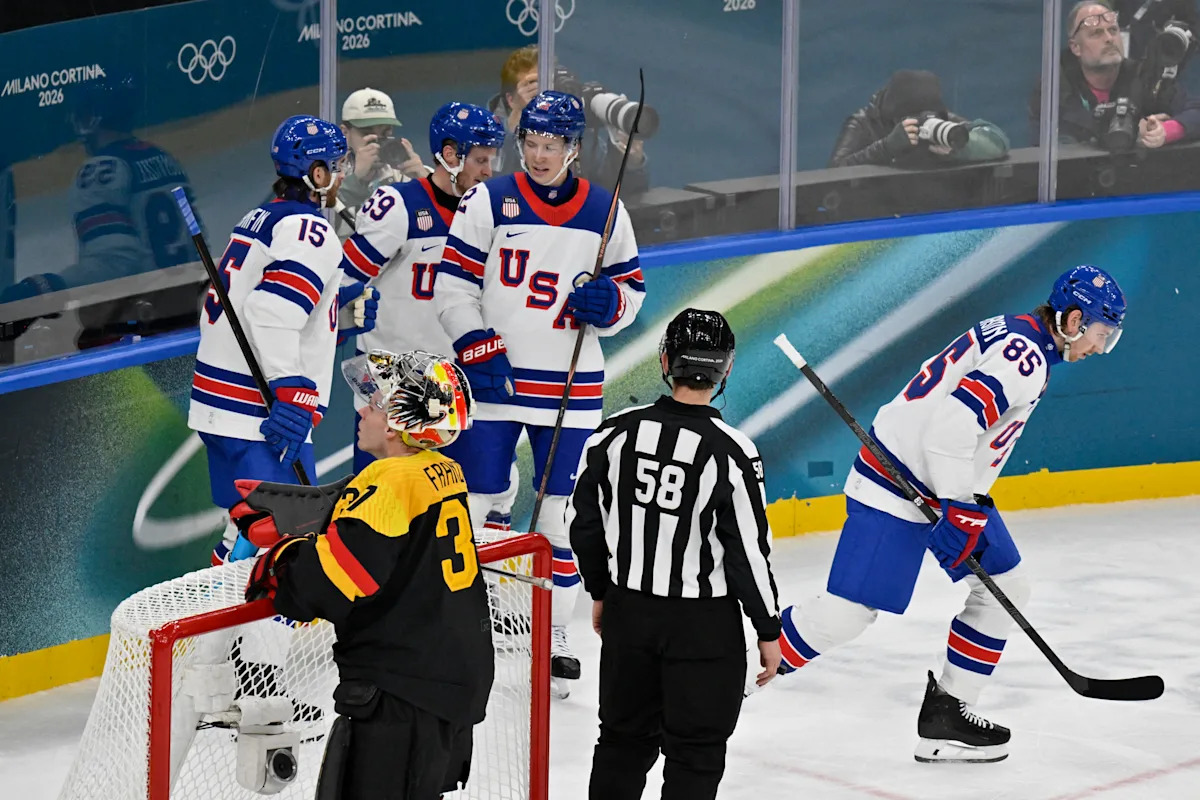
MILAN — For a team that comfortably won all three of its group-stage games to secure a bye to the Olympic men’s hockey quarterfinals, the U.S. will head to the knockout round with plenty of questions to answer.
The Americans weren’t as convincing as expected against a feeble group with no other credible medal threats.
A 5-1 victory over Germany on Sunday night served as a small step in the right direction. The U.S. finally seized control of the game in the latter two periods after being held scoreless for nearly the entire opening session.
Zach Werenski got the Americans on the board with 8.7 seconds left in the first period when he found space near the right face-off circle and fired the puck past German goalie Maximilian Franzreb. The goal salvaged a lackluster period for the Americans during which the Germans at times threatened to score.
The U.S. found its footing in the second period thanks to a pair of goals from Auston Matthews and Brock Faber. Matthews forced home the rebound of a Quinn Hughes shot from the point. Then Faber lofted a soft shot that appeared to be heading straight for Franzreb’s glove, but the German goalie whiffed on the catch and allowed the puck to find the net.
Tage Thompson and Matthews added goals early in the third period to extend the U.S. lead to 5-0. Only then did Germany finally get on the board as Tim Stützle found space near the left face-off circle and beat Connor Hellebuyck gloveside.
In the quarterfinals, the Americans could face much tougher competition. They’ll get the winner of a knockout-round matchup between Sweden and Latvia. The Swedes are loaded with NHL talent and arrived in Milan as medal favorites. They won two of their three group-stage games but failed to get a bye to the quarterfinals as a result of goal differential.
For the Americans to advance deep into this tournament, they will have to raise the level of play they have displayed so far.
Gold-medal favorite Canada outscored its three group-stage opponents by a score of 20-3. The U.S. hasn’t quite met that standard.
Read the full article here