




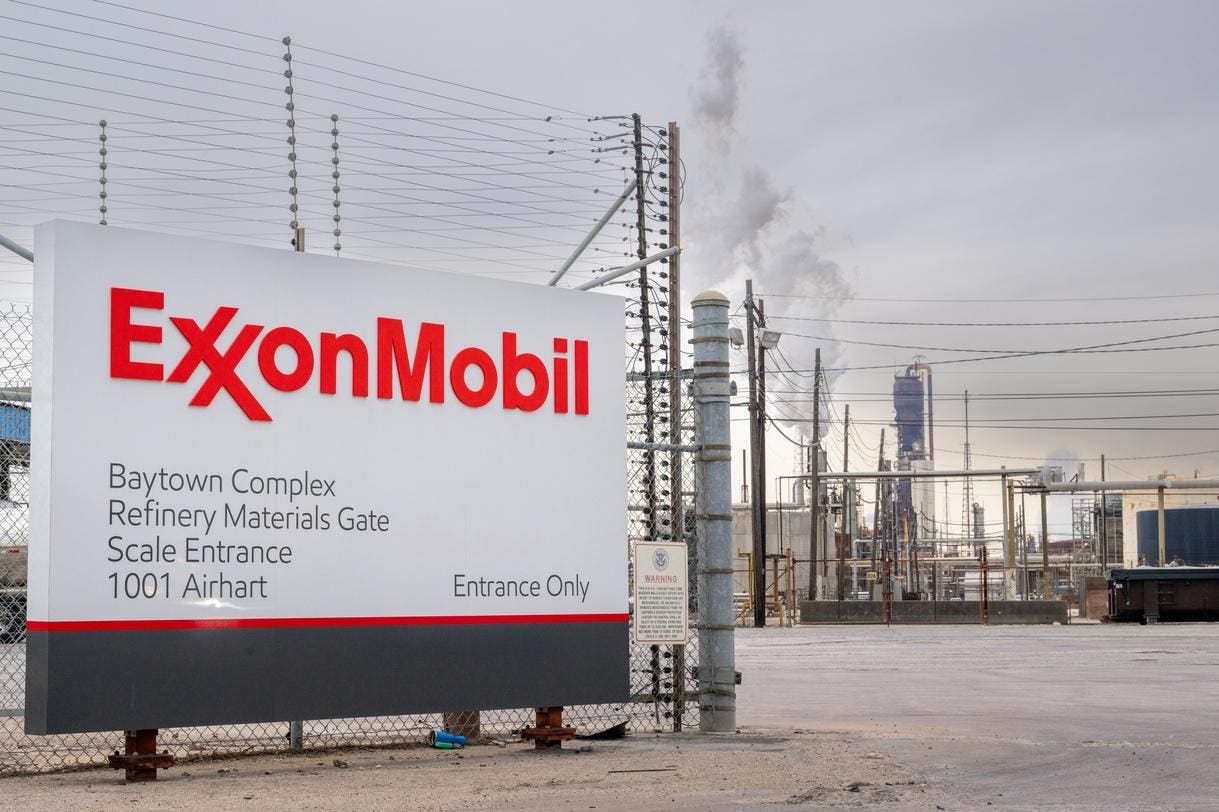
ExxonMobil stock has climbed more than 10% since the start of 2026, largely fueled by early January speculation that geopolitical shifts could allow U.S. oil majors to regain access to Venezuela’s extensive crude reserves.
This upward momentum is further supported by the company’s consistent production at high-margin assets in Guyana and the Permian Basin, alongside a wave of analyst “Buy” ratings and raised price targets based on resilient free cash flow. Separately, with volatility returning, see Bitcoin Downside: Where Does This Fall In BTC’s Price End?
However, despite this bullish market sentiment, a comprehensive assessment suggests this may be an opportune moment to sell. While the stock’s valuation appears moderate, it fails to account for underlying concerns regarding ExxonMobil’s operating performance and overall financial health. Because these fundamental weaknesses are not reflected in the current market price, the stock maintains an unattractive risk-reward profile with a potential downside target of $95.
Here is our evaluation:
Consider this – Is owning XOM stock risky? Certainly, it is. High Quality Portfolio reduces that risk.
Let’s delve into the details of each of the evaluated factors; but first, for a quick background: With $578 Bil in market capitalization, Exxon Mobil engages in exploration, production, manufacturing, trading, transport, and sale of crude oil, natural gas, petroleum products, petrochemicals, and specialty products worldwide.
[1] Valuation Appears Moderate
This table illustrates how XOM is valued compared to the broader market. For more details see: XOM Valuation Ratios
[2] Growth Is Extremely Weak
- Exxon Mobil has experienced a decline in revenue with an average rate of -5.6% over the past 3 years
- Its revenues have decreased -4.4% from $340 Bil to $325 Bil in the last 12 months
- Additionally, its quarterly revenues dropped -5.1% to $83 Bil in the most recent quarter, down from $88 Bil a year prior.
This table shows how XOM is growing compared to the broader market. For more information, see: XOM Revenue Comparison
[3] Profitability Seems Moderate
- XOM’s operating income over the last 12 months amounted to $36 Bil, which corresponds to an operating margin of 11.0%
- With a cash flow margin of 15.9%, it produced nearly $52 Bil in operating cash flow during this timeframe
- For the same period, XOM generated close to $30 Bil in net income, reflecting a net margin of approximately 9.2%
This table illustrates XOM’s profitability compared to the broader market. For more information, see: XOM Operating Income Comparison
[4] Financial Stability Appears Strong
- XOM’s Debt stood at $42 Bil at the close of the most recent quarter, while its current Market Cap is $578 Bil. This indicates a Debt-to-Equity Ratio of 7.2%
- XOM’s Cash (including cash equivalents) constitutes $14 Bil of $454 Bil in total Assets. This results in a Cash-to-Assets Ratio of 3.0%
[5] Downturn Resilience Is Moderate
XOM experienced an effect slightly worse than the S&P 500 index during various economic downturns. We evaluate this based on both (a) the magnitude of the stock’s decline and, (b) the speed of its recovery.
2022 Inflation Shock
- XOM stock declined 20.5% from a peak of $104.59 on 8 June 2022 to $83.14 on 14 July 2022, compared to a peak-to-trough drop of 25.4% for the S&P 500.
- However, the stock fully rebounded to its pre-Crisis peak by 21 October 2022
- Since then, the stock rose to a high of $134.97 on 23 January 2026 $134.97
2020 COVID Pandemic
- XOM stock decreased 55.6% from a peak of $70.90 on 2 January 2020 to $31.45 on 23 March 2020, in comparison to a peak-to-trough decline of 33.9% for the S&P 500.
- Nonetheless, the stock entirely regained its pre-Crisis peak by 11 January 2022
2008 Global Financial Crisis
- XOM stock declined 34.1% from a peak of $94.56 on 20 May 2008 to $62.35 on 15 October 2008, in contrast to a peak-to-trough drop of 56.8% for the S&P 500.
- However, the stock completely restored its pre-Crisis peak by 19 July 2013
However, the risk is not confined to major market crashes. Stocks can decline even in favorable market conditions – consider scenarios such as earnings reports, business updates, or changes in outlook. Examine XOM Dip Buyer Analyses for insights on how the stock has recovered from significant drops in the past.
The Trefis High Quality (HQ) Portfolio, featuring a selection of 30 stocks, has a proven history of consistently outperforming its benchmark, which includes all three indices – the S&P 500, S&P mid-cap, and Russell 2000. Why is that? Collectively, HQ Portfolio stocks have delivered superior returns while taking on less risk compared to the benchmark index; a less tumultuous experience, as illustrated in HQ Portfolio performance metrics.
Read the full article here