



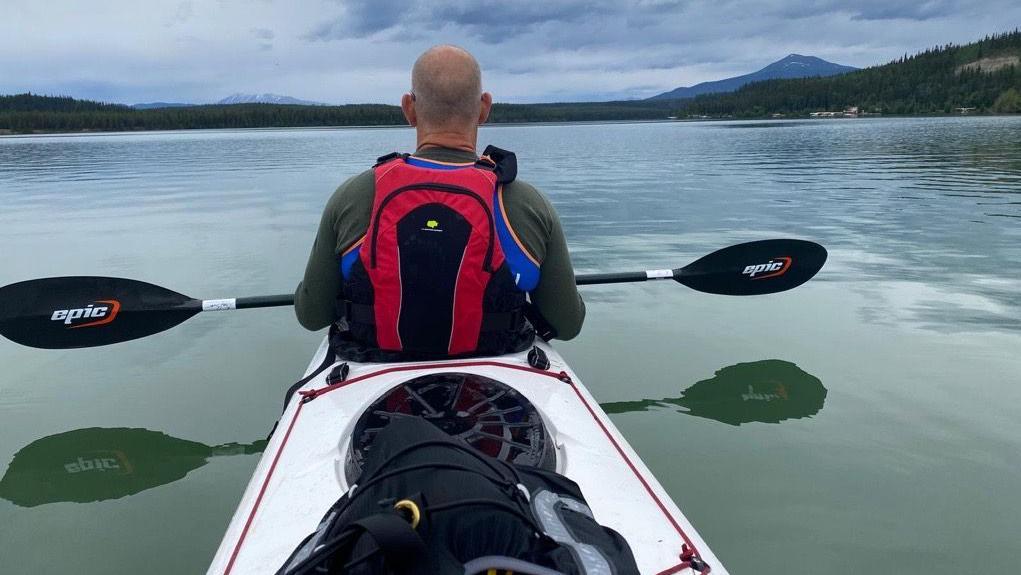
Two former Devon police officers are taking on a 1,000 mile kayaking challenge, canoeing up to 18 hours a day and camping wild, hoping to avoid bears and mosquitoes on the way.
Ex Devon and Cornwall Police assistant chief constable Jim Nye, 57, from Exeter and Ian Tyers, 61, from Rockbeare, were selected as one of 30 teams in this year’s 1,609km Yukon challenge that started on Friday.
They are kayaking from northern Canada to inside the Arctic Circle in Alaska to raise money for Devon’s FORCE cancer charity.
Nye said: “We have to take everything we need to survive in the wilderness for 10 days” for what is called the world’s longest kayak race.
Ian Tyers and Jim Nye are amongst 60 competitors in the race [Jim Nye]
Yukon 1000 organisers said participants “must have the physical and mental fortitude” to be completely self sufficient and “in extreme cases must be able to survive in true wilderness”.
The pair have been friends for more than 30 years and are hoping to to complete the race in seven and a half days, ahead of the cut off of nine days and 18 hours.
This the third event of their “water trilogy” after competing in the UK’s longest canoe race, 125 miles (201km) from Devizes to Westminster in 2009 and rowing 3,000 miles (4,828km) across the Atlantic in 2024.
Tyers said they have been planning for the Yukon event since 2009 and took on the other challenges to qualify for it.
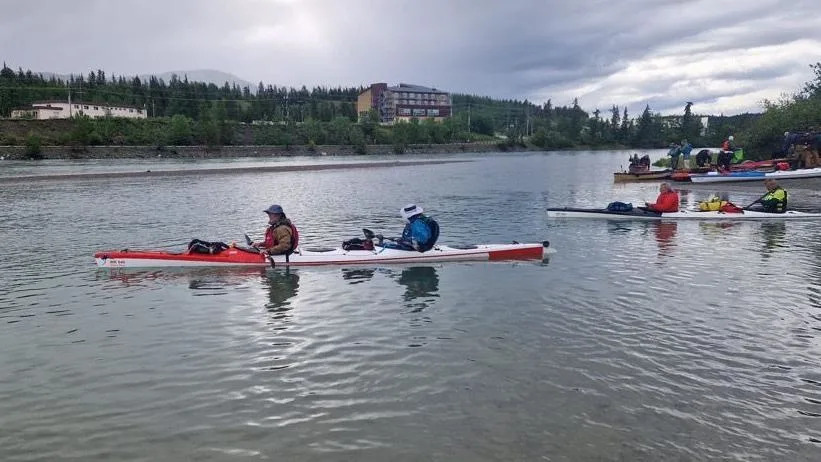
The duo have trained in the UK before taking to the Yukon [Jim Nye]
‘Race to midnight sun’
Competition rules allow them to kayak up to 18 hours a day and Nye said “the discomfort and the exhaustion” will be “part of the challenge”.
Tyers added: “It’s a sort of a race to the midnight sun, there’s no total absolute darkness, but I think we’ll be tired enough during our short breaks to get to sleep no problem.”
Nye said they were taking all the kit they needed to be self-sufficient camping in the wilderness including dried food, water purifying equipment and “special masks to protect us from smoke inhalation if we encounter wildfires”.
They also have to take precautions to avoid bears, including eating whilst paddling “because they advise that’s better than sitting on a bank in bear season having food,” Nye said.
Tyers added they are taking compulsory bear sprays and bangers and have followed advice about “being sensible” to avoid bears, “moving on” if they spot them.
Nye said he thought they would see bears but did not anticipate they would cause a problem.
He added mosquitoes would be “more of an annoyance” and they will wear face meshes to cover their heads to protect themselves from the insects.
He said they enjoyed “challenging ourselves” and “putting something back into where you live” at the same time by raising at least £1 for every mile of the race.
Follow BBC Devon on X, Facebook and Instagram. Send your story ideas to spotlight@bbc.co.uk.
Related external links

Read the full article here