




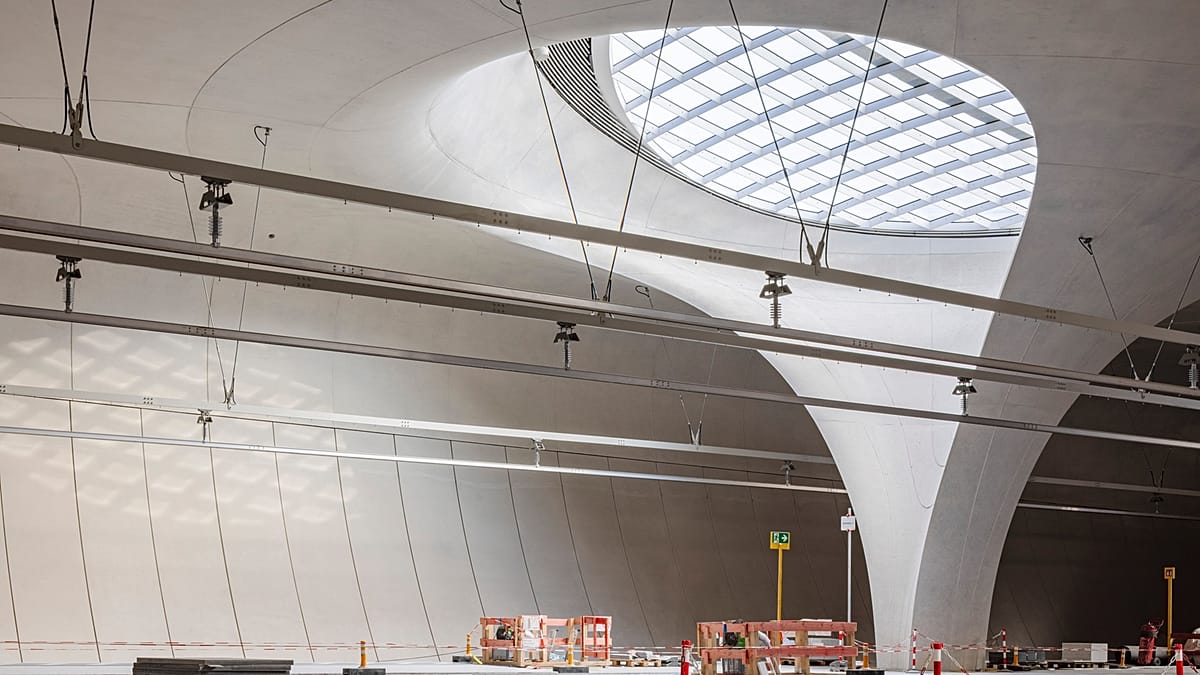
Deep beneath Stuttgart, a vast new transport hub is emerging. Known as Stuttgart 21, the subterranean replacement for the city’s main train station is designed to stay cool without air conditioning.
ADVERTISEMENT

ADVERTISEMENT
Having sweltered through record-high temperatures this summer, residents of the German city were surprised by this design detail, which was highlighted in an explainer released by rail operator Deutsche Bahn (DB) in August.
“Next video: Why the Titanic didn’t need lifeboats,” one commenter quips. “When the train station was planned, there were no air conditioners yet,” jokes another.
The megaproject was first conceived of in the late ‘80s and presented to the public in 1994. Construction began in 2010 and has been beset with costly delays.
Defending its air-con free design, Deutsche Bahn says that temperatures will remain stable – both during extreme heat and cold – in part thanks to the station being underground.
It also highlights that Stuttgart lies in a basin, with the station located at the lowest point. Tunnels will slope upwards from there, allowing air to cool as it’s pushed down into the station, its flow aided by passing trains and glass “light eyes” with automated ventilation flaps, DB says.
Emissions-cutting design or the train station’s next blunder?
“The future Stuttgart central station will operate entirely without artificial climate control,” Deutsche Bahn’s head of communications, Jörg Hamann, tells Euronews Earth.
Air flowing into the station will be cooled on its journey through tunnels ranging from three to 9.5 kilometres, Hamann explains.
With heating and cooling making up a significant portion of energy consumption in train stations, the air-conless design could help slash the railway hub’s carbon footprint long-term.
According to the IEA, air conditioning is currently responsible for emitting around one billion tonnes of CO2 per year, out of a total of 37 billion tonnes emitted worldwide.
Hydrofluorocarbon (HFC) and hydrochlorofluorocarbon (HCFC) refrigerants used in air conditioning also trap thousands of times more heat in the atmosphere than CO2, driving global warming.
But critics have been quick to question the functionality of the Stuttgart 21’s design.
Commenters on DB’s video wonder whether the natural airflow will be able to offset the heat of human bodies and operating trains in the station, especially as the trains’ own air-conditioners emit waste heat. They question how much heat will enter through the glass skylights.
Some worry the project risks falling into the same trap as other projects across Europe. “The underground Barcelona Sants train station gets unbearably hot in late summer,” one commenter says, while another points to Lisbon Metro’s costly cooling retrofits amid escalating summer heatwaves.
Stuttgart 21: A project fraught with setbacks
It’s unsurprising the news has been met with skepticism.
From intense protests in 2010 over the felling of 300-year-old trees in Schlossgarten – Stuttgart Palace Gardens – to the discovery of threatened lizards along the route, which had to be relocated to the tune of over €15 million, the Stuttgart 21 project has had a bumpy ride.
Setbacks like these have propelled it to farcical status among locals, with many wondering whether it will ever be completed at all.
A recent internal audit exposed the project’s latest crisis: a delayed opening that will now begin in phases from 2027, a ballooning €14.5 billion price tag, and what the railway’s own boss called “shocking” failures in planning and oversight. DB has faced scrutiny from the mayor over lack of transparency in refusing to release the report, while campaign groups are threatening legal action.
Deutsche Bahn tells Euronews that the audit was intended solely for internal use and cannot be made public for legal reasons.
Will the new station make life above ground hotter?
Above ground, concerns have been raised over the Stuttgart–Ulm project’s impact on the city’s climate.
As DB itself points out, the city is located in a natural valley basin known as the Stuttgart Cauldron, surrounded by steep, vine-covered hills and forests. This traps heat and reduces wind speeds, making it one of the warmest regions in Germany.
Moving the main station underground will free up 100 hectares of inner-city space, much of which is earmarked to become a new district called Rosenstein.
As well as including housing for more than 10,000 people, 20 hectares of new parkland will be created, according to Stuttgart City Hall.
Campaign group Aktionsbündnis gegen (Action alliance against) Stuttgart 21 says the current railway yard acts as a vital fresh air corridor that cools the city. It warns that building on this site is likely to restrict air flow in the city basin and add to the urban heat island effect.
The group has also raised concerns over soil sealing – concreting over land – which can prevent rain from soaking into the earth, destroying ecosystems, drying out greenery and compounding flood risks.
But Stuttgart City Council tells Euronews Earth that the project has been designed with cooling mechanisms in mind, including extensive greenery and minimal land sealing.
“The residential neighbourhoods are designed according to the sponge city concept. Rainwater will be retained and used to help cool the district during periods of high temperatures. Green public spaces, courtyards and building façades will also contribute to cooling.”
Height limits have been placed on buildings in the former railway development following a climate and environment impact assessment by municipal authorities.
In 2023, the urban master plan received a special award for ‘Designing Climate Adaptation’ as part of the Deutscher Städtebaupreis (German Urban Development Award).
Will Stuttgart’s railway project get cars off the road?
With 56 kilometres of new tunnels connecting to high-speed and regional lines, Stuttgart’s railway project promises to better integrate the southwest into the wider train system.
It will also slash travel times: the journey from Ulm–Stuttgart will become 28 minutes instead of 58, while Stuttgart Main Station–Stuttgart Airport will be slashed from 27 minutes to just six.
This could encourage more people to take the train over driving. However, critics say it could also entice more people to use the airport.
These shorter journey times are partly made possible by the transition from the old 16-platform terminal station to an eight-platform through station, where trains will no longer change direction and higher approach speeds will be possible. Critics, however, warn that reducing the number of platforms leaves very little safety margin or buffer for delays.
DB says that the station’s performance was proven in a 2011 stress test, and that it will be able to handle “significantly more” train traffic than the current terminal station, which has only five inbound and outbound tracks versus the new station’s eight. Efficiency will be further aided by the digitalisation of the railway network.
DB says the future station will enable many new direct regional connections, which will also relieve some of the pressure on the busy S-Bahn. It anticipates an increase in demand by around two million passengers as a result of the project.
Read the full article here