



The nursing home business is tough. Few want to live in them It is hard to make money running a good one. Government regulations make creative care a huge challenge. And they have a reputation, too often deserved, of being unpleasant and even dangerous places to live and work.
Yet, I sometimes come across a skilled nursing facility that trashes all the stereotypes. It shows what a nursing home can become with a committed and skilled staff, good organization, and passionate and creative leadership.
I recently visited one such place, the Leonard Florence Center for Living in the blue-collar Boston suburb of Chelsea. It struggles with insufficient Medicaid reimbursement, but the care and dignity it provides its residents are extraordinary. It has created a sense of personal autonomy among staff and residents that makes it possible for extremely ill people to live their best possible lives.
An Unlikely Partnership
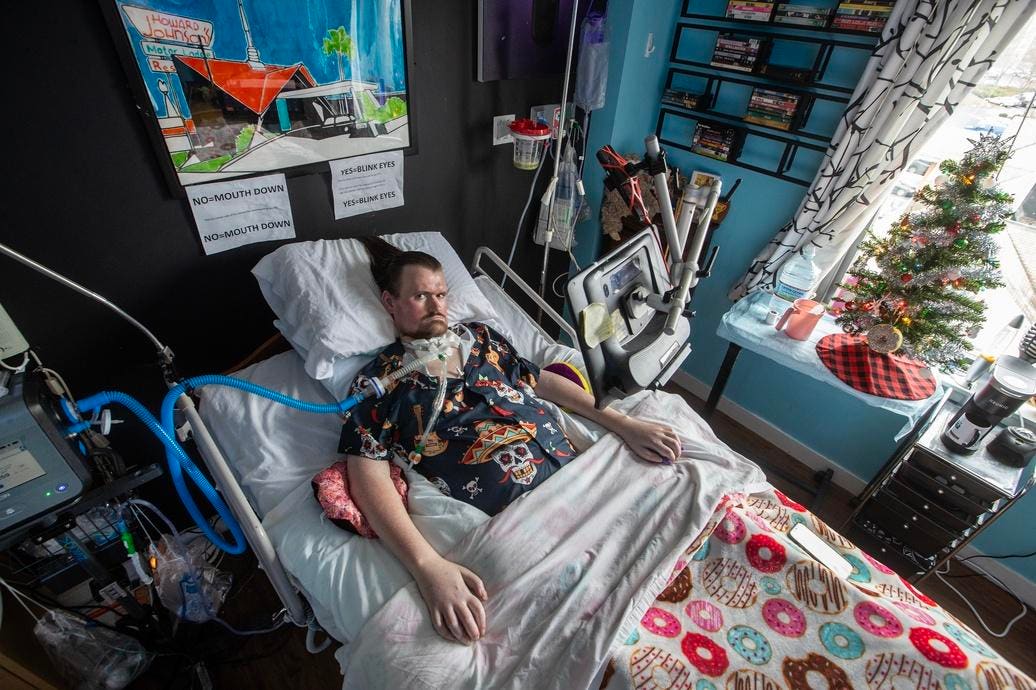
The Florence Center specializes in ventilator care, a service that the vast majority of nursing facilities won’t provide due to its cost and complexity. But that’s only the beginning. It focuses on care for residents living with multiple sclerosis and for 50 patients with amyotrophic lateral sclerosis or ALS, also known as Lou Gehrig’s disease. The Florence Center claims to care for more ALS residents than any facility in the world.
The current building opened in 2010, but its pedigree dates back more a century to an old-school house for the aged. Its parent, the non-profit Chelsea Jewish Lifecare, now operates communities in Chelsea, Peabody, and Longmeadow MA.
Its dedicated ALS program started thanks to an unlikely partnership between Chelsea Jewish Lifecare CEO Barry Berman and Steve Saling, an architect and assisted living resident who was living with the disease. When Saling realized traditional assisted living could not continue to care for him as his disease progressed, he convinced Berman to create a cutting-edge ALS facility, which Saling helped design.
Saling has lived for more than 20 years with the disease. One of the homes at the Florence Center bears his name.
High Tech And Independence
ALS destroys nerve cells in the brain and spinal cord that control muscle movement. Patients are cognitively intact and fully aware of everything going on around them. But they gradually lose the ability to move, speak, and even breathe on their own. Life expectancy averages 2-5 years. For many, their lives are reduced to waiting to die.
Yet, at the Florence Center, ALS patients often live a decade or more, are extraordinarily active, and rarely require hospital care.
Some of the program’s success results from the high intensity of care residents receive. Staffing levels are more than twice the national nursing home average, according to federal data.
Some is due to technology. For example, residents unable to move their limbs can control lights, turn their TV on and off, open doors, and operate elevators through eye movements or brain waves. In effect, they can think about opening a door and the door will open.
That makes it possible for residents who otherwise would be immobile to move around the building on their own. One took me on a tour.
The residents’ ability to navigate the building and its outdoor spaces without help not only gives them critical independence, it frees up staff. As one resident told me, “If I did not have this equipment, I’d have to wait 30 minutes for an aide to come and open my apartment door for me.”
The Value Of Staff Autonomy
The facility is built on the Green House model. It has 10 “households,” each made up of 10 private rooms with its own dedicated staff. Each large room is decorated to the residents’ specifications and feels more like an efficiency apartment than a typical nursing home room. Residents eat together at a communal table and socialize in a shared common living area.
The model is based on a universal staffing design, so an individual aide may care for all her resident’s personal needs as well as help cook for the group, much like a home care aide would. That makes it easier for residents and staff to get to know each other. And it gives front-line staff the independence they need to provide for a resident’s personal needs without waiting for instructions from a nurse.
A 2022 study by the RAND Corporation describes how and why resident and staff autonomy are so important.
Saturday Night Live
Because many residents want time outside of the nursing home, the Florence Center goes to great lengths to make that possible.
Residents regularly go to outside sporting events, such as Boston Celtics games. A few years ago, one asked to attend a taping of Saturday Night Live. Not only did he, an aide, and respiratory therapist get there, but visiting the show has become an annual event. Some residents even went sky diving.
For all that, there is a catch. Berman says nearly all the Florence Center’s ALS residents are on Medicaid. And the organization spends a half a million dollars more each year to care for them than the program pays. Pending cuts to Medicaid budgets pushed by the Trump Administration will likely increase that funding gap, which must be made up through philanthropy.
No Tissues Needed
Many people with disabilities can remain and thrive at home. But despite frequent criticism, skilled nursing facilities still play an important role in long-term care. That’s especially true for those with very complex care needs.
Without the personal assistance, medical care, and technology these facilities can provide, many residents would live far more diminished lives. Without the care and autonomy the Florence Center makes possible, it is hard to imagine many residents surviving longer than the typical brief life expectancy of ALS patients.
Before my visit, a nursing home expert urged me to bring lots of tissues. What I’d see, she warned, would be deeply depressing.
It was not. Rather, it made me optimistic about how compassion, technology, committed staff, and good management can combine to provide the best life possible for people living with extremely challenging diseases. I only wish it happened more often.
Read the full article here