



Success Can Create Fragility
Overextension, reputation strain, scheduling chaos, and the hidden operating risks of modern work.
A portfolio career often begins with the language of freedom: more autonomy, more interesting work, more income options, and less dependence on one employer. But the collapse rarely starts with one dramatic failure. It starts with small operating failures: missed follow-ups, thin preparation, late invoices, unclear positioning, tax obligations that were easy to ignore, and a calendar with no room to think. The problem is not that portfolio work is unserious. The problem is that it can become very serious before the system underneath it is ready.
A Portfolio Professional holds multiple structured, recurring mandates across institutions, anchored in specialized expertise rather than a single employment relationship. The common assumption is that more roles create more resilience. More clients, more advisory work, more boards, more teaching, more speaking, more visibility. From the outside, that looks like momentum. And sometimes it is. But more is not automatically stronger. Every additional role adds income potential, but also coordination cost, reputational exposure, compliance complexity, and attention debt. A portfolio career rarely collapses because someone lacked ambition. More often, it collapses because ambition outran structure, and individuals have not assessed related risks and uncertainty as discussed previously.
A Portfolio Is A System Of Commitments
The sharper frame is this: a portfolio is not a pile of opportunities; it is a system of commitments. Each role must fit with the others. It must reinforce a clear value story, leave capacity for quality, and remain administratively manageable. The better question is not simply, “Can I add this?” It is, “What does this add to the system — and what does it quietly take away?” That question is becoming more urgent as AI-enabled productivity, remote work, and rate uncertainty reshape professional life. Federal Reserve Chair Kevin Warsh’s Semiannual Monetary Policy Report testimony points to the possibility of meaningful AI-driven productivity gains, but also to an economy where those gains remain uneven and difficult to predict. For portfolio professionals, the implication is clear: it is getting easier to take on more work, but harder to manage the system behind it.
The current environment makes this more than a personal productivity issue. Upwork’s 2026 Future Workforce Index reports that skilled freelancing rose from 28% of skilled knowledge workers in 2025 to 38% in 2026, while 58% of full-time employees said they were considering freelancing.
At the same time, AI is changing the value of work unevenly. Routine execution is becoming easier to scale, while the premium increasingly shifts toward judgment, coordination, trust, and complex problem-solving. Microsoft’s Work Trend Index offers a useful view of both sides of this shift: the opportunity created by AI agents and the pressure as work becomes more continuous, fragmented, and difficult to govern. For portfolio professionals, that combination is powerful but risky. There are more opportunities, more tools, more channels — and more ways to overcommit before the operating system is strong enough to hold the work.
The Successful Professional Who Becomes Fragile
Consider a senior professional who leaves a corporate role and quickly builds what looks like a strong portfolio. A fractional mandate in one organization. Advisory work for a growth company in another. A board role. A paid speaking engagement. A teaching assignment. A small LLC. Some work happens remotely, some on-site, and some while traveling. From the outside, this looks like success. Underneath, the structure may be fragile: unclear positioning, overlapping deadlines, inconsistent pricing and invoicing, untracked expenses, weak records, late estimated taxes, and no clean view of which relationships actually strengthen the professional reputation.
`
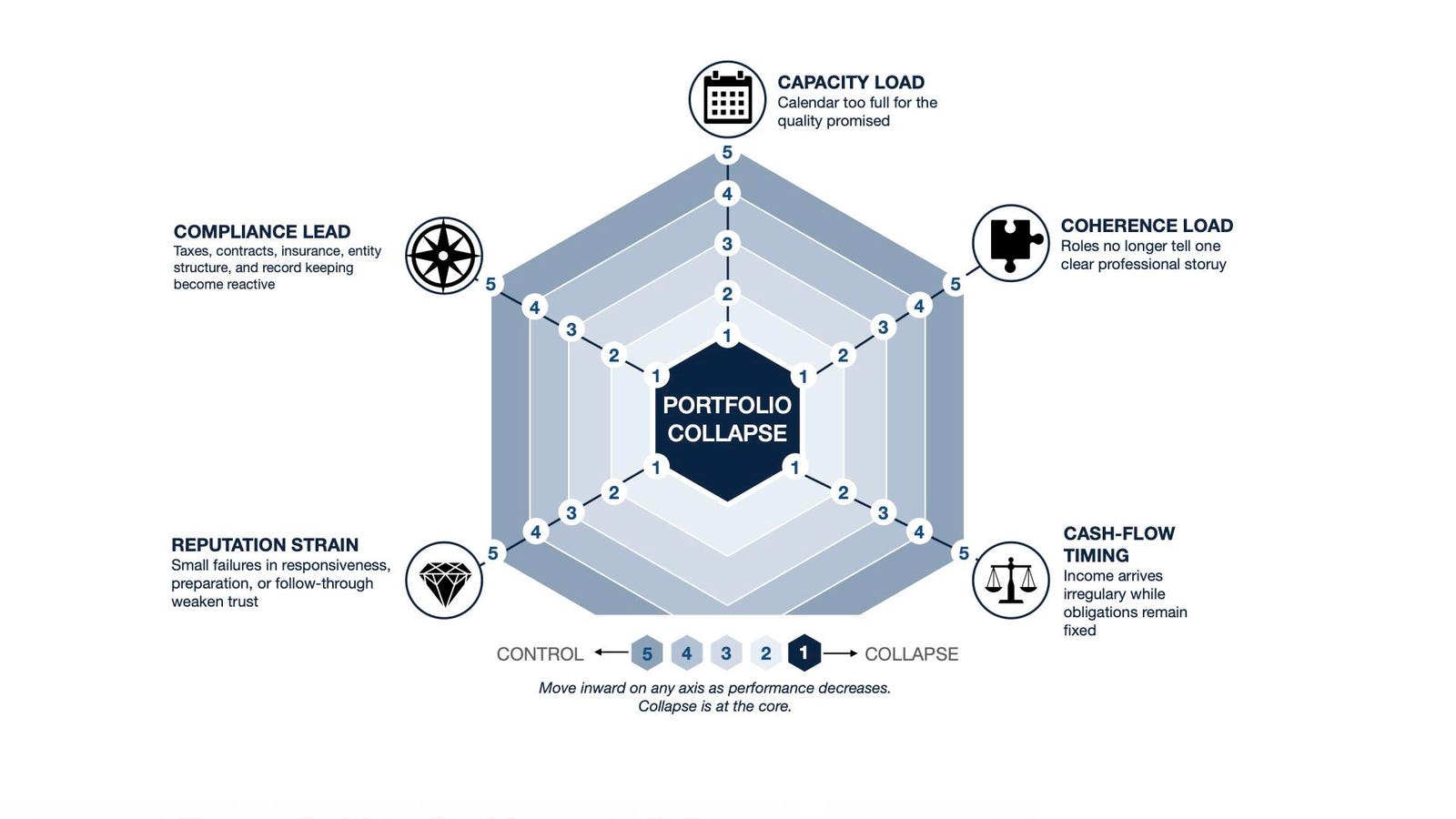
A simple way to think about this is the Portfolio Collapse Charter. It has five stress points as shown in the figure.
The warning signs usually appear before the collapse. You accept work that does not fit because the opportunity feels flattering. Your calendar is full, but your thinking time disappears. You describe your work differently depending on who asks. You have revenue, but no clean cash-flow visibility. You have clients, but no renewal rhythm. You have expenses, but weak records.
The most dangerous misreading is to confuse busyness with traction. A full calendar can hide a weak strategy. Revenue can hide poor pricing. Visibility can hide brand dilution. AI tools can increase output while also increasing the number of commitments a person believes they can absorb. Remote work can make geography feel flexible while tax systems still care where work is performed, where clients are located, and where income may be sourced.
The bigger risk is that collapse can arrive after visible success. The professional has enough work to look credible, but not enough structure to remain sustainable. Clients experience slower response times. Family sees the flexibility disappear. Banks see income that is harder to interpret. Tax authorities see incomplete records. Retirement planning becomes irregular. Rate-path uncertainty can also matter because fixed obligations may reprice faster than irregular portfolio income adjusts. What looked like freedom quietly becomes administrative debt. This is why portfolio careers need governance, not just opportunity.
Can The System Carry The Work?
The old question was, “How many opportunities do I have?” The better question is, “Can the system carry the opportunities I have accepted?” That question changes how portfolio professionals should think about clients, roles, pricing, taxes, scheduling, savings, and reputation. A portfolio career does not become sustainable because it has many pieces. It becomes sustainable because the pieces fit.
A portfolio career should be built like something that will eventually be stress-tested. The calendar will be tested. The reputation will be tested. The tax structure will be tested. The cash flow will be tested. The relationships will be tested. The goal is not to avoid growth. It is to make sure growth does not quietly weaken the structure that made the portfolio possible in the first place.
Read the full article here